
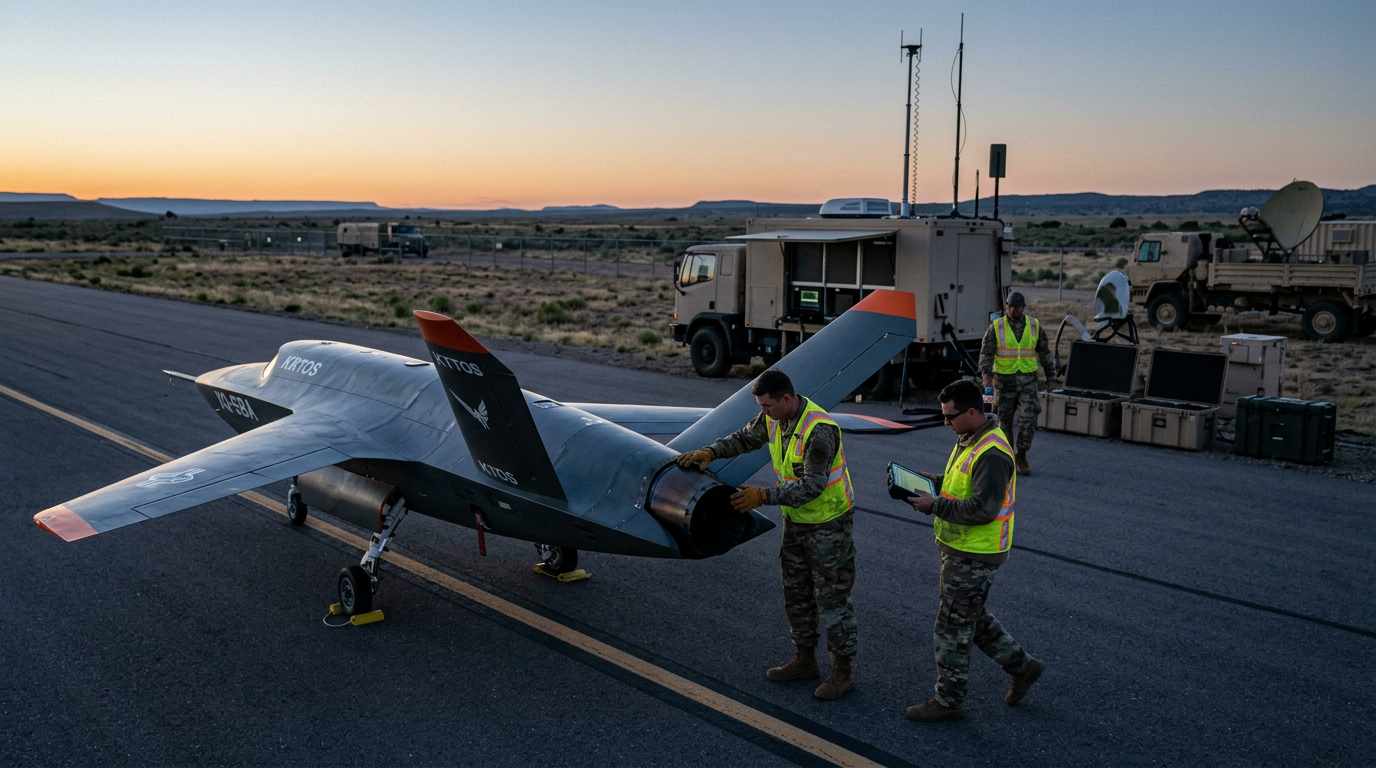
Something shifted in how the Pentagon talks about drones. It stopped being about surveillance. It became about mass, attrition, and cheap precision — the lessons written in Ukraine and now reinforced by conflict in the Middle East. And one company keeps showing up at the center of that conversation.
Kratos Defense & Security Solutions (NASDAQ: KTOS).
This isn’t a sprawling defense prime. It’s a focused, fast-growing manufacturer of the exact systems the U.S. military is trying to scale right now: jet-powered attritable drones, rocket motors, hypersonic test vehicles, and satellite ground systems. The kind of hardware that doesn’t make headlines but wins contracts.
The Q1 2026 numbers landed on May 6, 2026, and they were hard to ignore. Revenue came in at $371.0 million — a 22.6% year-over-year increase, with 15.8% of that being organic growth. Adjusted EPS hit $0.16. Net income rose to $11.9 million (up from $4.5 million a year ago). This was a quarter that came in ahead of consensus expectations.
The unmanned systems segment alone grew 30.9% organically. That’s not a rounding error. That’s a business responding to real demand.
What matters is the demand signal underneath those numbers. Kratos reported a record backlog of about $2.0 billion (with funded backlog disclosed separately), and management has described its opportunity pipeline as exceeding $14 billion. The book-to-bill ratio hit 1.6 to 1 in Q1 — meaning for every dollar of revenue recognized, $1.60 in new work came in the door. That’s not a company chasing contracts. That’s a company being pulled forward by them.
The flagship program is the XQ-58A Valkyrie — a low-cost, jet-powered drone designed to fly alongside manned fighters, absorb risk, and be expendable. The Pentagon and broader U.S. defense establishment have been increasingly explicit about scaling low-cost, attritable drone capability. In that context, the “Drone Dominance” effort has been reported as targeting hundreds of thousands of low-cost drones by 2027 (with reporting that references a long-term goal around 300,000 platforms). Kratos is positioned in the category of suppliers investors associate with that shift.
Slight tangent, but it matters: the FCC moved in late 2025 to restrict authorization of new foreign-produced drones and critical components, a change that has pressured agencies and buyers that depended on overseas suppliers to look for compliant alternatives. That’s a tailwind Kratos didn’t have to manufacture.
The company also raised its full-year 2026 revenue guidance after Q1, now targeting $1.70 billion to $1.76 billion. Adjusted EBITDA guidance was lifted to $170 million to $176 million. This is a business raising the bar, not managing to it.
Now, the risks are real and worth saying plainly. Free cash flow is expected to be negative — guided as a free cash flow use of $85 million to $105 million in 2026 as the company invests heavily in capacity expansion. The Valkyrie production ramp is still early. Margins are lean. And the stock, which ran sharply in 2025, carries a valuation that prices in a lot of the good news already.
None of that makes the story wrong. It makes the entry point something worth thinking through carefully.
Here’s where I land on it. Big drone-market numbers get thrown around loosely, and projections vary widely depending on what’s included (military-only vs. broader UAV categories). What’s clear is that expectations for military drone demand are rising across multiple forecasts through the early 2030s. NATO allies have committed to spending at least 2% of GDP on defense, and European governments have been emphasizing drones and autonomous systems as part of modernization. There’s also a European pipeline being built right now — Kratos has an Airbus partnership based on Valkyrie, with the maiden flight of the Airbus-integrated European mission-system variant scheduled for 2026 and an operational goal tied to Germany later in the decade.
The defense budget tailwinds are compounding. The geopolitical rationale for autonomous warfare systems is not a cycle — it’s a structural shift being written into doctrine. And Kratos is one of the few public companies positioned squarely at the intersection of that shift, with real contracts, real backlog, and numbers that keep coming in strong.
Whether the stock has room from here depends on your time horizon. But the business case is no longer speculative. Worth a closer look before the next earnings call.