Two catalysts are stacked right on top of each other for Tesla. First one lands in about a week.
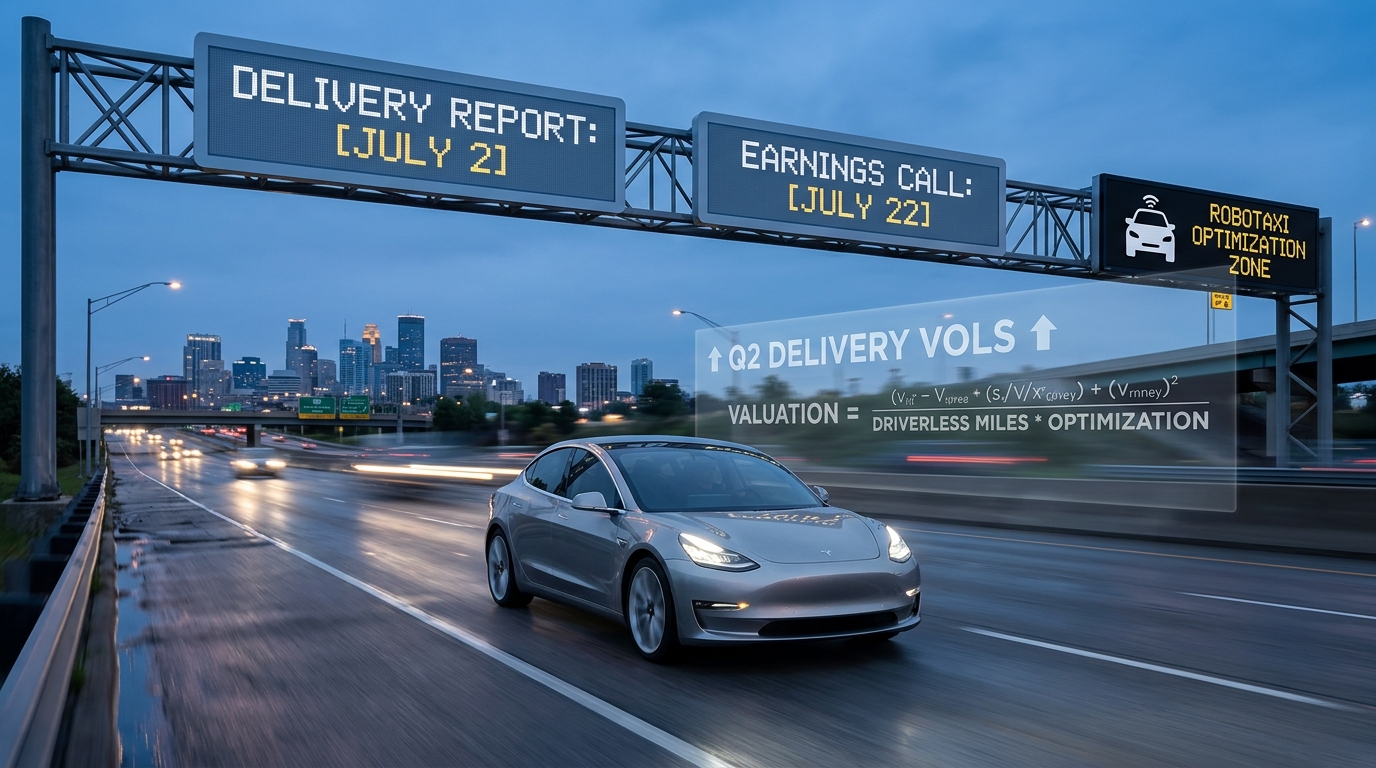
Q2 delivery figures are expected around July 2. Wall Street estimates are scattered — RBC’s Tom Narayan is calling for 405,000 units, above the roughly 401,000 Visible Alpha consensus. Baird is sitting at 392,900. Other banks have been moving numbers into the low-400Ks as regional data rolls in, but the direction and the “why” varies by shop. That spread is wider than it looks. A miss against even the low end of that range hits sentiment at exactly the wrong time — three weeks before earnings.
Then July 22 arrives.
Q2 EPS consensus sits near $0.45 per share. That’s actually an improvement from Q1, where Tesla posted GAAP EPS of $0.16 (and non-GAAP EPS of $0.33) — and the stock still fell about 3.6% the next day as investors focused on the size of the 2026 spending ramp. Q1 revenue was about $22.39 billion, but gross margin was not 21.1% — Tesla’s company-compiled analyst consensus ahead of the quarter had gross margin at 17.5%. Free cash flow is also not cleanly supported by the company’s own consensus table; notably, Tesla’s company-compiled consensus ahead of Q1 had free cash flow negative (average about -$1.6B), even as some market recaps later framed the quarter as a “positive FCF surprise.” Either way, Q2 will almost certainly be tighter — the company is spending aggressively.
Slight tangent here, but it matters. Tesla has guided to roughly $25 billion of capex in 2026 (a sharp step-up versus 2025), tied to a broad buildout across AI compute and manufacturing capacity. The income statement is not the right lens. The capital allocation story is. Every dollar Tesla spends on AI and autonomy infrastructure is a bet that the autonomous revenue model arrives before the free cash flow drain becomes a problem.
So far, the bet is getting rewarded. In Q1, Tesla said paid Robotaxi miles nearly doubled sequentially. Tesla also discussed expansion groundwork for additional major U.S. metros and noted unsupervised rides in Dallas and Houston in April (in addition to Austin). However, specific claims about “12 major U.S. cities,” Cybercab output of “~2,000 units per week,” “10,000 weekly by year-end,” or “under $25,000 to produce” are not confirmed in Tesla filings and should be treated as unverified.
The Autonomy Premium Is Not Speculation. It Is Already In the Multiple.
Tesla’s forward P/E is elevated (roughly in the mid-170s, depending on the data vendor). The stock’s market cap has been hovering around the low-$1.4T range in late June 2026. No auto business justifies that number. No energy business does either. What gets you there is the assumption that autonomy and a fleet-based model eventually generate something closer to platform-style economics than manufacturing-style economics.
The stock is up roughly 67% over the past year. It has traded between $288.77 and $498.83 over the 52-week range. At roughly $375 as of this writing, it’s sitting in the lower third of that range — not cheap, but off the highs. Analyst consensus is about $421, with a range stretching from $25 to $600. That spread alone tells you this is not a valuation story anymore. It’s a conviction call.
RBC has a $475 target with an Outperform. JPMorgan has been trimming estimates and remains cautious. UBS sits at Neutral with a $364 target. Barclays expects above-consensus Q2 deliveries but is still cautious. The institutional view is fractured in a way that creates real options opportunity.
Options Market Structure
With two layered catalysts — deliveries expected around July 2 and earnings expected on July 22 after close — the options market is pricing for a wide move. Tesla’s beta sits at roughly 1.80. It has historically delivered outsized post-earnings moves relative to what the at-the-money straddle implies.
For context: after Q1 earnings in April, the stock fell about 3.6% the next day, then drifted higher over the following sessions. That post-earnings drift pattern is exactly the kind of dynamic that defined-risk structures are designed to exploit.
Bull case framing: For traders who believe Q2 deliveries come in near or above the ~401K consensus and that July 22 earnings show autonomy-related revenue and traction beginning to show up more clearly in reported results, a bull call spread structure targeting the $420–$450 range through August expiration captures the upside without full premium exposure at elevated IV. The July 22 earnings date is widely expected — IV compression post-announcement can be sharp.
Bear case framing: If Q2 deliveries miss meaningfully — sub-390K — and EPS guidance is trimmed on capex pressure, the stock revisits the $330–$350 zone. A put spread in the $370–$340 range through July expiration captures that scenario with defined risk.
Neutral/IV-sell framing: With two events stacked in a 20-day window, a short strangle or iron condor structure becomes attractive for traders who believe the stock oscillates but does not break out of its 2026 range. The risk is that one of the events is a genuine catalyst — which, given the autonomy timeline, is not unlikely.
Risk Factors
- Q2 deliveries could miss on EV demand softness (the “battery capacity constraints flagged in Q1” point is not confirmed in Tesla’s Q1 materials and should be treated cautiously)
- Free cash flow risk rises as capex steps up; whether it is negative for “the remainder of 2026” is not something Tesla has formally guided in a single line item
- The potential SpaceX-Tesla merger, flagged by Baird as possible within 12 to 18 months, is both a positive and a distraction for the fundamental model
- Unsupervised FSD regulatory approvals in new markets are not guaranteed, which creates a ceiling on the robotaxi expansion story
- Bitcoin mark-to-market impacts can add noise to EPS; Tesla has disclosed digital asset gains/losses as a reconciling factor in consensus materials (the specific “contributed to the Q1 EPS miss” framing was not accurate given Q1’s GAAP/non-GAAP context)
What to Watch Between Now and July 22
The delivery number around July 2 is the first tell. Anything above 400K and the stock likely holds or bounces into earnings. Anything below 390K and the earnings setup gets murkier fast.
The real question on July 22 is not the EPS number. It’s whether management can show, in actual dollars, that the autonomy and fleet strategy is generating recurring revenue at a meaningful scale. The market has been willing to fund the vision. At some point — and July 22 might be that point — it needs to start funding something more concrete than that.
That’s where the trade lives.