Here is the thing about the OpenAI IPO delay. It is not really a story about one company’s timing. It is a story about the single largest unverified assumption holding up a multi-trillion dollar market.
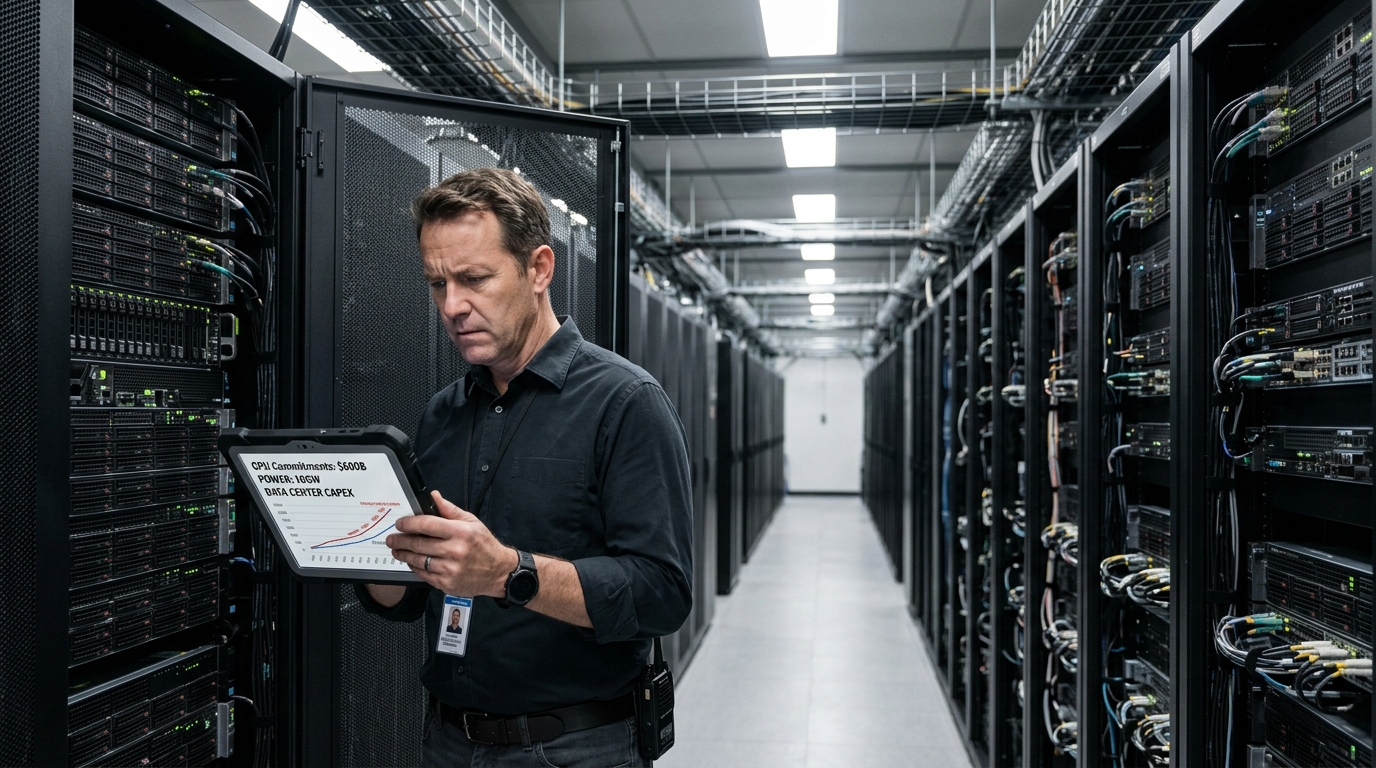
OpenAI has reportedly committed to something on the order of $600 billion in future computing capacity, including 10 gigawatts of Nvidia systems, a 6-gigawatt chip deal with AMD, and roughly $300 billion with Oracle for cloud capacity. That is a staggering sum for a company generating a reported $25 billion-plus in annualized revenue that is not yet profitable. The entire semiconductor sector has been pricing in those purchase orders as if they were locked, guaranteed, and fully funded.
They are not.
Reports surfaced Friday that OpenAI is leaning toward delaying its IPO until 2027. The company’s advisors reportedly laid out two paths: wait until 2027 and chase a $1 trillion valuation, or go public sooner at a lower price. CEO Sam Altman reportedly rejected any cut to that trillion-dollar target.
The market’s reaction said everything. OpenAI’s potential IPO delay rattled chip stocks, dragging the Nasdaq Composite down 5.2% for the week and raising doubts about AI infrastructure spending. Arm Holdings and Marvell Technology fell around 4%, while Advanced Micro Devices was off 3.5% and Intel dropped 3% in Friday’s session.
The Funding Gap That Changes Everything
OpenAI posted a net loss of $38.5 billion for 2025 on $13.07 billion in revenue, and the company is still projected to burn through roughly $14 billion in losses for 2026. When you combine that cash burn with a massive $600 billion data center and infrastructure commitment stretching out to 2030, the hurdle for public investors becomes extremely difficult to clear in a high-interest-rate environment.
Slight tangent, but it matters: OpenAI’s own CFO, Sarah Friar, has reportedly warned colleagues that the company could struggle to pay for all that compute if revenue growth slows. That warning, sitting inside one of the most valuable private companies in history, is the kind of thing that gets buried in the AI euphoria but should probably be one of the first things analysts are asking about.
An IPO would have solved this. It would have been the clean mechanism for OpenAI to raise the capital its spending commitments require. So when reports suggest one of the biggest buyers in AI is hesitating to tap public markets, partly because of recent volatility in tech stocks, some investors may start to question how durable all that promised spending is.
SoftBank Is the Most Exposed Name in the Room
If OpenAI is the center of the trade, SoftBank is the most concentrated single expression of it. And the math there deserves more attention than it’s getting.
SoftBank has invested a cumulative total of approximately $65 billion in OpenAI, holding about a 13% stake, second only to Microsoft’s 27% among external shareholders. SoftBank stock fell the most since August 2024 on the IPO delay news. Expectations of a big financial windfall from OpenAI’s public debut had buoyed SoftBank shares to record highs, helping the company’s market capitalization soar above Toyota Motor Corp.’s just last month.
The single-day drop was over 12%. SoftBank also faces a $40 billion unsecured bridge loan due in March 2027. The company originally sought $10 billion for a margin loan backed by its OpenAI stake in May 2026, cut that target by 40% after lender enthusiasm faded, and even the reduced $6 billion target failed to close.
That is a company with a ticking clock.
SoftBank’s $65 billion stake in OpenAI is worth $65 billion in 2026 and worth $65 billion in 2027. But the carry cost of delaying capital recycling for a year in a higher-for-longer rate regime is not trivial. And the rate regime just got materially more complicated.
Kashkari Flipped. That Changes the Denominator.
Minneapolis Federal Reserve President Neel Kashkari said Friday he has changed his outlook and now expects that one interest rate increase will be necessary this year, citing the economy’s continued exposure to spiking inflation tied to Middle East conflict and other factors.
His comments are critical because Kashkari has long been seen as one of the Fed’s more dovish policymakers. His shift suggests inflation concerns are spreading inside the central bank, leaving investors to rethink how long borrowing costs may stay high.
This is the context that makes the OpenAI delay more than a one-day event. The Fed’s preferred inflation gauge has risen to 4.1%, while core inflation reached 3.4%, both hitting more than two-year highs, with inflation deviating from the 2% target for five consecutive years. Kashkari specifically stated that investment in data centers and AI pushes up interest rates and is inflationary in the near term, and he sees the Fed refraining from rate reductions in 2026, projecting policy rates at 3.8%.
Read that again. The Fed’s most prominent dove just argued that AI capital spending is itself an inflationary force. The same spending that the entire semiconductor sector is pricing as a permanent tailwind is now being cited as a reason rates might go higher. That is not a small idea.
What the Market Is Missing
Most of the coverage this week framed the OpenAI delay as a sentiment event. A confidence shock. A narrative disruption. But the more important question is structural.
While AI optimism has been enough to drive markets higher for much of the past year, investors are becoming increasingly focused on whether the enormous capital spending required to build AI infrastructure will generate sufficient returns.
The Q1 earnings season gave the bulls everything they needed to stay comfortable. With 97% of the S&P 500 reported, FactSet puts the blended year-over-year earnings growth rate at 28.6%, up sharply from the 13.1% analysts had expected at quarter-end, which would be the highest growth rate since Q4 2021 and the sixth straight quarter of double-digit gains. But Information Technology led all sectors with 54.3% earnings growth; excluding Nvidia and Micron, that figure drops to 30.1%. Communication Services’ 48.9% growth flips to a 4.1% decline once Alphabet and Meta are stripped out.
The AI earnings story is real. It is also extraordinarily narrow. And a delay in the primary funding mechanism for the world’s largest AI buyer puts pressure on the width of that story in a way the index hasn’t fully absorbed.
The Honeywell Angle: A Completely Different Kind of Spinoff Story
While the AI complex was unwinding, one of the most interesting structural events of the quarter was completing quietly in the background. Today, June 29, Honeywell Aerospace begins regular-way trading on Nasdaq under the ticker symbol HONA, completing its formal separation from Honeywell International.
This one deserves more attention than it’s getting. Honeywell Aerospace expects about $19.3 billion of 2026 sales and $4.6 billion to $4.7 billion of EBIT, roughly a 24% EBIT margin. The company is targeting $6.5 billion of adjusted earnings by 2030, with 6% to 8% annual sales growth expected through 2030, supported by commercial aviation, aftermarket demand, and defense. Its order backlog is $19 billion, up 20% year over year.
Honeywell Aerospace is set to join the S&P 500 and S&P 100, with the parent retaining a major index role under the Honeywell Technologies name. That index inclusion creates a forced buying event. Honeywell Aerospace will be one of the largest publicly traded, pure-play aerospace suppliers, with leading positions in technology and systems positioned for increasing electrification and autonomous flight.
The GE Aerospace comparison is the one to watch. GE Aerospace is the comparison investors will reach for first. GE gave investors a working example of what can happen when a big industrial conglomerate turns into a focused aerospace company. That rerating from conglomerate discount to pure-play premium took GE’s aerospace multiple significantly higher in the years after separation. Honeywell Aerospace starts with a cleaner balance sheet and a backlog that’s growing at 20% year over year.
Given how hot the aerospace sector is, Honeywell Aerospace could go on a tear. The remaining Honeywell Technologies could pull back, as can happen when a company spins off a faster-growing business from a slower-growing one. But a post-spinoff sell-off in Honeywell Technologies could create a new opportunity. If investors bail, it could become oversold, offering an opportune entry point from a value perspective.
Options Market Framework
Two trades worth structuring against this week’s developments:
On the AI infrastructure fragility theme: IV across semiconductor names has spiked after five consecutive down sessions for the Nasdaq. For traders who believe the OpenAI delay is a near-term sentiment overhang rather than a fundamental break in AI capital spending, a defined-risk bull put spread on NVDA or AVGO in the August expiration captures elevated premium while limiting downside exposure to a specific level. If you believe the spending commitments remain intact and OpenAI’s delay is ultimately a 12-month timing issue rather than a cancellation, the risk-reward on selling near-term fear is asymmetric. That said, if Kashkari’s hawkish pivot accelerates and the broader market begins pricing in a rate hike before year-end, growth multiples across the sector face additional compression regardless of the IPO timeline.
On Honeywell Aerospace (HONA): Index inclusion mechanics create a structural buyer for the first two to four weeks of trading. Pure-play aerospace peers trade at materially higher multiples than Honeywell did as a conglomerate. The first number to watch is HONA’s implied value against 2026 EBIT of $4.6 billion to $4.7 billion. If HONA trades at a premium aerospace multiple, the market is saying Honeywell’s aerospace business deserved a cleaner public valuation. For options traders, defined-risk call structures in the first 30 days of trading capture both the index-buying tailwind and the potential rerating to peer multiples, with the primary risk being a broader defense sector rotation reversal.
The Risk Wall Street Is Underweighting
The consensus still reads this week as a consolidation. A healthy pullback inside a structurally intact AI cycle. That may be right. But there is a version of this that is more uncomfortable.
OpenAI sits at the center of the entire demand chain. OpenAI may be private, but it sits at the center of the AI build-out, having signed an extraordinary string of supply deals that underpin much of the industry’s expected demand. A delay in going public does not cancel those deals. But it does raise the question of how a company burning $14 billion annually funds $600 billion in commitments without a major capital raise. And if the answer involves renegotiating some of those commitments, even the strongest AI infrastructure stocks face a demand revision that has not been modeled.
Add Kashkari’s explicit statement that AI data center spending is itself inflationary, layer in a potential rate hike before year-end, and the discount rate applied to every high-multiple AI name moves in one direction. The earnings are real. The question is whether the market has been pricing the peak version of those earnings against the lowest possible discount rate, and whether both of those assumptions are now moving against the trade at the same time.
That is the version of this week that is still being debated on trading desks. The index barely noticed. The Nasdaq was down 4.6% on the week. The Dow was up 0.6%. The S&P 500 slid nearly 2% on the week, while the Nasdaq fell 4.6% in the period. The Dow outperformed, rising 0.6% week to date. That divergence is not noise. It is the same rotation that has been building all year, suddenly accelerating.
The question now is whether this is a rotation or a repricing. And nobody has a clean answer yet.