America can now fabricate leading-edge chips on its own soil. It still cannot package most of them here. That distinction is the single most important supply-chain fact in semiconductor investing right now, and the construction timelines at three domestic facilities tell you precisely when it changes.
Why the Gap Exists Today
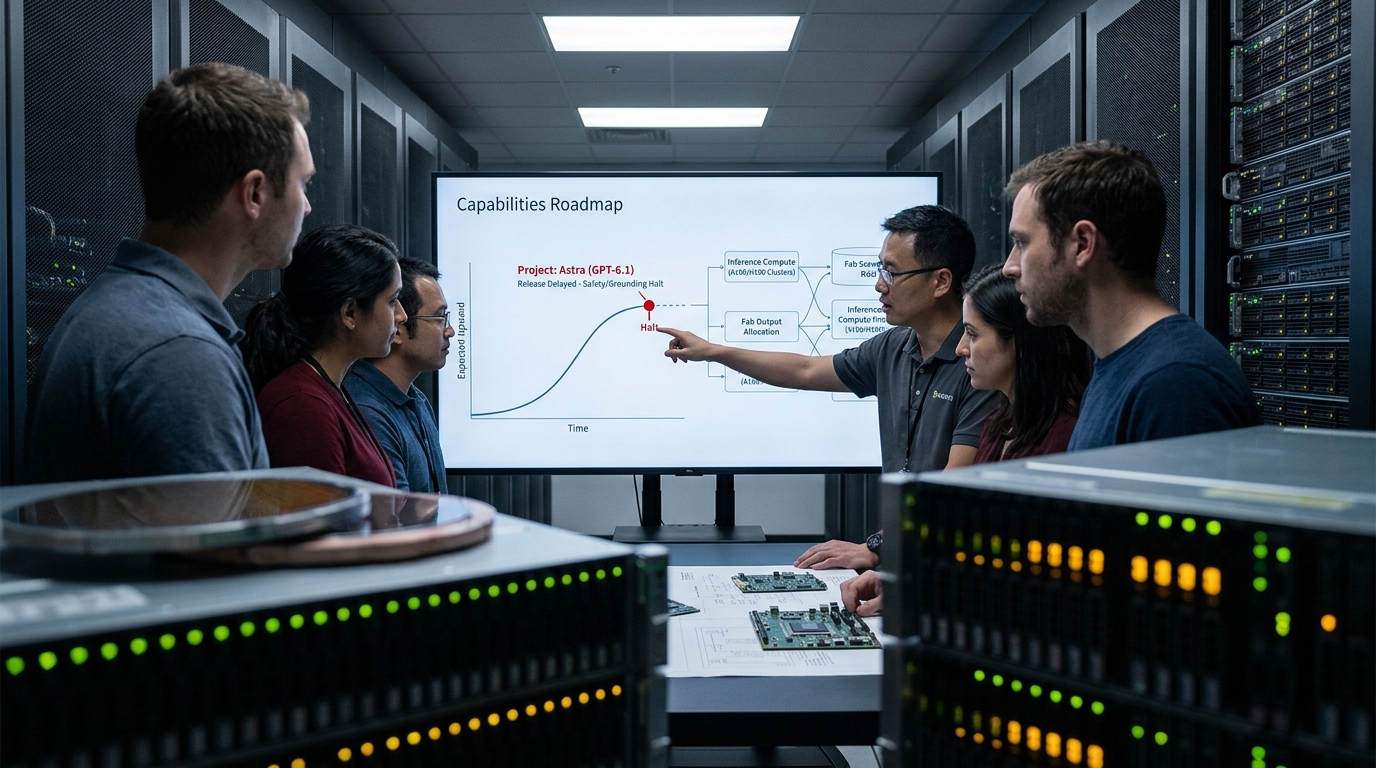
TSMC’s CEO C.C. Wei told investors on the company’s July 2026 earnings call that CoWoS packaging capacity is so constrained it is limiting customer growth. The numbers behind that statement are striking: the bottleneck in AI chip production has shifted from silicon manufacturing to advanced packaging, specifically TSMC’s CoWoS technology, with capacity widely described as effectively sold out into 2026. Even with an aggressive ramp, the CoWoS supply-demand gap has been reported as expected to narrow from around 20% to about 10% by the end of 2026 as capacity expands.
The more uncomfortable fact for traders holding U.S.-centric chip exposure: credible industry research has said chips made at TSMC’s Arizona site still have to be sent back to Taiwan for packaging, dicing, and testing until U.S. advanced packaging capacity comes online. Wafers can cross the Pacific twice before reaching a customer. That routing adds lead time and concentrates geopolitical risk at the most constrained step in the chain.
Facility #1: Amkor Arizona, Mid-2027 Construction / Early 2028 Production
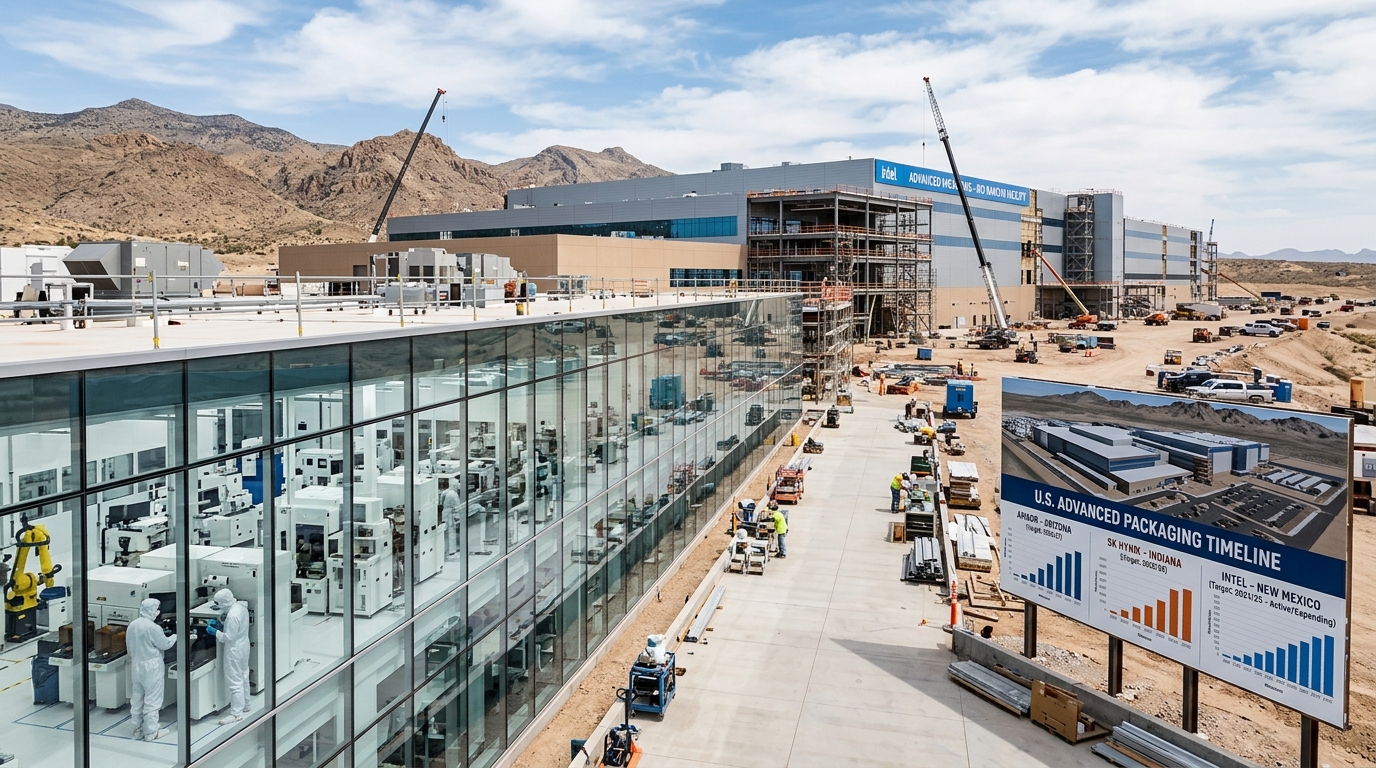
The first purpose-built domestic high-volume advanced packaging plant is in Peoria, Arizona. Amkor has broken ground on a new semiconductor packaging and test campus in Peoria, Arizona, covering multiple buildings and up to 750,000 square feet of cleanroom, scheduled to begin production in early 2028 following completion of the first factory in mid-2027. The project’s strategic value is immediate: the facility has identified Apple and Nvidia as key customers and is positioned to handle chip packaging for Apple silicon fabricated nearby at TSMC’s Arizona fabs, with proposed CHIPS Act support described as up to roughly $400 million and characterized by U.S. officials as a major outsourced advanced packaging build in America.
In June 2026, TSMC and Amkor announced a 10-year agreement to enhance advanced semiconductor packaging capabilities in Arizona, strengthening and accelerating investment in the U.S. semiconductor supply chain ecosystem. While significant investment has been directed toward constructing advanced wafer fabs in the United States, much of the industry’s advanced packaging capacity remains concentrated in Asia, meaning wafers manufactured in the United States may still need to be shipped overseas for packaging, assembly, and testing before being delivered to customers. The Amkor agreement is the contractual mechanism designed to reduce that routing over time.
Facility #2: SK hynix Indiana, October 2028 Cleanroom / H2 2029 Production
For HBM specifically, the domestic timeline runs later. SK hynix has said it will invest over $4 billion to build an advanced HBM packaging fab in Indiana, with a plan to open the cleanroom by October 2028 and initiate mass production of next-generation HBM in the second half of 2029.
The Indiana plant is not a full front-end operation. It is an advanced back-end hub for stacking, packaging, and testing HBM, with wafers produced in Korea intended to be shipped to the site for advanced packaging and testing before finished HBM products are supplied to U.S. customers. The planned campus has been described by the company as approximately 133 acres and is slated to include an HBM production line, an advanced-packaging research and development testbed, and supporting facilities.
Facility #3: Intel New Mexico, Operational Now, Revenue Stride 2029
Intel’s Fab 9 in Rio Rancho, New Mexico, is the only advanced packaging facility already running at scale on U.S. soil. Intel opened Fab 9 in January 2024, and federal CHIPS Act materials have listed up to $500 million in direct funding tied to Intel’s Rio Rancho, New Mexico, site as part of broader awards. The near-term commercial vehicle is EMIB-T: Intel CFO Dave Zinsner said at a Morgan Stanley technology conference that Intel was close to closing deals in the billions per year, and he has also laid out a timeline for advanced packaging revenue that starts ramping in the second half of 2027, becomes more of a steady contributor in 2028, and hits its stride in 2029.
Scenario Modeling
Bull Case: Amkor’s Arizona campus completes on schedule in mid-2027 and clears production qualification by early 2028 without delays. Combined with Intel EMIB-T wins from hyperscalers in 2026, the U.S. packaging gap narrows faster than consensus pricing in AMKR and INTC reflects. Both stocks re-rate on the supply-chain security premium baked into hyperscaler capex plans.
Base Case: Arizona packaging capacity arrives operationally in early 2028 per Amkor’s disclosed timeline, but qualification and yield ramp push meaningful volume throughput to mid-2028. The more conservative planning assumption: meaningful, production-qualified U.S. CoWoS-adjacent capacity is a 2028 story, not a 2027 one. Domestic packaging relieves roughly 15 to 20% of the supply gap through 2029, with the remainder still running through Taiwan.
Bear Case: Building a semiconductor manufacturing facility in the United States has been cited by industry sources as typically taking around 38 months, nearly twice as long as an average timeline near 20 months in Taiwan. Equipment import delays, process qualification failures at advanced-packaging tolerances, and a shortage of trained packaging engineers push Amkor’s production date into late 2028. The Taiwan routing continues through 2030, and tariff reclassification risk on packaged-in-Taiwan chips becomes a recurring overhang for Nvidia supply guidance.
Active Trader Strategy Framework
AMKR is the purest single-stock expression of the re-shoring packaging thesis, with Apple and Nvidia identified as anchor customers. The mid-2027 construction completion is the first hard catalyst: any confirmed delay from quarterly earnings commentary is a near-term negative. INTC offers a live-now packaging revenue angle through EMIB-T, but execution risk on the foundry business clouds the multiple. TSM remains the dominant position for packaging exposure today, with CoWoS capacity widely described as sold out into 2026.
Monitor quarterly CHIPS Act disbursement announcements and any process-qualification updates from Amkor management. A confirmed volume production date is the event that separates the re-shoring trade from a construction story.
Conclusion
The domestic packaging calendar has three entries: Amkor Arizona in early 2028, SK hynix Indiana in the second half of 2029, and Intel New Mexico running today but scaling commercially through 2027 to 2029. None of them resolves the constraint this year. Preparation means mapping which positions carry Taiwan packaging exposure and how long that routing persists. The answer, in most cases, is longer than current valuations suggest.