The hydrogen economy has a logistics problem that almost nobody prices into industrial gas stocks. Moving hydrogen today means either compressing it to 700 bar or chilling it to around minus 253 degrees Celsius to liquefy it. Both methods are expensive, energy-intensive, and a genuine deterrent to widespread adoption. The solution that materials scientists have been refining for decades is beginning to reach commercial reality: solid-state storage in metal-hydride alloy matrices.
Why this matters for APD
As the leading global supplier of hydrogen, Air Products develops, engineers, builds, owns, and operates some of the world’s largest hydrogen projects, supporting the transition to low- and zero-carbon energy in the industrial and heavy-duty transportation sectors. That infrastructure footprint is exactly why the metal-hydride breakthrough lands in APD’s favor before it lands in anyone else’s.
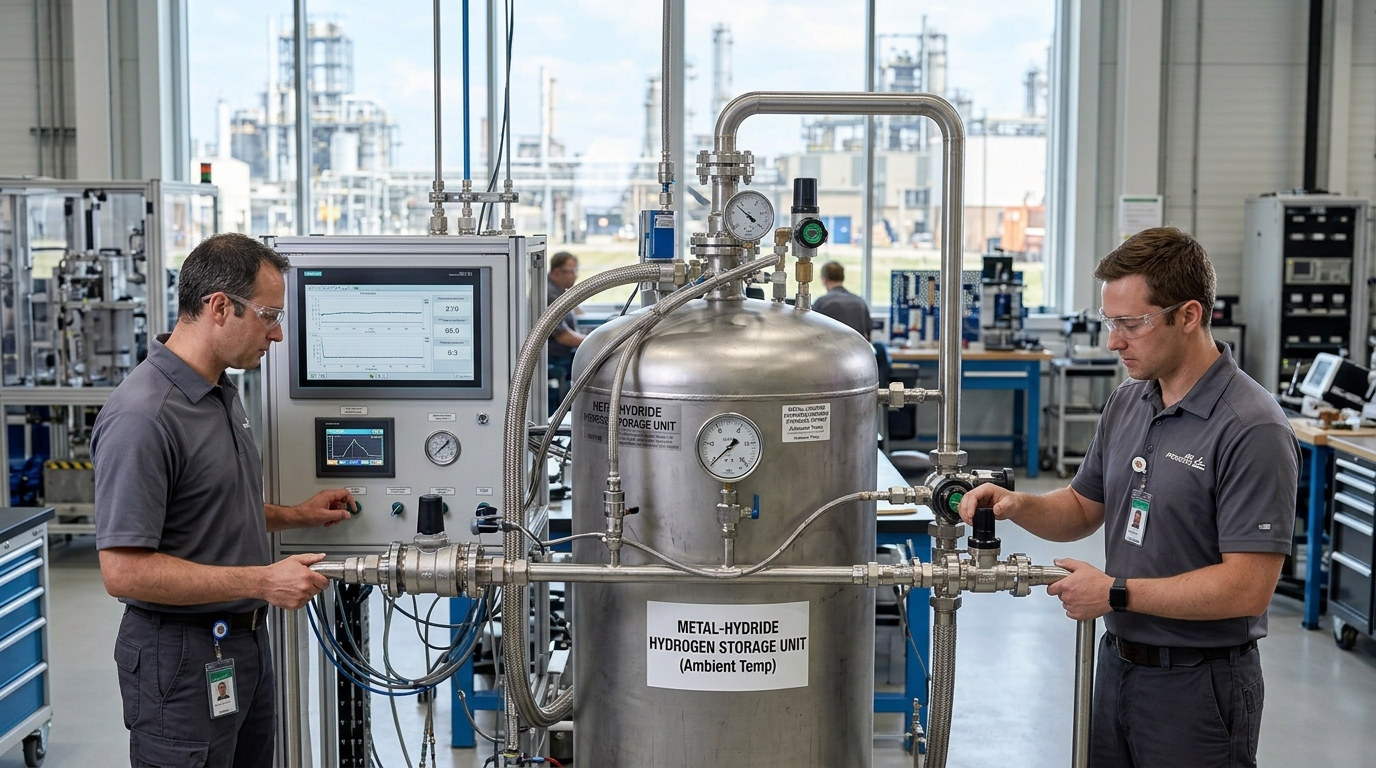
Metal hydrides and complex hydride materials occupy a central position among solid-state hydrogen storage systems due to their ability to provide high storage density under relatively moderate pressure and temperature conditions. In many designs, metal hydrides can store and deliver hydrogen at relatively low pressures, often in the 8 to 30 bar range. For context, that is roughly 20 to 90 times lower pressure than a 700-bar compressed-gas tank. The safety implications alone could rewrite the transportation calculus.
On volumetric density, 700-bar compressed hydrogen is around 40 kilograms per cubic meter at typical reference conditions. Some metal-hydride materials can exceed that substantially, with frequently cited lab-scale or material-level figures reaching roughly 100 to 150 kilograms of hydrogen per cubic meter under favorable assumptions. In real systems, the delivered density can be lower once you account for container design, heat exchangers, and fill fraction, but the engineering trade-off can still be compelling for heavy-duty trucking and industrial depot storage where space and safety standards are constant constraints.
Patent and investment momentum is real, but the exact surge figures in this draft cannot be verified from a consistent public tracker. It is safer to say that solid-state hydrogen storage has seen rising patent activity and commercialization attempts since 2020, alongside ongoing investment in hydrogen storage and fuel cell supply chains. Forecasts for the metal hydride market vary widely by firm; some industry forecasts cluster around high-single-digit annual growth over the late 2020s, but there is no single authoritative 7.2% figure that holds across sources.
Where APD’s advantage is structural
Air Products does not need to invent a new alloy to win here. The company combines process development, hydrogen supply, safety, and scale-up expertise, which helps customers transition from testing to commercial operation. That integration capability is the moat. A metal-hydride storage module is only as valuable as the hydrogen supply chain connected to it, and Air Products operates in approximately 50 countries.
The integration advantage Air Products holds also matters for who buys the hydrogen at the other end of the chain. Fuel cell operators scaling to meet data center baseload demand represent a fast-growing class of industrial hydrogen customer.
Investors are also overlooking a structural bottleneck Air Products controls through its Gardner Cryogenics business, which designs and manufactures storage tanks used to transport hydrogen and helium for the industrial gas industry. That does not mean Air Products controls global distribution, but it does mean the company owns a relevant piece of specialized equipment capability that matters when supply chains tighten. A similar logic could apply to solid-state distribution equipment as it scales.
Air Products raised its full-year fiscal 2026 adjusted EPS guidance to a range of $13.39 to $13.49. The November 5, 2026 earnings call is scheduled as Air Products’ fiscal Q4 2026 earnings conference call, and it will give investors a closer look at how current hydrogen megaprojects and electronics contracts are feeding into near-term profitability and cash generation.
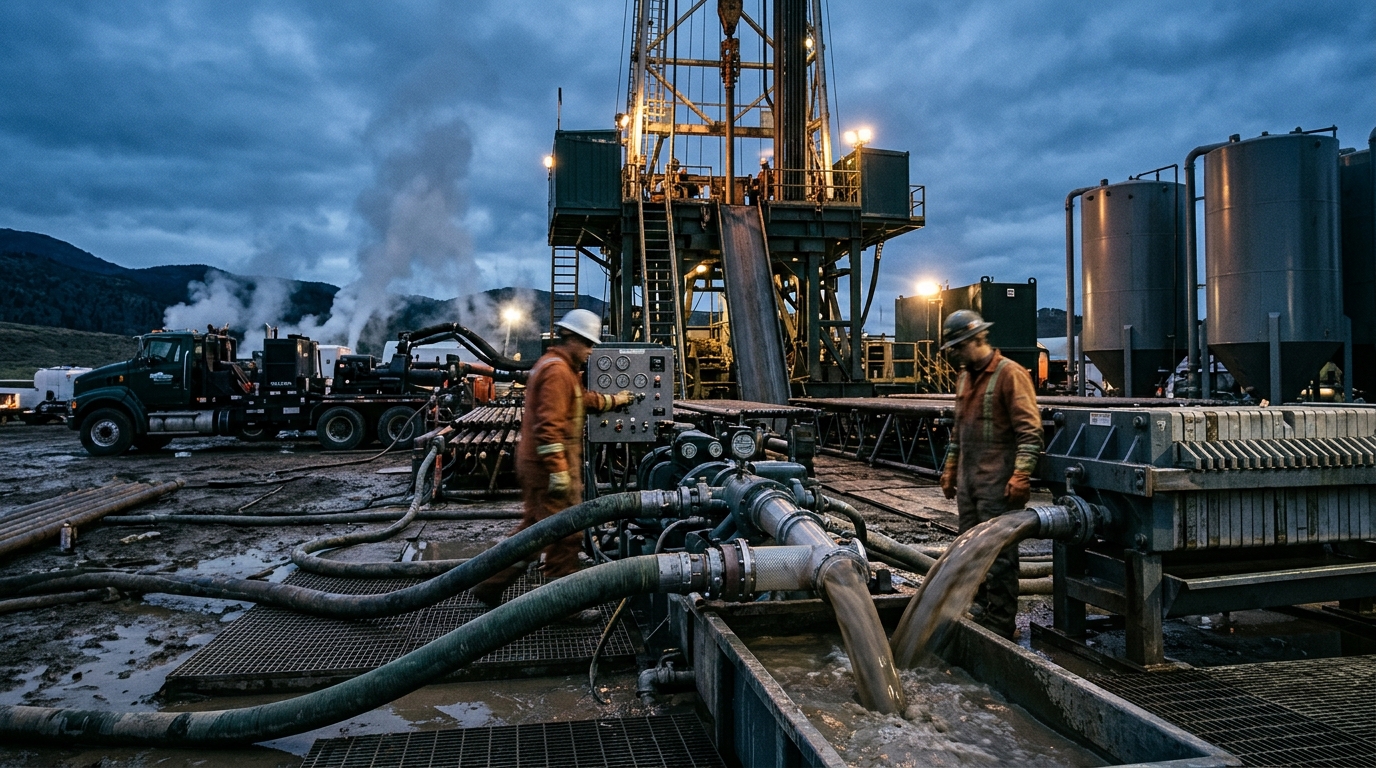
Capital spending cycles in energy infrastructure rarely move in isolation. Equipment backlogs and constrained manufacturing capacity across the broader energy supply chain set the pace for how quickly hydrogen megaprojects can actually reach commissioning.
Risks to Watch
Metal hydrides offer high volumetric density and moderate operating pressures, but their performance is often limited by thermodynamics, kinetics, activation requirements, and cost. Thermal management remains the sector’s most persistent engineering challenge: the alloy generates heat when absorbing hydrogen and demands heat when releasing it, which adds system complexity at scale. Key risks for Air Products include heavy capital spending, competitive pressure in clean hydrogen and ammonia, and the risk of delays or cost overruns across major projects. The NEOM Green Hydrogen Project has experienced timeline pressure in the past, even as project partners reported construction completion in August 2026 and have indicated commissioning and a 2027 start-up window. The Edmonton-area net-zero hydrogen complex is under construction, and, as with any mega-project, schedule risk remains a live variable.
Wealth Takeaway
The hydrogen storage bottleneck is real, and whoever solves the logistics layer can win disproportionately. Solid-state metal-hydride systems attack that bottleneck at the physics level. Air Products is positioned not just to sell the hydrogen that flows through these systems, but to build and own the infrastructure around them. The November 5 earnings call is the next opportunity to judge whether execution is keeping pace with the opportunity.