
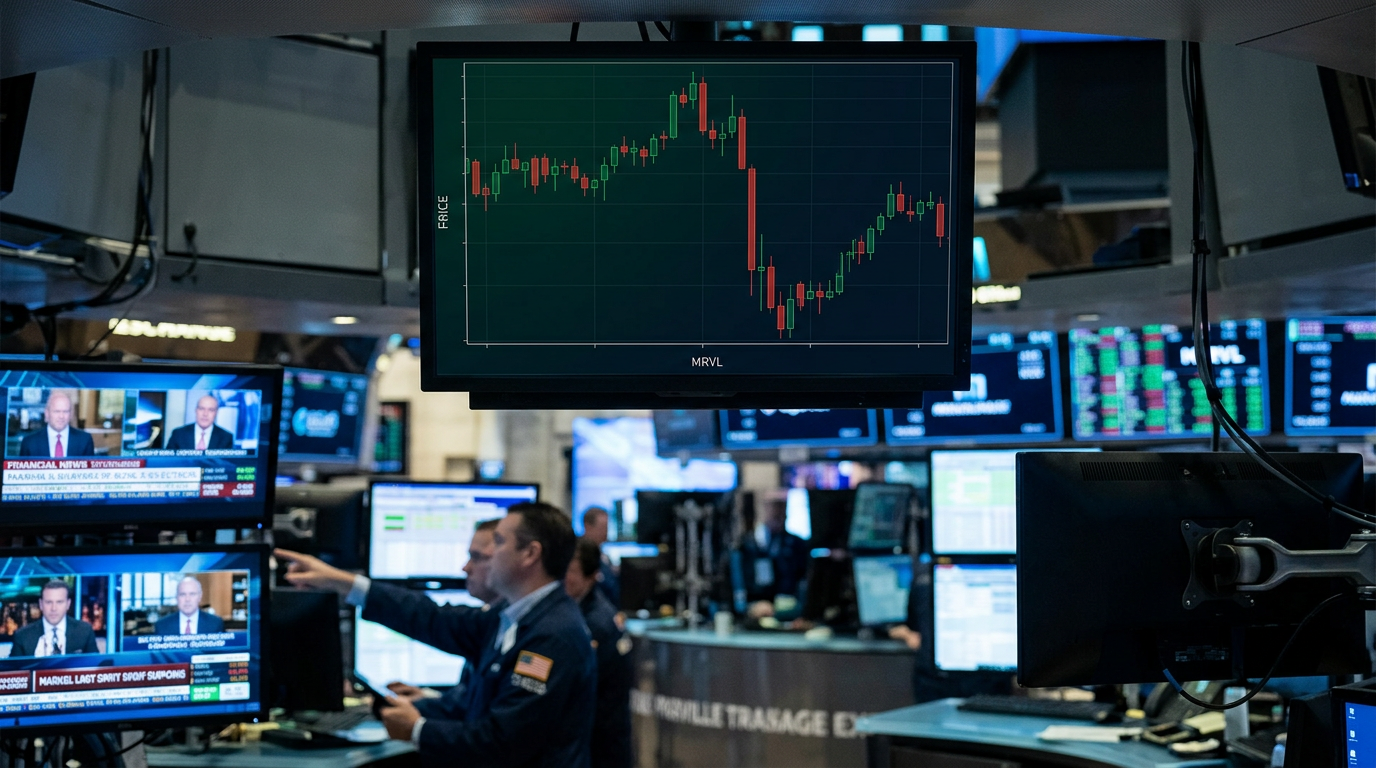
Let’s start with the tape, because it tells you everything. Marvell Technology (MRVL) closed at a record $316.43 on June 4. By the close on June 6, it had collapsed to $263.47 — a 16.7% single-session drop that dragged the iShares Semiconductor ETF down roughly 10%, its worst session since March 2020. Then, this past Monday morning, MRVL jumped another 10.3% on the news that S&P Dow Jones Indices would be adding the stock to the S&P 500 effective June 22.
Three sessions. A record high, a historic selloff, and a sharp recovery. That is not normal volatility. That is a stock trading far ahead of its earnings base — and the market reminding everyone of it in real time.
What Actually Happened
Two things converged last Friday to light the fuse. First, Broadcom (AVGO) reported earnings on June 3 but declined to raise its 2026 AI chip revenue forecast. Investors read that steady guidance as a ceiling on hyperscaler AI spending growth, and AVGO fell roughly 12% the next session. That removed the sector’s most visible near-term catalyst.
Then the May jobs report printed 172,000 new payrolls — roughly double the consensus estimate of 85,000. Treasury yields spiked, rate-cut odds evaporated, and the CME FedWatch Tool showed a 72% probability of at least one rate hike by year-end. Semiconductor stocks, which are valued on earnings expected years from now, are acutely sensitive to discount rate movements. When yields rise, those future profits are worth less in today’s dollars. The priciest names fall hardest.
MRVL had been up approximately 237% year-to-date before Friday’s drop. That kind of run builds in a lot of assumptions. Broadcom’s flat guide and a hot payroll print were enough to break them — at least temporarily.
Slight tangent here, but it matters: the selloff wasn’t just a U.S. story. South Korea’s KOSPI fell 5.5% that same session, with Samsung down 6.4% and SK Hynix nearly 10%. ASML fell 3.8% in Europe. Infineon lost over 6%. This wasn’t a single-stock event. It was a global repricing of AI infrastructure valuations against a backdrop of rising rates and uncertain demand.
The Recovery and What’s Coming June 22
Monday’s bounce came from a different catalyst entirely. S&P Dow Jones Indices confirmed MRVL will join the S&P 500 on June 22 — a significant structural development because index-tracking funds must purchase the stock, creating forced mechanical demand. NVIDIA CEO Jensen Huang had already called Marvell a potential future trillion-dollar company at Computex, and Nvidia has reportedly invested $2 billion in MRVL while tying the company to NVLink Fusion architecture. Stifel raised its price target to a Street-high of $321 post-Computex.
The fundamental setup is genuinely compelling: Marvell reported record first-quarter fiscal 2027 revenue of $2.418 billion, up 28% year-over-year, and guided Q2 to $2.7 billion. The company’s optical networking and custom ASIC portfolio sits at the center of AI data center infrastructure. The AI story is real.
Here’s the part people skip though. Marvell disclosed that its ten largest customers represented 82% of fiscal 2026 revenue, with two customers each accounting for at least 10% of total revenue. Concentration risk at that level can accelerate growth during an AI capex boom — and magnify the downside when spending pauses, shifts, or moves in-house. That’s not a thesis-killer. It’s a risk parameter every trader should have front of mind.
Options Market Analysis
The volatility environment in MRVL options is elevated and worth examining carefully. After 39 single-session moves greater than 5% over the last year, the stock’s realized volatility profile is genuinely extreme. On the day MRVL rebounded from its selloff lows, option volume surged to 28.77 million shares equivalent, with call volume at 61,666 contracts against put volume of 25,078 — a put/call volume ratio of approximately 0.41, reflecting short-term bullish positioning. However, the open interest put/call ratio sits at 1.27, indicating that the broader options positioning remains skewed toward downside protection — a divergence between short-term speculation and medium-term hedging that deserves attention.
IV rank is elevated given the two-week window of extreme realized moves. For traders assessing defined-risk structures, that elevated implied volatility works both ways: premium sellers are better compensated, but long options buyers face elevated breakevens.
Structured Trade Framework
- Bull Case (If you believe MRVL holds post-S&P 500 inclusion and AI infrastructure spending accelerates): A defined-risk bull call spread — buying the July $300 call and selling the July $330 call — allows participation in continued upside while capping premium outlay. The June 22 inclusion date creates a known near-term catalyst window.
- Bear Case (If you believe the inclusion rally fades post-rebalance and rate pressure persists): A put spread — buying the July $270 put and selling the July $250 put — offers defined downside exposure if MRVL breaks back below its post-selloff range after index funds complete forced buying. The key watch level is whether MRVL can hold above the $263 post-selloff close once the rebalance window closes.
- Neutral / Volatility Case: Given elevated IV and a known near-term catalyst window, a short iron condor in July expiration captures premium from both sides while the stock digests the index inclusion mechanics. The risk is a continuation of outsized directional moves — of which this stock has demonstrated a clear capability.
Risk Analysis
Customer concentration is the structural pressure point the market will return to. Marvell’s own risk disclosures warn that current AI infrastructure spending may not be sustainable over the long term and that customers could decelerate or reallocate capital. A trillion-dollar valuation — which Jensen Huang’s endorsement implies — would require roughly a 4.25x increase from current market value near $235 billion. Against fiscal 2026 revenue of approximately $8.2 billion, that math demands flawless execution on revenue acceleration and margin expansion over several years. The valuation question isn’t whether MRVL can grow. It’s whether the market is already paying for an earnings base that still has to be built.
Rate sensitivity is the second variable. MRVL is not a cheap stock by any traditional metric. If the Fed signals rate hikes — and CME FedWatch now shows 72% odds of at least one — the multiple compression trade becomes the primary risk to every AI infrastructure name in the sector.
Action Checklist
- Watch the $263–$270 zone: the post-selloff low is the first key support level
- June 22 S&P 500 inclusion: monitor price action in the days immediately after forced buying clears — a bid that holds is structurally different from one that fades
- Track the OI put/call ratio: elevated at 1.27 vs. the bullish 0.41 volume ratio signals institutional hedging against short-term retail optimism
- For defined-risk structures, size around the stock’s demonstrated capacity for 10–17% single-session moves
- CPI data later this week: if inflation comes in hot, rate hike odds will reprice — and high-multiple semiconductor names are the first to feel it