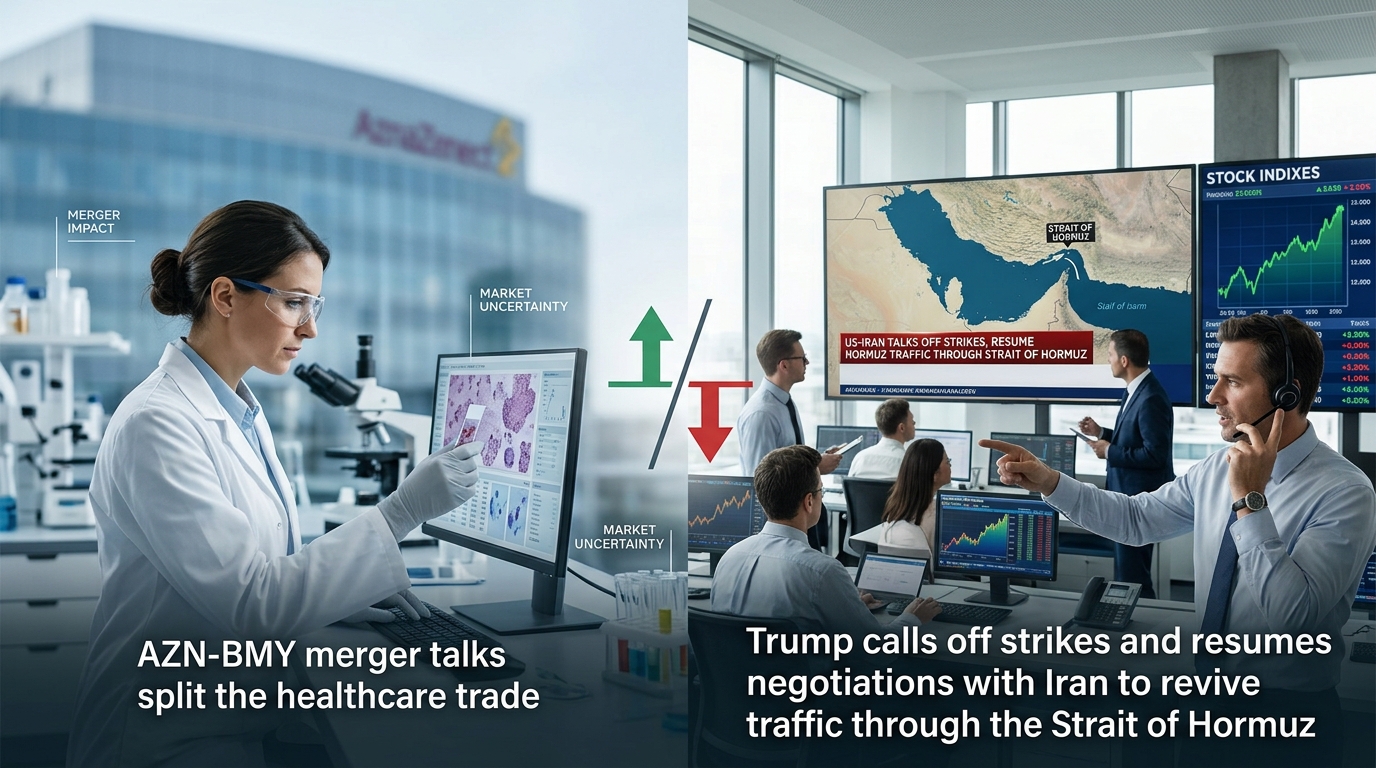
Two things happened over the weekend that are moving markets this Monday morning, and they’re pulling in almost opposite directions.
Trump called off what he described as a massive planned strike on Iran and announced that US-Iran negotiations would resume today, Monday afternoon. Those talks are focused squarely on ending the conflict and reviving cargo traffic through the Strait of Hormuz, a waterway through which about a fifth of all traded oil and natural gas passed before the war. Oil is falling on the news. Futures are up.
Then, quietly, a different story dropped out of London.
AstraZeneca and Bristol Myers Squibb have been discussing a merger that would create a combined company valued at roughly $400 billion, first reported by the Financial Times on Sunday. AstraZeneca’s market value stands at approximately $296 billion, while Bristol Myers Squibb is valued at around $133 billion. Neither company confirmed the report.
The market reaction this morning is telling. AstraZeneca shares fell more than 4% in premarket trading while BMS rose nearly 6%. That divergence matters. The market is pricing this as a win for BMY shareholders and a strategic question mark for AZN. That’s not an unreasonable read.
Why BMY Needs This
Bristol Myers has been doing smaller deals to gain new drugs as it faces declining sales of older medicines, some of which will soon face generic competition. The patent situation is real. Revlimid has already lost patent protection and its current top sellers, cancer immunotherapy Opdivo and blood thinner Eliquis, could lose patent protection by 2028.
So the logic for BMY is straightforward. You swap into one of the most robust oncology pipelines in the industry, protect yourself from the cliff, and let AZN’s R&D engine carry you through the next decade. A combination would give AstraZeneca immediate access to BMS’s hematology, immunology, and cardiovascular franchises, and complete its ongoing transformation into a trans-Atlantic giant generating the majority of revenue from the US market.
AZN CEO Pascal Soriot has set a goal of $80 billion in annual revenue by 2030. Acquiring BMS would provide immediate revenue at a scale no organic pipeline could deliver in the available timeframe. That’s the bull case for why AZN might actually want this.
The Antitrust Wall Nobody Is Skipping Over
Here’s where it gets complicated. Oncology accounted for about 40% of AZ’s total revenue in the first half of 2026, and AZ and BMS’s cancer immunotherapies compete directly. It isn’t a case of complementary pipelines; it’s the two companies’ core franchises overlapping in the same treatment classes.
Specifically, BMS’s Opdivo and AstraZeneca’s Imfinzi are rival checkpoint inhibitors used across lung cancer and other solid tumors, with both companies pushing into earlier treatment settings. Regulators are going to have opinions about that.
If the deal’s strategic logic rests on combined oncology scale, and regulators force the company to shed oncology assets to get the deal approved, how much of the original rationale survives the approval process? That question is the one serious investors are sitting with today. BMO Capital Markets wrote Sunday evening that “based on significant business overlap, we believe a deal is less likely to materialize.”
The counterargument, flagged by Jefferies, is slightly more nuanced. Working together, BMS and AstraZeneca could create complex treatment regimens in lung, breast, ovarian, and gastrointestinal cancers, and the ability to develop and commercialize more complex multi-drug regimens without cross-company negotiations may ultimately prove one of the most compelling strategic rationales. That’s an interesting way to frame it. The value isn’t just the combined pipeline, it’s the ability to run combination therapies internally, without licensing negotiations slowing the clock.
The Broader Healthcare Week
Slight tangent, but it matters: the AZN-BMY story is not the only reason healthcare is in focus this week. Eli Lilly reports this week, alongside McDonald’s and Occidental Petroleum, making it one of the more cross-sector heavy calendars of the summer.
Wall Street expects Lilly to report Q2 earnings of approximately $6.06 per share on revenue of about $20.7 billion when it reports on August 5. That’s off a remarkable base. In Q1 2026, worldwide revenue was $19.8 billion, an increase of 56% compared with Q1 2025, driven by a 65% increase in volume. The GLP-1 machine is not slowing down.
But the AZN-BMY story is eating the room this morning, and understandably so.
Stocks to Watch
- Bristol Myers Squibb (BMY): The cleaner side of this trade. Patent cliff pressure is real, and a deal with AZN’s pipeline would directly address the 2028 expiry problem on Opdivo and Eliquis. The 6% premarket pop reflects that logic accurately.
- AstraZeneca (AZN): Down 4%-plus this morning and analysts are “perplexed.” That word is doing a lot of work. AZN had a best-in-class pipeline story running cleanly before this report. The market is selling the uncertainty. Worth watching whether the selloff creates an entry or confirms the strategic concern.
- Eli Lilly (LLY): Reports August 5. The GLP-1 growth story is largely independent of the AZN-BMY drama, which is part of what makes it interesting. If the AZN-BMY deal collapses or stalls, LLY becomes the cleanest large-cap healthcare growth story with nothing attached to it.
- Smaller oncology names: If forced divestitures become a condition of any AZN-BMY deal, mid-tier oncology assets get shopped. Watch the space. The biggest moves in biotech this morning were already in smaller oncology names reacting to the deal headlines.
The week starts with geopolitics and a potential $400 billion pharma transaction both in motion simultaneously. Neither is settled. The futures gain is real but so is the uncertainty sitting underneath it. That combination, optimism on Hormuz, skepticism on the pharma deal, Lilly earnings in two days, is exactly the kind of week where the second and third-order moves end up mattering more than the headline.