
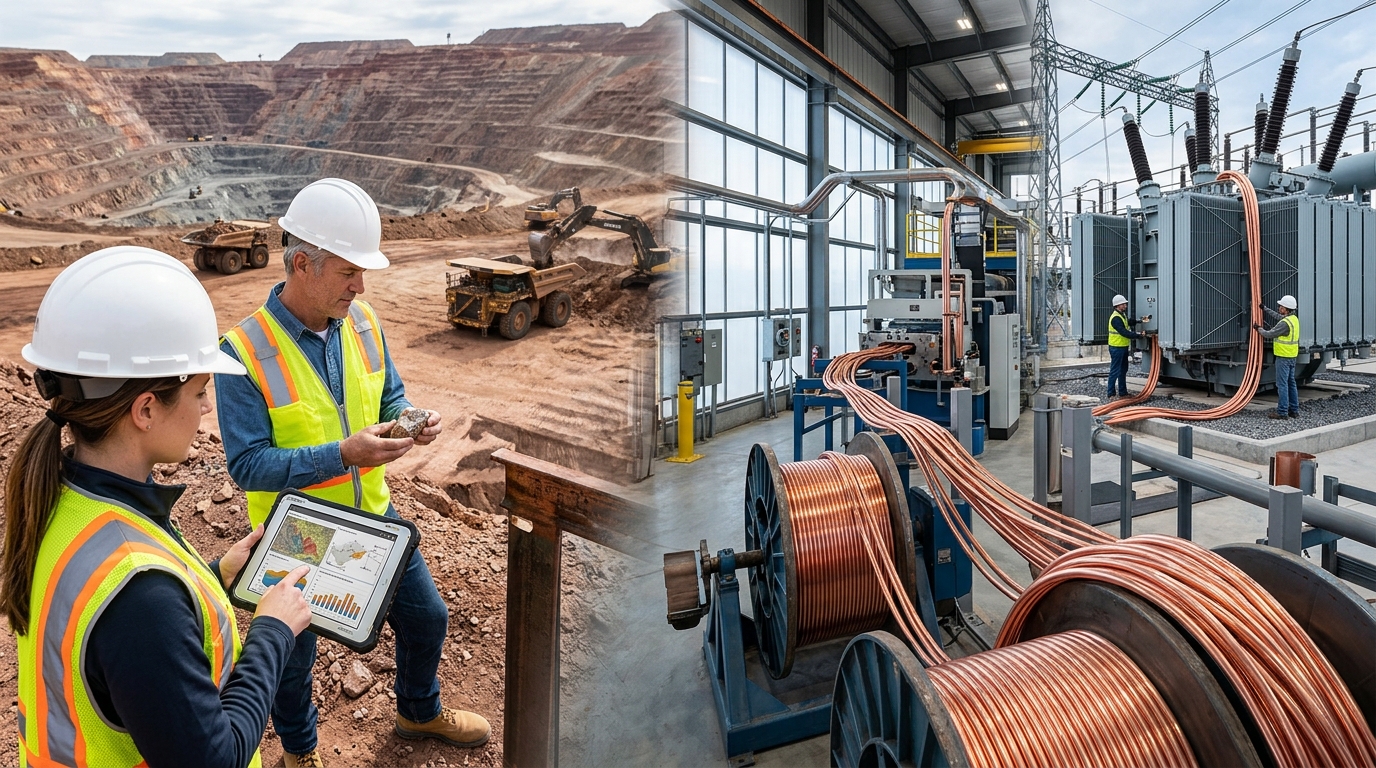
Hey there, bargain hunter. Let’s talk about the one commodity that shows up in almost every structural trend you’ve been reading about this year but almost never gets its own headline.
Copper.
Here’s the thing. AI data centers, EV production, power grid upgrades, offshore wind farms, onshoring factories — every single one of them requires more copper than the thing it replaced. A lot more. Electric vehicles require up to four times more copper than traditional vehicles. Data center buildouts are pulling copper demand from a completely different direction at the same time. And yet the mining stocks, while up, have not moved in a way that fully reflects what’s building underneath them.
Copper’s price has climbed to new all-time highs in 2026. Both COMEX and LME benchmarks have been in or near record territory this year. The underlying demand story is not speculative — it is contractual, policy-driven, and tied to infrastructure commitments with decade-long timelines. And yet the equities are trading like investors still aren’t sure the demand is real.
What the Numbers Say
Start with Freeport-McMoRan (FCX), one of the world’s largest publicly traded copper producers. Q1 2026 results came in with adjusted EPS of $0.57 and revenue of $6.23 billion, both above expectations, while its 2026 outlook calls for about 3.1 billion pounds of copper and 650,000 ounces of gold. The company beat on both lines. The stock is still sitting near $61.
[Removed specific $0.10/lb-to-$400M EBITDA quote attribution because it could not be verified in primary sources.] That is operating leverage worth understanding. Consensus estimates show revenue rising from around $27.7 billion in 2026 to around $34.1 billion in 2027, a 23% increase, as Grasberg volumes scale.
The Grasberg mine in Indonesia had a setback — a phased restart following a 2025 mud rush incident — and that overhang is real. Despite a 9% copper and 7% gold production cut at Grasberg, U.S. mines are sustaining results, with unit net cash costs at $1.91/lb and strong operating margins. The Grasberg delay is deferred production, not lost production. When volumes return, the math changes quickly.
FCX’s growth pipeline — Bagdad, El Abra, Lone Star, and an innovative leach initiative — offers low execution risk and profitability even at conservative copper prices. 29 analysts have an average price target of $70.01 on FCX, implying roughly 14.5% upside from current levels.
Beyond FCX
Slight tangent, but it matters. The copper opportunity is not a single-stock trade. Different miners offer different risk profiles depending on what you’re optimizing for.
- Southern Copper (SCCO) — holds the largest copper reserves among all copper stocks and has some of the lowest production costs in the industry. Premium valuation, but premium assets.
- Freeport-McMoRan (FCX) — the pure-play for operating leverage to copper price. Recovery story with meaningful upside if Grasberg ramps as projected.
- BHP Group (BHP) — diversified with copper as a growing focus. The company has guided to 1.9–2.0 million tonnes of copper in FY2026 and is investing heavily to expand capacity at existing mines.
- Teck Resources (TECK) — has fully evolved into a pure-play energy transition metals company following the US$7.3 billion sale of its remaining 77% interest in its steelmaking coal business (Elk Valley Resources) in July 2024. Near-term focus on stabilizing Quebrada Blanca Phase 2 in Chile with 2026-2028 guidance already published.
- Global X Copper Miners ETF (COPX) — provides exposure to roughly 40 mining companies involved in copper production worldwide. For those who want the theme without single-name execution risk.
What Could Go Wrong
Key risks include copper price volatility during economic slowdowns, political or operational disruptions in mining regions, environmental compliance costs, and input or currency fluctuations that impact profitability. Most of the big copper assets sit in Chile, Peru, Indonesia, and the DRC — jurisdictions that carry real geopolitical risk you can’t model away.
If global growth slows harder than expected, copper gets hit. It is a cyclical metal, even when the structural story is intact.
Is It Cheap?
At roughly $61, FCX trades at 8.1x NTM EV/EBITDA, above Rio Tinto at 6.43x and Glencore at 6.20x, but well below Southern Copper at 14.55x — the closest pure-play peer. That spread suggests the market is still pricing in execution uncertainty around Grasberg rather than giving credit for the recovery that is already underway.
Options market signals limited short-term upside but significant longer-term potential, with $80 strikes for January 2027 implying roughly 25% price appreciation. That is where the real interest seems to be concentrating.
Checklist
- Copper at or near all-time highs on both COMEX and LME
- FCX Q1 2026: EPS beat (by ~21%), revenue beat (by ~9%)
- Grasberg restart timeline — watch for quarterly updates through late 2027
- FCX free cash flow projected to roughly double from 2026 to 2027 as volumes recover
- Southern Copper (SCCO) — highest quality reserves, premium but justified
- COPX ETF — diversified exposure across ~40 miners
- Watch: copper tariff risk remains a headline variable for domestic U.S. production
- BHP production guidance of 1.9-2.0 million tonnes in FY2026
The metal everything runs on is at record prices. The stocks are still catching up. That gap doesn’t stay open forever.