Everyone’s talking about the chips. Nobody’s talking about the wires.
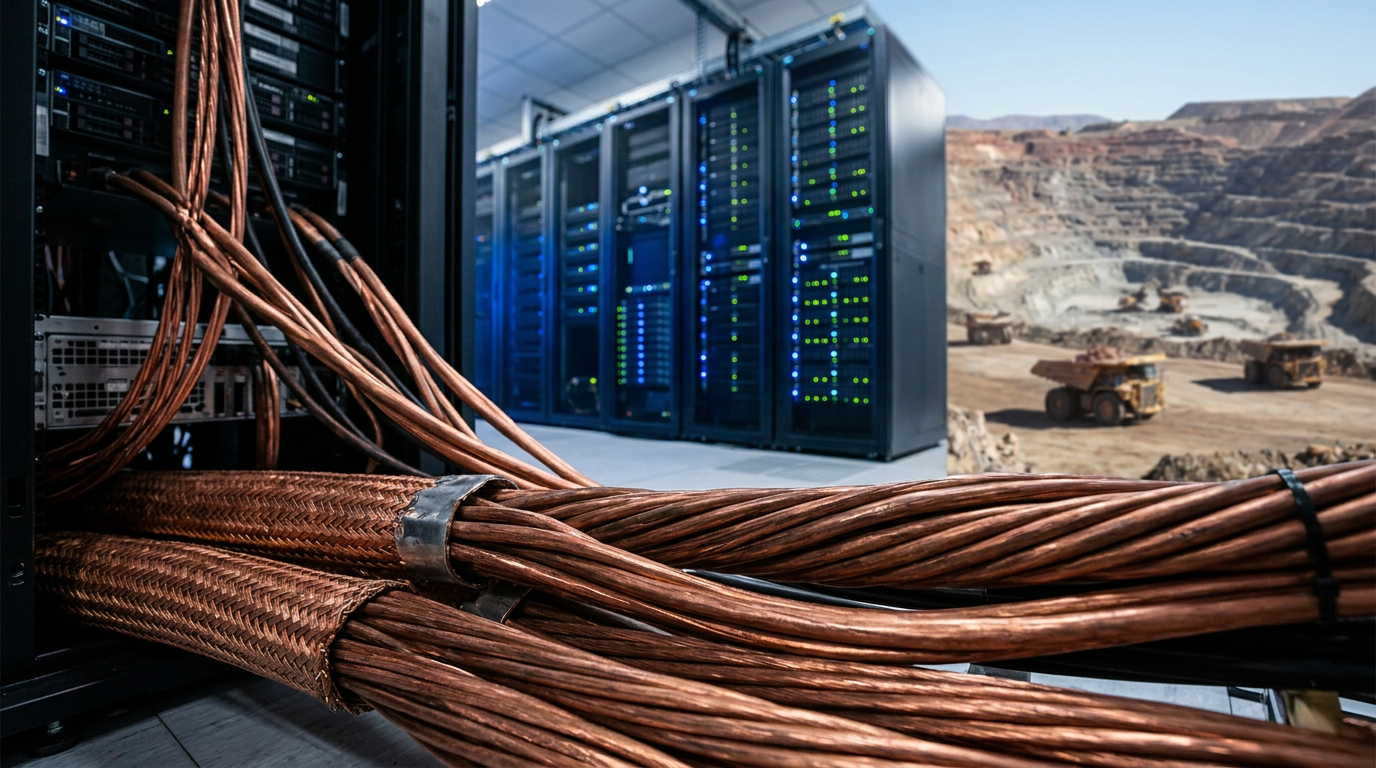
Here’s the part of the AI buildout story that keeps getting buried under semiconductor headlines: you cannot build a hyperscale data center without copper. A lot of it. According to J.P. Morgan, a single large AI data center can require up to 50,000 tonnes of copper, with total data center copper demand projected to reach 475,000 tonnes annually by 2026 alone. That number is expected to peak near 572,000 tonnes in 2028, according to BloombergNEF. That’s not a rounding error. That’s a structural shift in the demand curve for one of the most important industrial metals on earth.
And supply? Supply isn’t keeping up.
As of early June 2026, copper is trading at record levels near $13,800 per tonne on the London Metal Exchange, driven by a collision of supply disruptions, tariff uncertainty, and demand from AI infrastructure and electrification. Goldman Sachs recently raised its year-end 2026 copper forecast to $13,735 per tonne, more than 10% above its prior target. J.P. Morgan projects a refined copper shortfall of roughly 330,000 metric tons this year. The International Copper Study Group flipped its own forecast from a 209,000-ton surplus to a 150,000-ton deficit.
Slight tangent, but it matters: the U.S. government quietly declared copper a national security issue. In August 2025, a 50% tariff was imposed on semi-finished copper products, and a June 30 review could impose additional tariffs on refined copper starting in 2027. The policy intent is clear. Washington wants more domestic copper production. That’s not bearish for miners. That’s a floor under their pricing power.
S&P Global warns of a potential supply deficit that could reach 10 million metric tons by 2040, with global demand set to surge 50% from current levels. The root cause isn’t geopolitical gamesmanship. It’s geology. Supply growth remains constrained by declining ore grades, permitting timelines averaging 15 to 17 years from discovery to production, and a weakening discovery pipeline, with only 5% of major copper deposits found in the last decade.
So where does that leave investors?
Freeport-McMoRan (FCX) is the closest thing to a pure-play copper bet among U.S.-listed miners. The company generated roughly $25.9 billion in trailing revenue, with copper as the primary driver. Wall Street’s consensus EPS estimate for 2026 stands at $2.67, up sharply from $1.77 in 2025. The company operates key assets in the Americas and Indonesia, and its operations account for roughly 70% of U.S. refined copper production. FCX’s organic pipeline includes the Bagdad expansion in Arizona, the Safford/Lone Star expansions, and the Kucing Liar project. Grasberg operations – disrupted after a 2025 mudslide at the world’s second-largest copper mine – are targeting 85% capacity by the second half of this year.
Southern Copper (SCCO) tells a different story. The company expects 2026 revenues near $16 billion, up roughly 17% year-over-year. It carries a 52.4% operating margin that leads all major copper producers, and its Tia Maria project in Peru, 24% complete with $800 million committed, targets first production in 2027. This week, SCCO priced a $1.25 billion unsecured notes offering due 2036, signaling management’s confidence in long-cycle capital deployment. The Zacks consensus for SCCO’s fiscal 2026 earnings points to year-over-year growth of 33.4%, with estimates revised upward 6.4% over the past 60 days.
What’s interesting is how the copper thesis has evolved. Institutional investors are re-allocating capital from precious metals to copper, viewing it not as a cyclical trade but as a growth-oriented strategic allocation. Copper is transitioning from a commodity that tracks GDP to one that tracks technological adoption curves. AI needs copper. EVs need copper. The grid needs copper. The demand is not discretionary.
The risks are real. A weaker Chinese economy could dampen near-term demand. Tariff clarity around refined copper in late June could introduce short-term volatility. And after a historic rally, some froth is almost certainly embedded in current prices.
But here’s what doesn’t get discussed enough: even cautious analysts are projecting historically strong copper pricing. A Reuters poll of 31 analysts placed the median 2026 forecast at $11,975 per tonne – described as the highest consensus forecast ever recorded, despite sitting well below recent peaks. That tells you something about where the floor is being repriced.
The chip stocks get the headlines. The copper miners are getting the contracts. That gap may not last much longer.