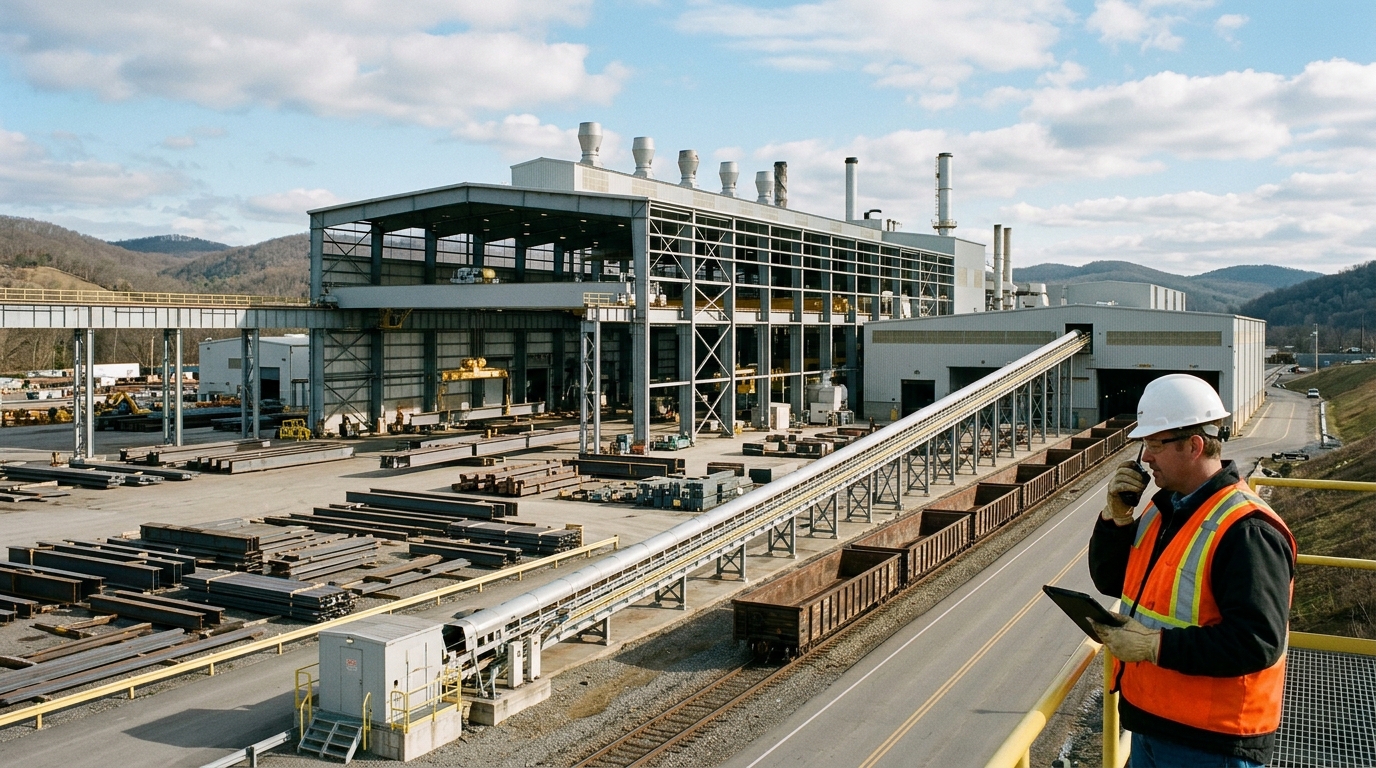
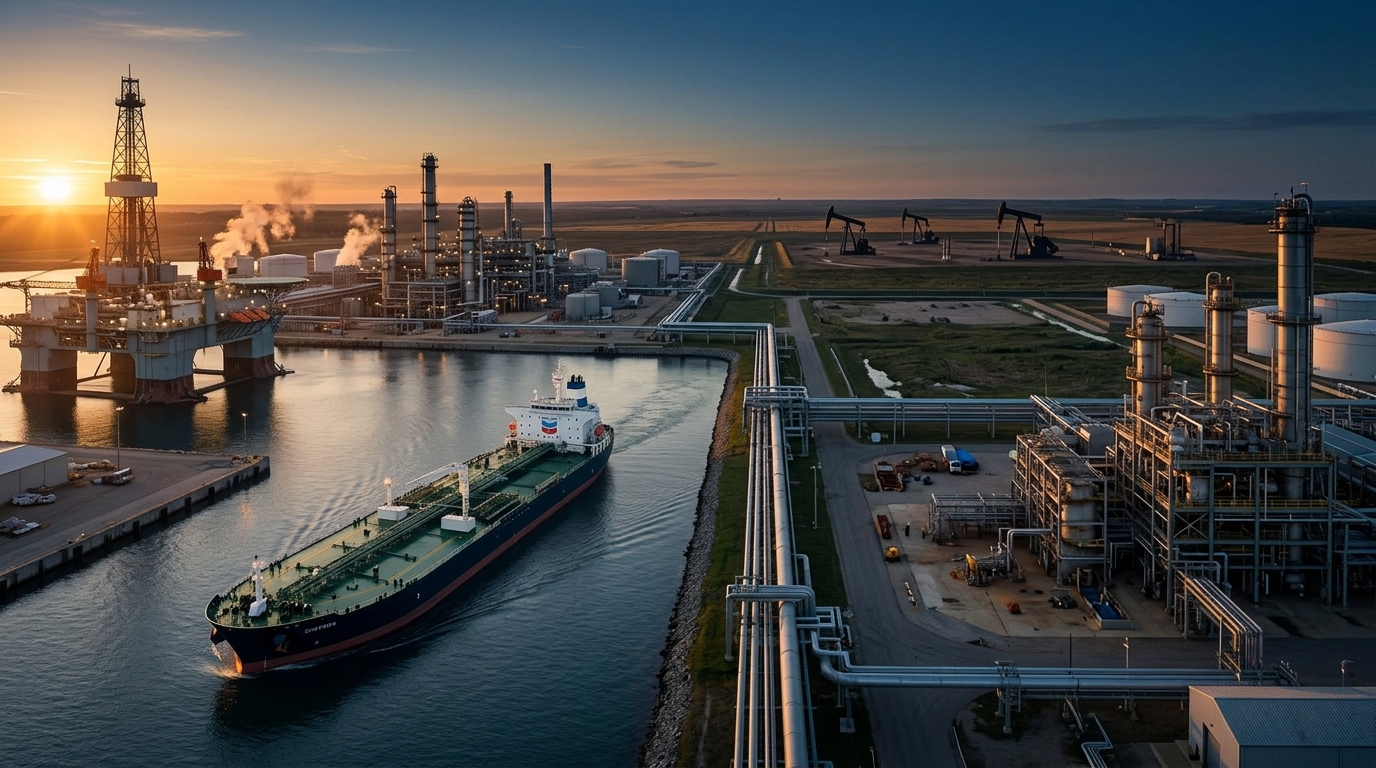
This morning’s Q2 results from America’s two largest energy companies told a tale of two portfolios. Chevron beat. Exxon missed. The gap between them has nothing to do with the price of crude, both companies lived through the same Iran war-driven commodity surge. The difference came down to where each company was positioned when the margin window opened.
What’s Driving the Market
The US-Iran conflict has restructured the global refining map in ways that nobody fully priced a year ago. The war has damaged refinery capacity in the Middle East, and Ukraine’s drone strikes have disrupted Russia’s refinery operations simultaneously. That supply disruption made the refineries still running extraordinarily valuable. Industry analyst Andy Lipow noted that US refineries are “doing fantastic” and that the market is seeing record refining margins for gasoline, jet fuel, and diesel.
Both majors operated inside that environment. Only one fully captured it.
Chevron’s Quarter in Plain Numbers
Chevron reported adjusted earnings of $6.06 per share, well above consensus estimates of $5.57 per share. The result marked the company’s largest quarterly net income since 2022, when the Russian invasion of Ukraine sent energy prices to multiyear highs. Shares gained roughly 1.5% in premarket trading.
The downstream reversal was the standout. Chevron’s downstream business swung from a loss of $817 million a year ago to a profit of $4.9 billion. That is not a marginal improvement, it is a structural turn driven by refining margins that benefited directly from capacity disruptions overseas.
On the production side, the Hess acquisition is already delivering. Chevron reported record US oil production of 2.07 million barrels per day, 18% higher than the same quarter a year earlier, while total global production rose 20% year over year, with part of those gains attributed to the July 18, 2025 closing of the Hess deal, which added Hess assets including a stake in Guyana’s offshore Stabroek Block. US refinery crude unit throughput hit a record 1.07 million barrels per day, with crude unit capacity utilization running above 97%.
Adjusted earnings for the quarter stood at $12.0 billion, or $6.06 per diluted share, while Chevron reduced its total debt by $8.4 billion during the period. That debt reduction matters: it signals that Chevron is using the commodity windfall to clean up the balance sheet it stretched to close the Hess deal.
Exxon’s Miss, Explained
Exxon’s numbers were not bad in absolute terms. The company reported its biggest quarterly profit in four years, with Q2 adjusted earnings rising 67% quarter over quarter to $14.7 billion. But the market cares about relative to expectations, and Exxon fell short. Shares slid roughly 2% in premarket trading after the company posted earnings per share of $3.52, below the analyst consensus of $3.60.
Scheduled maintenance costs ate into Exxon’s bottom line, leading earnings to miss expectations. The company had telegraphed this dynamic in its pre-quarter filings. Planned maintenance was expected to modestly reduce segment earnings, and volume-related disruptions from Middle East events were estimated to carry negative impacts across both Upstream and Energy Products. The warning did not prevent the miss.
The Upstream segment was the largest contributor to Exxon’s results, with adjusted earnings of $9.19 billion, up from $6.27 billion a year earlier. Energy Products adjusted earnings nearly doubled to $4.10 billion from $2.80 billion, while Chemical Products adjusted earnings also improved. Cash flow from operating activities reached $23.6 billion and free cash flow came in at $17.2 billion, with shareholder distributions totaling $9.4 billion, including $4.3 billion in dividends and $5.1 billion in buybacks.
The Investment Opportunity
The straightforward read on this morning’s results is that Chevron is the better-positioned major right now. The Hess acquisition closed on July 18, 2025 after years of regulatory delays and an arbitration battle with Exxon over Guyana preemption rights. The deal gave Chevron a 30% non-operated interest in Guyana’s Stabroek Block, one of the world’s most promising oil discoveries with estimated recoverable resources exceeding 11 billion barrels of oil equivalent. That asset is now producing, and its contribution showed up clearly in this quarter’s volume numbers.
But the more interesting angle is what Chevron is building beyond oil. In June 2026, Chevron’s subsidiary Energy Forge One signed a 20-year power purchase agreement with Microsoft to develop a co-located power facility in West Texas for a Microsoft data center. The project, called Kilby, is expected to deliver approximately 2.67 gigawatts of capacity through a phased, modular approach. The project targets mid-teen returns and is designed to generate diversified cash flow that is independent of oil and gas price cycles. Final investment decision is expected before year-end 2026, with first power delivery in 2028.
This matters to precious metals investors because it speaks to a broader theme: the largest energy producers are no longer purely oil and gas companies. They are becoming infrastructure providers for the AI buildout. That repositioning has capital allocation consequences for every commodity tied to power demand, from natural gas to copper to uranium.
Risks to Monitor
The bull case for both Chevron and the broader energy sector rests almost entirely on the Hormuz conflict staying unresolved. Chevron CEO Mike Wirth has warned that physical oil shortages would begin appearing around the world as the Strait of Hormuz remained closed. That warning is also a risk disclosure: a diplomatic resolution that restores regional flows and repair progress would compress margins sharply and quickly.
For Chevron specifically, the Hess integration carries execution risk. The deal was large, the arbitration fight with Exxon was expensive in time and management attention, and the Guyana assets are non-operated, meaning Chevron cannot fully control development pace. Exxon, as the Stabroek Block operator, retains that lever.
Exxon’s maintenance overhang should largely clear by Q3. In its Q2 commentary, Exxon reaffirmed its commitment to disciplined capital allocation, with spending guided toward high-return upstream projects, refining upgrades, and selected chemicals investments. A cleaner maintenance calendar in Q3 gives Exxon a path to closing the gap with Chevron on execution, assuming commodity prices cooperate.
Bottom Line
What today’s results confirm is that portfolio architecture matters as much as commodity exposure when energy markets are this volatile. Chevron and Exxon both benefited from the same $90-plus oil environment. Chevron also benefited from the Hess integration timing, a downstream business that absorbed the full benefit of the global refining disruption, and a balance sheet that improved by $8.4 billion in a single quarter. Exxon’s maintenance cycle cost it the beat and the premarket move.
The wider read for investors is that the war-driven energy surge is creating a short window where refining economics are extraordinarily attractive. That window closes when conflict dynamics shift. The companies with the strongest non-oil revenue pipelines, Chevron’s Project Kilby is the clearest current example, are building the bridge to what comes after the current commodity cycle. That is the structural position worth tracking, not the quarterly earnings variance.