September 9, 2026
Automation is turning delivery from a money-loser into a margin lever, and rivals are running out of time to respond.
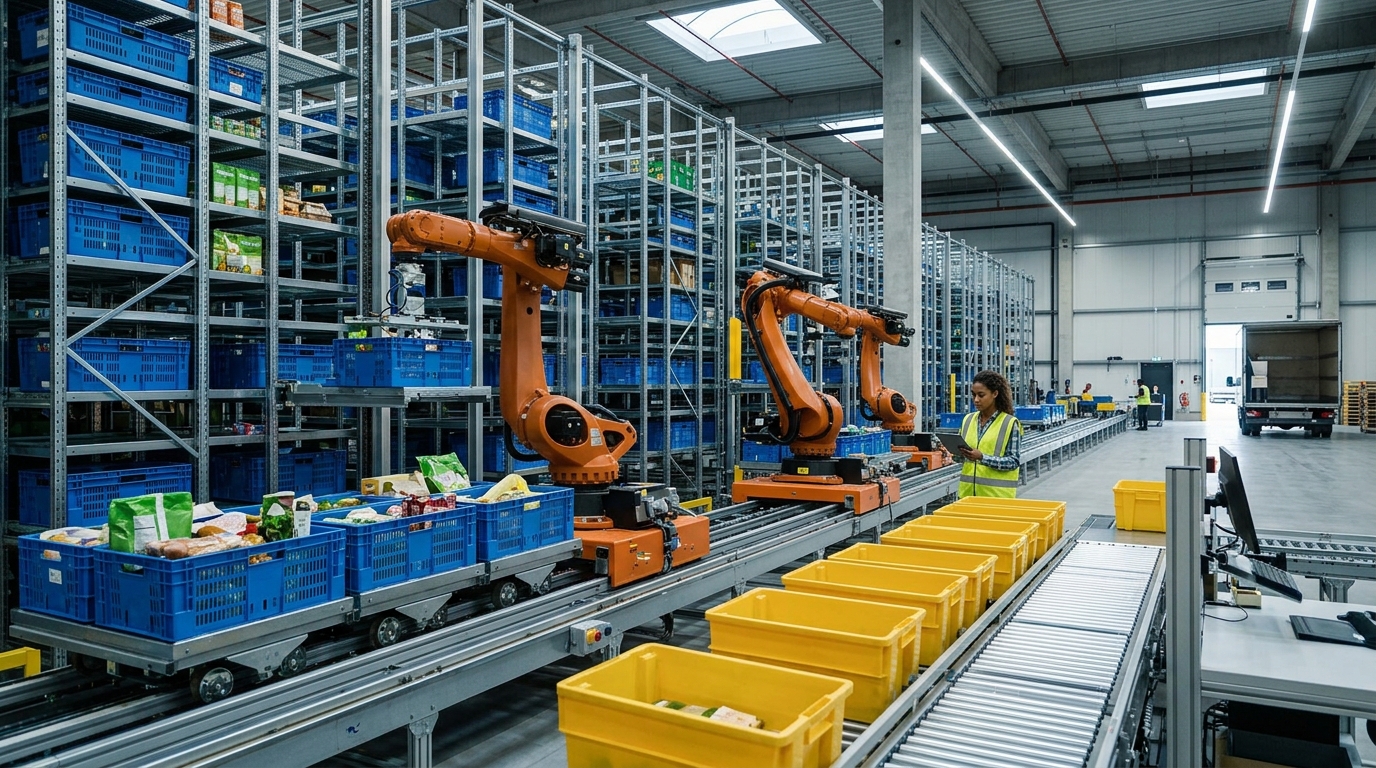
Walmart’s grocery supremacy has never been about price tags alone. The deeper advantage being built right now is structural, and it runs through hundreds of thousands of square feet of robotics, sensors, and automated storage systems quietly reshaping what it costs to put groceries on your doorstep.
A Pound of Gold Pays Your Annual Salary Now
In 1971, the average U.S. wage bought 125 pounds of gold. Today it buys just one. Under the guise of strengthening it, a 55-year policy has eroded the dollar’s purchasing power. Weiss Ratings senior analyst Gavin Magor calls this “Project Pyramid.” Foreign nations have noticed too. Global gold reserves are up 130% since 2015, while dollar reserves are at an all-time low.
Roughly 60% of Walmart’s U.S. stores now receive at least some freight from automated distribution centers, and Walmart has said that level of automation has helped keep shipping costs down in the “30% range” for many quarters. That matters because grocery delivery has historically been a margin destroyer. Automation is changing that arithmetic faster than most investors realize.
The Cost Advantage Is Real and Widening
Walmart executives have described automation’s impact in plain terms: more throughput with fewer people. The financial consequence is measurable. In a Walmart earnings call, CFO John David Rainey said shipping costs have been consistently down in the “30% range” over many quarters, and that the company has continued to see double-digit improvements.
These next-generation fulfillment centers use a combination of people, robotics, and machine learning, doubling storage capacity and daily order throughput compared with legacy sites, and enabling Walmart to reach 95% of the U.S. population with next- or two-day shipping. The network’s reach alone is a competitive moat that no mid-size grocer can replicate from scratch.
A 96% win rate using this strange trading approach
There’s a way to profit from the AI boom that has nothing to do with picking stocks.
Wall Street legend Larry Benedict calls it “AI Profit Loops.”
This pattern hits the market every 90 days. Over the last five years, it has come around 23 times.
In 22 of them, Larry handed his members multiple winning trades. That’s a 96% win rate, and the next “Loop” is due to hit on September 16.
Watch this presentation to learn how to get positioned today.
The Market Share Picture Is Complicated
Here is where the story gets interesting for investors. Costco, Amazon, and Walmart each saw their share of grocery sales increase over the past year, while major supermarket companies posted declines, according to Numerator data. The traditional grocery middle is hollowing out.
Amazon and Whole Foods, grouped together, saw the largest year-over-year increases, with their combined share rising from 6.4% in 2024 to 8% in 2026. That acceleration is the real competitive threat to Walmart, not Kroger. Still, Walmart has pointed to share gains in consumer packaged goods in recent reporting, with higher shopper traffic and higher spend per trip across multiple categories.
What It Means for Investors
In Walmart’s fiscal 2026 fourth-quarter materials, the company reported global e-commerce growth of roughly 24%, with U.S. e-commerce up about 27%. Walmart also said digital represented about 23% of total net sales, while sales through expedited store-fulfilled delivery channels grew more than 50% year over year. Those are not vanity metrics. They represent a fulfillment model where the store is the warehouse, dramatically compressing last-mile costs.
5 Nasdaq Stocks Under $5 That Aren’t What You Think
Most stocks under $5 come with a reputation. These don’t.
Each company on this list is tied to major trends like AI, cybersecurity, and next-gen infrastructure.
They may not have the spotlight yet, but they are building real businesses in real markets. That combination is not always easy to find at this price level.
Walmart’s fiscal 2027 capital spending guidance has been approximately $25 to $27 billion, with a focus on technology, supply chain, and customer-facing initiatives. That spending will pressure near-term free cash flow, which is the primary risk for income-oriented shareholders watching the dividend. The thesis is not without friction.
But the structural case is intact. Automation is converting what was historically a low-margin grocery operation into a platform with compounding cost advantages. Every quarter that Kroger and regional chains delay equivalent investment is a quarter Walmart’s lead widens. For patient investors, that is a durable edge worth owning.