
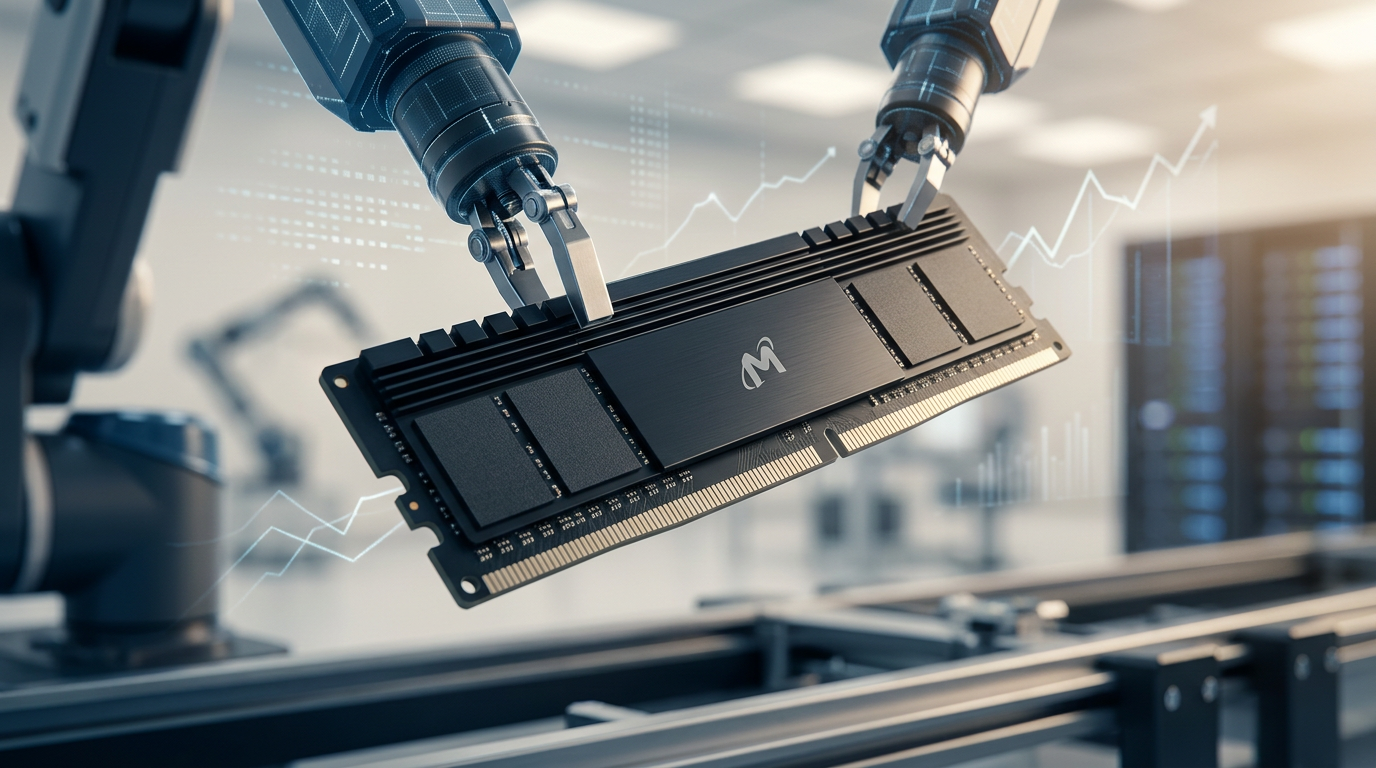
On May 26, 2026, Micron Technology closed at $895.88 — up 19.29% in a single session — briefly crossing a $1 trillion market cap for the first time in the company’s history. That move wasn’t retail noise. It was the market repricing a commodity business into a strategic AI infrastructure story, almost overnight.
Here’s the thing. UBS pulled the trigger first, raising its price target to $1,625 — nearly tripling its prior number. Melius Research followed with a $1,100 target and called AI-driven memory a structural “bottleneck” with the power to “steal market cap from old-school software names.” Mizuho reiterated Outperform with no clear visibility on when the supply-demand imbalance ends.
The numbers behind the thesis aren’t subtle. Micron’s fiscal Q2 2026 print came in at $23.86 billion in revenue — up 196% year-over-year — with a gross margin near 75%. Management guided fiscal Q3 to a record $33.5 billion ± $0.75 billion in revenue, with non-GAAP diluted EPS of $19.15 ± $0.40. The Street consensus for Q3 EPS sits around $19.55. The next earnings date is confirmed for June 24, after close.
What makes this different from prior cycles is the HBM dynamic. Micron CEO Sanjay Mehrotra confirmed the company is currently fulfilling only 50–65% of key customers’ medium-term demand — and the entire 2026 HBM4 production capacity is already sold out. That is not a supply chain hiccup. That is pricing power that doesn’t exist in commodity memory markets. Hyperscalers — Meta, Microsoft, Amazon, Alphabet — are collectively planning over $725 billion in 2026 capex for AI infrastructure, all of which requires advanced memory that must scale as model complexity grows.
What the Options Market Is Doing
With MU having surged roughly 68% year-to-date heading into the June 24 print, implied volatility in near-dated contracts has expanded meaningfully. The options market in MU hit 5x average daily volume on the session of the UBS upgrade, with the tape heavily skewed toward calls. Open interest has clustered in June and July expirations — traders positioning either for continuation through earnings or using the elevated IV environment to sell premium against a name that has already repriced sharply.
Slight tangent, but worth noting: the Direxion Daily MU Bull 2X ETF (MUU) has crossed $5 billion in assets, signaling that leveraged retail participation is now layered on top of institutional positioning. That creates a feedback loop on upside moves — and a sharp unwind risk if the June 24 print disappoints even slightly.
The Structural Bull vs. the Cycle Reality
The bull case is straightforward. Unlike previous semiconductor cycles where supply overexpansion collapsed prices, AI demand is outpacing new manufacturing capacity in a way that could extend well into 2027. Micron is also diversifying its fab footprint — spending more than $2 billion to expand its Manassas, Virginia facility — which anchors it as a strategic U.S. domestic supplier to automotive, defense, and industrial markets alongside the AI data center story.
The bear case is equally honest. Memory has always reverted. SK Hynix holds the dominant HBM position with Nvidia’s flagship platforms, and Samsung’s competitive pressure is a known risk. If AI infrastructure spending softens — or if the June 24 report shows any crack in the pricing dynamic — MU at $900+ is priced for perfection. A forward P/E below 8x sounds cheap until you remember the cycle can turn quickly.
Defined-Risk Framework
- Bull case: For traders expecting HBM pricing power to sustain through fiscal Q3 and Q4, a long call spread in the July expiration above current levels defines risk while capturing continuation through earnings.
- Bear case: For traders expecting mean reversion after a 68% YTD run, a put debit spread below key support levels ahead of the June 24 print captures downside without unlimited exposure to short gamma.
- Neutral case: With IV elevated post-move, a short iron condor structured outside the expected move for the June expiration targets premium decay in a stock that may consolidate after a 19% single-day surge.
The June 24 print will either confirm the re-rating thesis or expose the gap between narrative and execution. The options market is already positioning for both outcomes.