
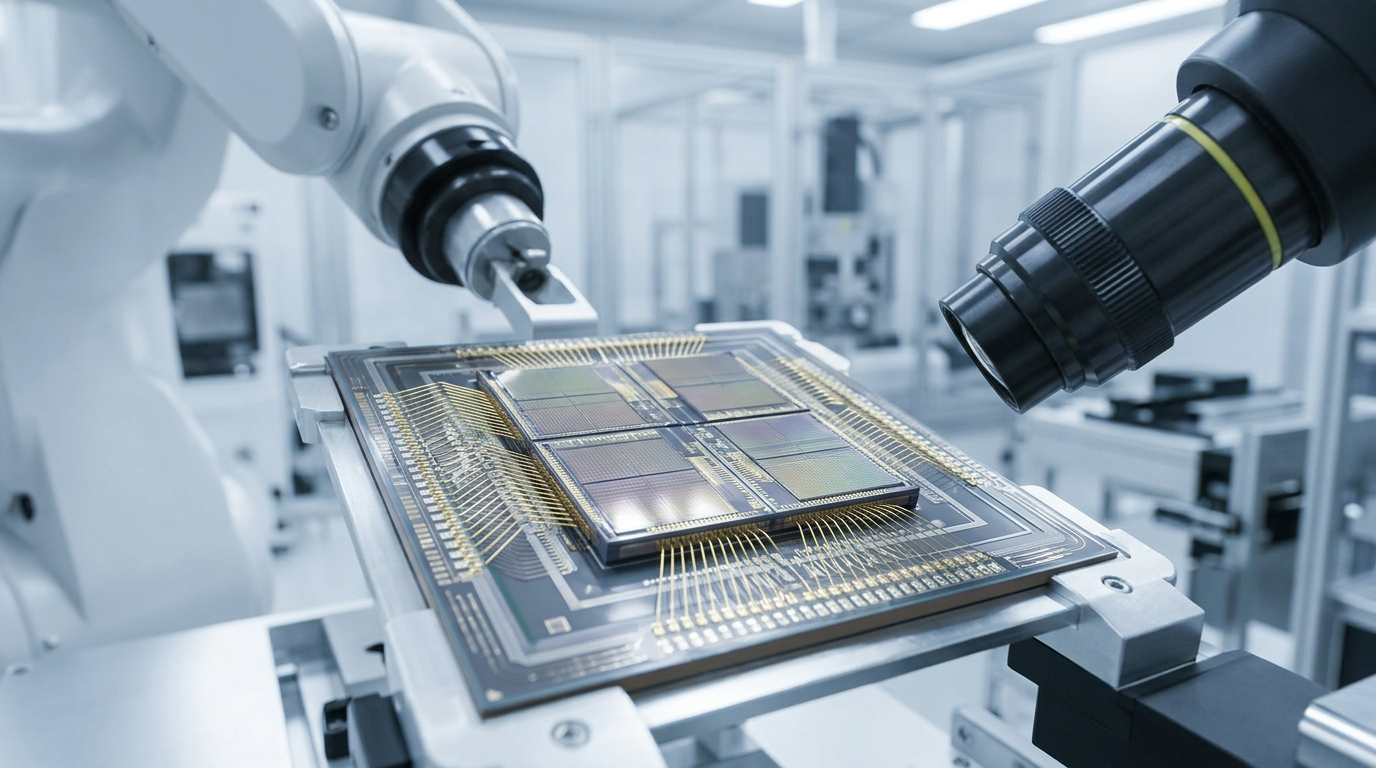
Start with a simple question: what happens when a GPU fails?
Not the chip. The package.
Because in 2026, the most expensive moment in semiconductor manufacturing is not the silicon. It is the millisecond before a multi-thousand-dollar AI accelerator gets stacked, bonded, and sealed and nobody ran the right inspection tool before it happened.
That is where this story begins. Not with Nvidia. Not with TSMC. With the specific, brutal physics of what it means to build an AI chip at scale.
The Force: Packaging Has Become the Bottleneck Nobody Priced
For two years, every institutional investor owned the same thesis. GPUs were scarce. Training demand was insatiable. Allocation queues were the only number that mattered. That was the first-order trade. It was correct. And it is over.
Advanced chip packaging has emerged as the single most critical bottleneck in the global AI supply chain in 2026. The silicon gets made. The problem is what happens next. Even when silicon dies are fabricated successfully, they cannot ship as functional AI accelerators without this backend process.
The scale is hard to overstate. TSMC is scaling CoWoS production from approximately 35,000 wafers per month in late 2024 to a projected 130,000 wafers per month by end of 2026. That is nearly a 4x increase in under two years. And it is still not enough to fully satisfy demand.
Here is the part the market has not fully processed.
The semiconductor packaging market is projected to reach $103 billion in 2026, driven by hyperscale data-center demand for AI accelerators. The capacity is expanding. But capacity expansion without yield control is just expensive waste.
Slight tangent, but it matters: the packaging process for a CoWoS-assembled AI accelerator involves stacking multiple high-bandwidth memory chips on an ultra-thin silicon interposer at tolerances measured in nanometers. With more components and interconnects placed into a single package, the number of potential failure points multiplies. A single chip or interconnect defect can compromise the entire multi-die package, resulting in costly yield loss.
This is where the third and fourth derivative of the AI chip trade lives. And it is where Wall Street is still largely looking away.
The Derivative Chain: From GPU to Yield Police
Follow the logic.
AI demand drives GPU shipments. GPU shipments require advanced packaging. Advanced packaging at scale requires near-perfect yield control. Yield control at nanometer tolerances requires inspection and metrology equipment. And that equipment — not the GPU, not the package, not the fab — is the least discussed, most structurally irreplaceable link in the entire chain.
As semiconductor nodes shrink below 5 nanometers and chip architectures incorporate 3D stacking, chiplets, and high-bandwidth memory, the number of process steps requiring inspection multiplies. Unlike conventional equipment that scales with wafer volume, inspection and metrology tools scale with process complexity. The more steps, the tighter the tolerances, the more catastrophic an undetected defect — and therefore the more inspection equipment a leading fab must deploy.
That dynamic — where complexity increases the value of process control faster than it increases the cost — is one of the rarest economic structures in industrial technology. It is essentially a hidden royalty on every AI chip that gets built.
The global advanced packaging inspection and metrology equipment market was valued at $890.9 million in 2025. It is expected to grow to $975.6 million in 2026 and reach nearly $1.07 billion in 2027, with the market forecast to reach around $2.2 billion by 2035. That is not a niche. That is a compounding toll booth embedded in the AI infrastructure stack.
The Company: Onto Innovation
Most people have heard of KLA Corporation. Dominant process control player. 58% overall market share. Well-covered. Rightly valued. Not the discovery here.
The discovery is Onto Innovation.
This is a company most general equity investors have never tracked. No earnings call soundbites on financial television. No viral analyst notes. A $14.5 billion market cap sitting at the exact intersection of advanced packaging complexity and AI-driven yield pressure and it just posted the best results in its history.
Onto reported record quarterly revenue of $291.9 million for Q1 2026, up 9.5% from $266.6 million in the prior-year period and nearly 10% higher sequentially. But the revenue number is almost secondary to what management said about the trajectory going forward.
Management stated they believe advanced packaging revenue will grow more than 50% in 2026. That is not a forecast hedge. That is conviction based on customer qualification wins that were already in flight when the quarter closed.
The company expects 2026 revenue growth of more than 30% and total 2026 revenue greater than $1.3 billion. And management forecasts over 30% revenue growth and operating margins above 30% by Q4, specifically citing strong AI compute demand and expanding advanced packaging and node businesses as key drivers.
The Product Nobody Is Watching
The Dragonfly G5.
It sounds like a racing drone. What it actually does is inspect 2.5D AI chip packages at a defect sensitivity of 150 nanometers — finding flaws no human eye can see and that, if missed, render a multi-thousand-dollar chip assembly worthless. Onto launched the Dragonfly G5 as a fundamentally new inspection and metrology platform delivering best-in-class throughput and enhanced sensitivity required to detect defects as small as 150nm, designed to be extensible for the next several generations of process technology inflections across front-end and advanced packaging applications.
The Dragonfly G5 system was qualified at a leading 2.5D logic customer and a high-bandwidth memory customer, while the Atlas G6 system was selected by a second logic customer for gate-all-around metrology. Customer qualification wins in this industry are not press releases. They are multi-year revenue commitments embedded in a fab production process. Once a tool is qualified, switching costs are enormous.
Onto said advanced nodes grew 13% in Q1 and are positioned for approximately 25% growth for the full year. Advanced packaging growing more than 50%. Advanced nodes growing 25%. These are not two separate stories — they are the same AI infrastructure cycle hitting Onto from both ends simultaneously.
The Rigaku Move Most Coverage Missed
The company agreed to buy a 27% stake in Rigaku for about $710 million, while the two companies work on X-ray process-control solutions for increasingly complex logic, memory, and advanced packaging structures. Most coverage reduced this to a balance sheet line.
What it actually represents is a strategic position in the next generation of metrology. Rigaku has over a 75-year history in X-ray with over $600 million in 2025 revenue, of which approximately 40% is related to the semiconductor industry. Optical inspection tools are reaching their physical limits at the most advanced nodes. X-ray metrology can penetrate packaging structures that optical tools cannot fully image. That is the capability gap Onto is positioning to fill.
Management expects near-100% margin licensing revenue from AI Diffract on Rigaku X-ray systems, potential additional Atlas G6 tool sales to Rigaku customers, and dividends estimated at roughly $7 million per year from the stake. The licensing piece is what matters structurally — software revenue layered on top of a hardware install base is how you build a durable operating leverage machine.
The Financial Structure
Q1 2026: $291.9 million revenue. 55.7% non-GAAP gross margins. 26.7% operating margin. EPS of $1.42, a 13% improvement versus Q4 2025.
For Q2 2026, the company guided revenue to $320 million to $330 million, and non-GAAP diluted EPS to $1.65 to $1.73. That is roughly 20% year-over-year revenue growth in a single quarter, and management was explicit that the back half of the year accelerates further from there. The company expects at least 50 basis points of gross margin improvement per quarter in Q3 and to exit Q4 with operating margin above 30%.
Operating leverage is the key mechanic. When advanced packaging revenue grows faster than total revenue, the margin structure expands non-linearly. Every incremental dollar of advanced packaging inspection revenue flows through at significantly higher margins than blended averages suggest.
On the analyst side, the upgrade cycle has been building. Cantor Fitzgerald raised its price target to $410 from $350 in late June. Oppenheimer lifted its target to $450 from $370. Morgan Stanley initiated with an Overweight rating. The consensus average sits near $370 against a stock trading around $317 as of early July 2026.
Scenario Framework
Bull Case
Advanced packaging revenue growth meets or exceeds the 50%-plus guidance. The Dragonfly G5 qualifies at additional 2.5D logic and HBM customers beyond the two already announced. Operating margin exits Q4 above 32%. The Rigaku software licensing revenue begins contributing faster than guided. Some analyst projections currently estimate EPS reaching roughly $9 to $10 by 2027. A re-rating toward peer-level multiples would imply price targets in the $430 to $450 range. Q2 earnings on August 6 confirm the trajectory without revision.
Base Case
Onto delivers against its greater-than-$1.3 billion full-year revenue guidance. Advanced packaging grows 45% to 55%. Operating margin exits Q4 at 29% to 31%. The average analyst price target currently sits near $370, with the stock trading around $317 as of July 8. Most of that gap closes over the following two quarters as the investment community catches up to the fundamental trajectory.
Bear Case
A pullback in AI capital spending from hyperscalers slows advanced packaging demand faster than expected. Geopolitical disruption to Taiwan’s semiconductor ecosystem delays customer qualification timelines. Supply-chain concentration in a few regions exposes buyers to geopolitical and export-control risk, while specialty materials and substrate shortages can throttle output during demand spikes. In a bear scenario, full-year revenue growth decelerates to 15% to 20% and margin expansion stalls, putting the stock at risk of returning toward the $250 to $270 range.
Active Trader Strategy Framework
The August 6 earnings date is the next hard catalyst. Management has set a specific, public bar: greater than 30% full-year revenue growth, greater than 50% advanced packaging growth, operating margins above 30% exiting Q4. Any shortfall against those specific targets creates headline risk regardless of whether the underlying business is healthy.
The technical picture heading into August 6 is worth monitoring. ONTO moved above its 50-day moving average on June 8, 2026, and the 10-day moving average crossed bullishly above the 50-day on June 11, indicating that the trend shifted higher. More recent momentum indicators have softened, which is actually constructive for positioning — it suggests the market has not already front-run the catalyst.
Key levels: $300 is significant near-term support. A close below that level on volume ahead of the August earnings would be a warning sign. On the upside, $340 to $360 is where near-term resistance clusters around several analyst targets. A clean break above $360 on post-earnings volume would likely trigger additional institutional accumulation and further upgrades.
Position sizing is the discipline here. Onto is a mid-cap semiconductor equipment name with genuine operating leverage and a clear structural demand driver — but the cyclicality risk is real. If AI capex fades faster than expected in late 2026, the entire equipment sector could face pressure. Sizing for the catalyst without overconcentrating on a single earnings date is the framework that survives to compound.
Why Most Analysts Are Still Late to This
Here is the honest read on why this trade is not yet consensus.
Market attention in semiconductor equipment is overwhelmingly concentrated on KLA and Applied Materials — the largest, most liquid names. Those are legitimate businesses. Well-covered for a reason. But that coverage concentration means the derivative opportunity sits in companies operating in the fastest-growing subsegment of semiconductor equipment without the institutional ownership base that would already have priced the growth in.
Onto Innovation is emerging as one of the most strategically important semiconductor equipment companies in the AI supply chain. While much investor attention remains focused on GPU manufacturers and memory suppliers, the next bottleneck increasingly lies in advanced packaging — the complex process of stacking, connecting, and inspecting AI chips and HBM memory at nanometer precision.
The GPU trade was first-order and crowded. The packaging capacity trade became second-order consensus. The yield and inspection trade — the thing that actually determines whether all that packaging capacity produces chips that work — is still third and fourth derivative. Still underowned. Still priced for a business growing at half the rate management has already publicly committed to delivering.
August 6 is where the market decides whether to keep looking away.
For informational and educational purposes only. Not investment advice. Trading involves risk, including loss of principal.