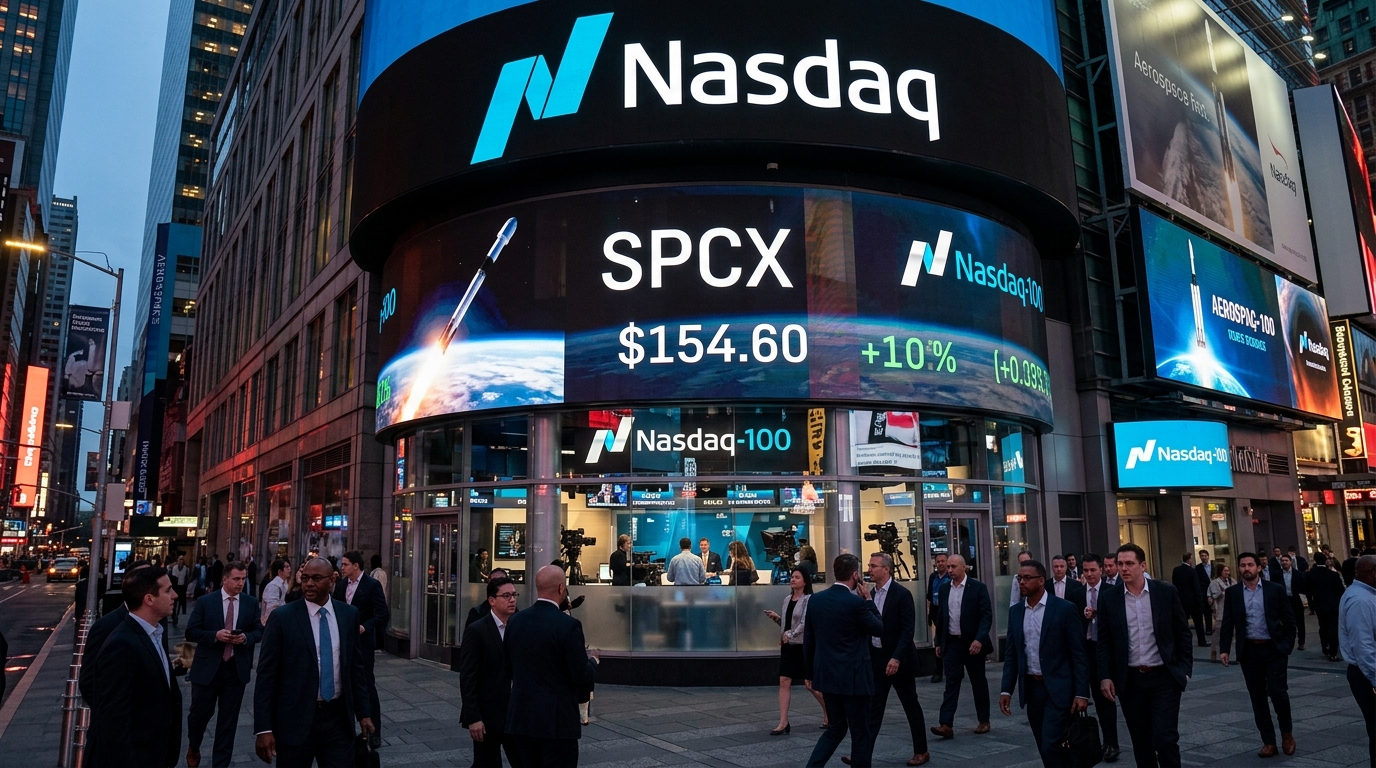
On June 12, SpaceX completed the largest IPO in financial history. It raised approximately $75 billion at a $135 IPO price, opened at $150, closed at $160.95, hit an intraday high of $225.64 within four days, then sold off hard to a low of $147.11 by June 23. As of July 2, SPCX is trading near the mid-$150s. The 52-week range is already $147.11 to $225.64.
That’s a ~$78 swing on a roughly $2 trillion company in less than a month. Now there’s a new event to trade around: Nasdaq-100 inclusion effective July 7.
The Forced Buying Catalyst
Nasdaq confirmed SPCX will be added to the Nasdaq-100 before the market opens on Tuesday, July 7. This is one of the first companies to benefit from Nasdaq’s new “fast entry” pathway, which took effect May 1, 2026 and allows eligible mega-cap new listings to become candidates for inclusion after 15 trading days rather than waiting for the traditional annual process.
The Nasdaq-100 is tracked by exchange-traded funds with more than $800 billion in assets. Every index fund, ETF, and benchmark-tracking institution that mirrors this index has to buy SPCX whether they want to or not. Precise estimates for forced passive buying from the Nasdaq-100 inclusion vary by product and final index weight, and should be treated as directional rather than exact.
What’s interesting is that this isn’t passive demand from people choosing to buy. It’s mechanical. Index rules mandate the purchase. That’s a different kind of flow than sentiment-driven retail or even institutional conviction buying.
The counterpoint: the float is tiny. Multiple reports around the IPO have put SpaceX’s initial public float at roughly ~5%. A small float against forced buying creates the conditions for outsized price moves, but it cuts both ways. When that forced buying is complete, the demand cliff is real.
What SpaceX Actually Is
The business isn’t just a rocket company. It includes launch services and Starlink broadband, and reporting around the IPO has also described an AI-related segment tied to Grok and xAI infrastructure.
Starlink subscriber counts and Starlink revenue figures cited below were not verifiable from primary, broadly credible public sources at the time of review, so they’ve been removed.
The Anthropic compute deal is significant and often underappreciated. Multiple reports say Anthropic will pay xAI $1.25 billion per month for compute through May 2029. Other details in this paragraph (including specific GPU counts, megawatts, a separate Google contract, and a precise 2026 revenue run-rate) could not be verified from credible primary sources at the time of review, so they’ve been removed.
The valuation math: at ~$157, the market cap is roughly ~$2.1 trillion based on the widely reported IPO valuation of about $1.77 trillion at $135 per share. Morningstar analysts have argued the IPO valuation looked overvalued relative to their fair value estimate, and a Truist study (reported contemporaneously with the IPO) highlighted that large, high-profile IPOs often experience severe first-year volatility.
Specific analyst-consensus price targets and buy/sell counts were not verifiable from a credible, citable consensus source at the time of review, so they’ve been removed.
What the Stock Is Actually Doing
SPCX hit an intraday high of $225.64 on June 16, just four trading days after the debut. By June 23, it had traded as low as $147.11. The round-trip was violent and fast. Since that low, the stock has recovered into the mid-$150s.
The stock’s first-week post-IPO pattern of surging and then correcting sharply is a documented pattern in high-profile IPOs. The key question now is whether $147 was the washout low or the beginning of a more extended correction.
SPCX is set to join the Nasdaq-100 Index about 15 trading days after its debut. Funds tracking the index may adjust positions ahead of the effective date, which can pull flows forward.
The July 7 Trade: Three Scenarios
Bull Case
The forced buying from Nasdaq-100 inclusion drives SPCX back toward and through the $175 level. Front-runners who bought in the $150 to $160 range exit into the flow. Any positive news on Starlink subscriber momentum or AI-related monetization adds fuel. A move toward $190 to $200 becomes possible if sentiment turns and the float dynamics squeeze short sellers.
Base Case
SPCX absorbs the index inclusion buying in an orderly fashion, grinds to $165 to $175 around the July 7 effective date, then settles back as the forced demand is satisfied. The stock trades in a wide range of $150 to $185 through the summer until the next earnings report provides the next major fundamental anchor. The $150 area holds.
Bear Case
The index inclusion was fully front-run and the buy-the-news, sell-the-fact dynamic kicks in. SPCX fades after July 7, drifting back toward $145 to $147 as retail momentum cools and the valuation overhang reasserts itself. The lock-up overhang and broader corporate-structure uncertainty can weigh on the multiple. Bears note the company is still losing money on a GAAP basis.
The Bigger Picture
SpaceX’s IPO has functionally reshaped the composition of the Nasdaq-100. Exchange-traded funds tracking the index hold more than $800 billion in assets, and SpaceX is expected to enter at less than 1% initial weighting—meaning it becomes a structural, automatic position inside those products, whether investors explicitly chose it or not.
S&P 500 inclusion timing and rules are more complex than a simple “one-year wait,” and this specific claim could not be verified as stated. More broadly, if SpaceX is ever added to the S&P 500, the passive buying wave would likely be larger given the scale of S&P 500 tracking capital.
The next scheduled earnings date is not reliably confirmed as August 6, 2026; at least one widely used market calendar currently shows an earnings date later in August. Between now and then, the key metrics active traders should track are: Starlink net subscriber additions, AI-related compute monetization, any Starship test milestones that validate the long-term launch economics thesis, and float dynamics as lock-up expiration discussions begin.
Active Trader Framework
The July 7 inclusion date is a dated, mechanical catalyst against a historically thin float. That combination has produced sharp moves in both directions in prior high-profile index additions. The clean technical trade is simple: the forced buying has a defined start date and ends relatively quickly. Traders should know their exit level before July 7 arrives.
Key support: $147 to $150. First resistance: $175. Post-IPO high: $225.64.
Volatility will be high. The stock has already demonstrated it can move sharply in either direction inside a single week. Position sizing and defined risk levels matter more here than almost any other name in the market right now.
The earnings report is the next real fundamental test. Until then, this is largely a technical and flow-driven trade. After earnings, the debate shifts back to whether Starlink, AI infrastructure, and Starship can generate the cash flow required to justify a ~$2 trillion starting point.
That answer is still weeks away. Right now, the market is focused on July 7.
For informational and educational purposes only. Not investment advice. Trading involves risk, including loss of principal.