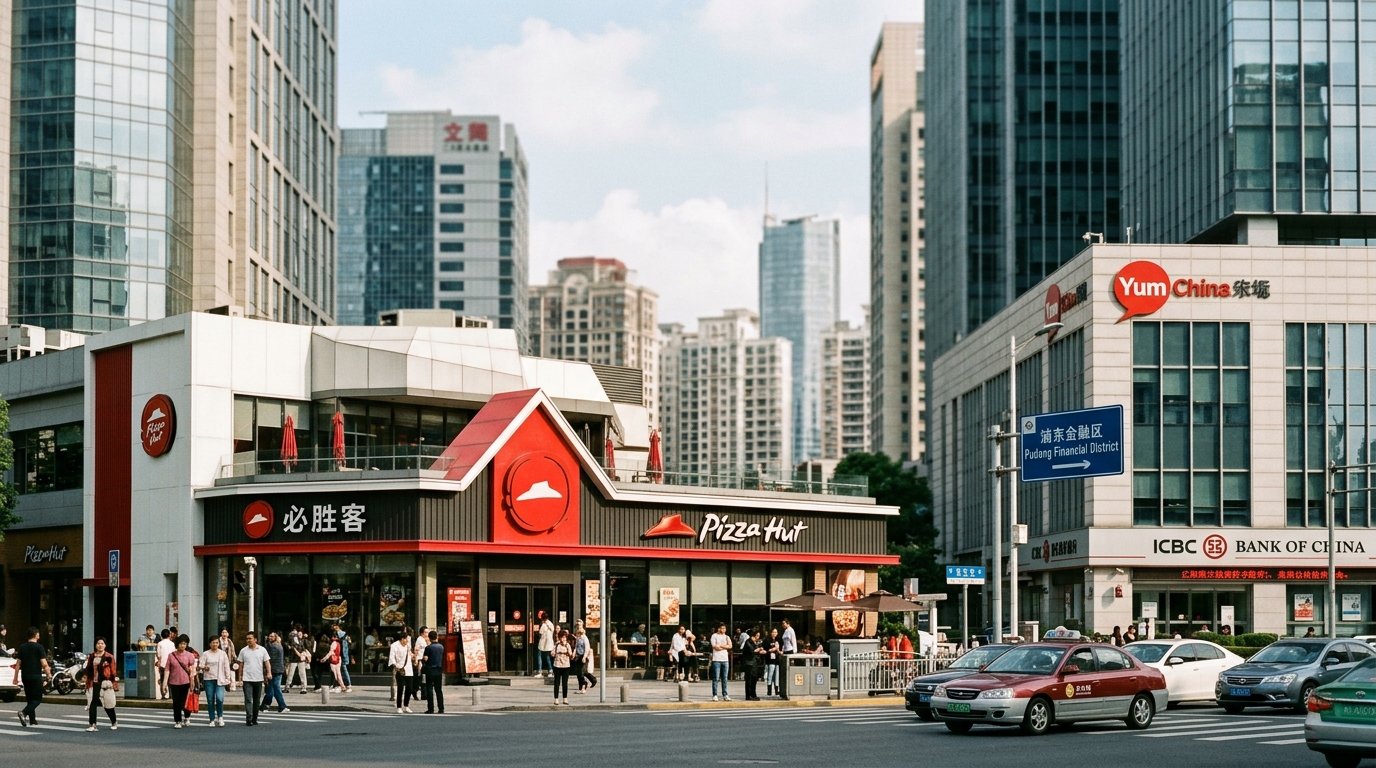
For 36 years, Yum China operated Pizza Hut in Mainland China while sending a 3% license fee to Yum! Brands. That arrangement ended on August 7, 2026, when Yum China completed its acquisition of the ownership of the Pizza Hut brand in Mainland China from Yum! Brands for $1.2 billion. The headline price matters less than what disappears along with it.
He Doesn’t Buy Gold. He “Skims” It.
A former hedge fund manager ranked in the top 1% by Barron’s has developed a three-step strategy to profit from gold – without buying a single ounce.
His followers have had the chance to collect $2,975… $3,781… and even $6,786 at a time. With a 73% win rate.
He calls it “Gold Skimming.” And he’s just revealed the full strategy for the first time.
The elimination of the 3% license fee payments to Yum! Brands is expected to add 2.8 percentage points to Pizza Hut’s restaurant and operating profit margins net of VAT. That is not a rounding error in the restaurant industry, where chains routinely battle over fractions of a margin point. For Pizza Hut China, it is the equivalent of a structural cost cut that requires no new customers, no menu price increases, and no operational overhaul to realize.
The numbers behind the deal are worth examining. For the year ended December 31, 2025, the acquired Pizza Hut China business reported revenue of $2.3 billion and operating profit of $183 million. In the first quarter of 2026, Pizza Hut delivered its 13th consecutive quarter of same-store transaction growth and its eighth consecutive quarter of operating profit margin expansion. A brand in that kind of momentum rarely trades at a price that makes a franchisee want to become an owner. Yum China moved anyway, betting that full control unlocks the next phase.
“My system said ‘SELL’ right before this stock tanked. Today, I’m shouting ‘BUY NOW’ before it soars.”
In 2023, Marc Chaikin’s system flashed bearish on an automotive company no one had yet heard of. The stock crashed 35%. Today, his system rates this company “Very Bullish” and Marc calls it a screaming buy thanks to a new “groundbreaking partnership” with Nvidia that hands this company the keys to the self-driving kingdom on a silver platter.
CEO Joey Wat called becoming the owner of the Pizza Hut brand in Mainland China a major breakthrough, and said that over the longer term, brand ownership should give Yum China greater strategic flexibility and allow it to respond more nimbly to market opportunities and consumer needs. That flexibility is not abstract. In 2027 and 2028, Yum China now expects to accelerate Pizza Hut’s net new store openings from the original target of over 600 to more than 800 per year.
Meanwhile, the broader enterprise kept performing. Second quarter 2026 revenue increased 13%, operating profit rose 14%, and diluted EPS grew 21% year over year. Same-store sales growth improved sequentially to 1%, led by the 14th consecutive quarter of same-store transaction growth. Fourteen straight quarters of traffic gains, across a network that is approaching 20,000 locations, is a durability that most Western quick-service operators would envy.
The broader China foodservice market is projected to reach $901.70 billion by 2031, expanding at an 8.04% compound annual rate from 2026. Yum China, as the largest restaurant operator in that market, is positioned to capture a disproportionate share of that growth simply by owning the category infrastructure: a digital supply chain, a large loyalty program, and now full brand rights to its second-largest concept.
Elon Musk, Larry Fink & Brian Armstrong Are ALL Piling Into This
It’s not AI, robotics, crypto, or rocket ships.
But Elon, Larry Fink, and Coinbase CEO Brian Armstrong are all quietly piling in.
Robinhood founder Vlad Tenev calls it a “freight train” that will “eat the entire financial system.”
Jeff Brown says it will unleash an impact 1,900 times bigger than Bitcoin…
90 times bigger than AI…
And will reshape the kinds of homes, cars, and investments you can own – in a way we haven’t seen in 400+ years.
Click here to uncover the $2 investing move Jeff is recommending.
Risks are real. Yum China used an offshore bridge loan equivalent to approximately $1.2 billion to finance the transaction, which introduces refinancing risk if credit markets tighten. The company has also disclosed a long-running national audit on transfer pricing by Chinese tax authorities regarding related-party transactions for the period from 2006 to 2015 that remains unresolved, and it could result in material tax penalties. Chinese consumer spending also remains uneven, and same-store sales growth of 1% in Q2 is not a number that commands a premium valuation on its own.
But the strategic logic holds. Yum China is no longer just a licensee managing someone else’s brand in the world’s largest dining market. It is now a brand owner with the margin structure, expansion runway, and operational depth to press that advantage. Investors who treat this only as a leveraged acquisition are missing the more durable story underneath it.