
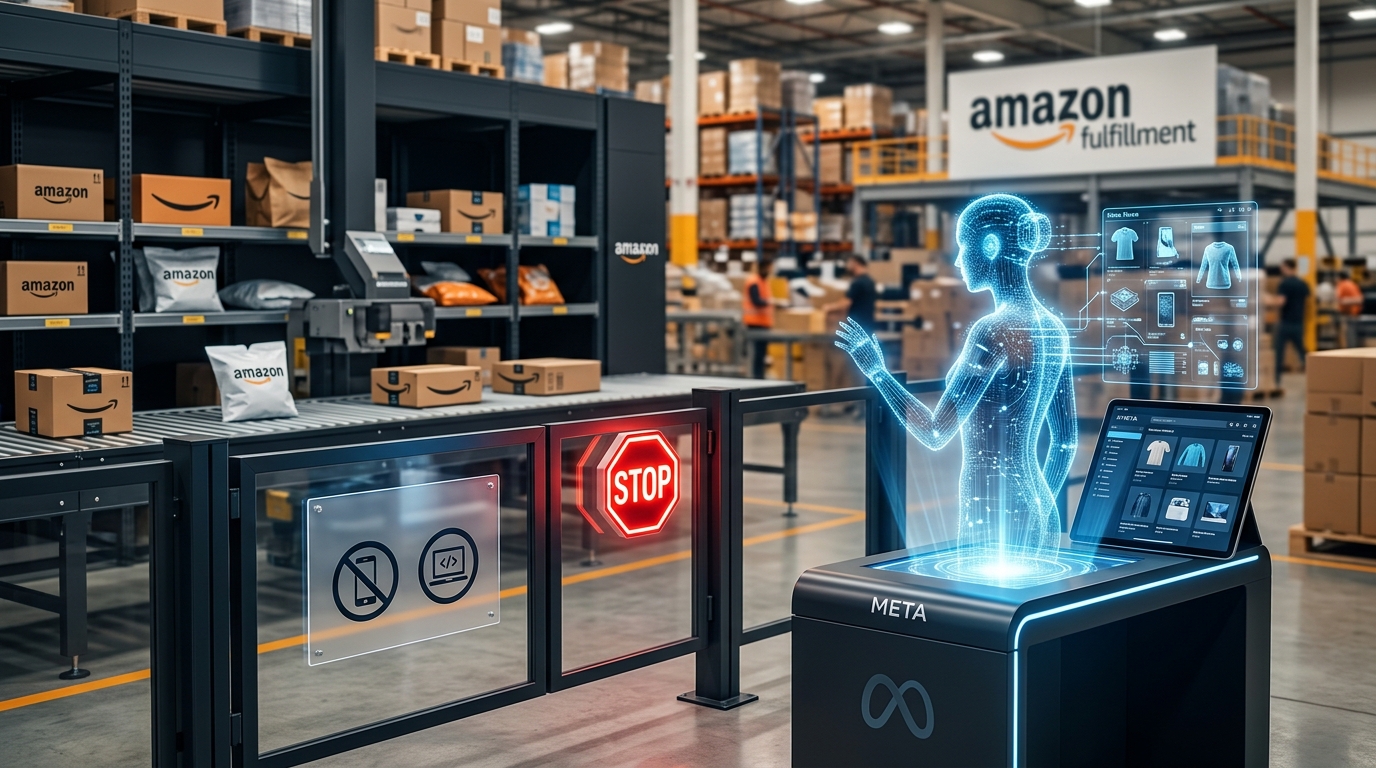
The most consequential fight in e-commerce right now is not about price, shipping speed, or ad spend. It is about which company gets to sit between a customer and a purchase. Amazon blocked Meta’s Muse AI agent from making purchases on its site Sunday night, escalating a dispute over who controls the online shopping experience when AI acts on a customer’s behalf.
Meta introduced Muse on September 8 as a personal agent that can open a browser, fill out forms, and check out on the user’s behalf. When a service does not provide a public API, Meta says Muse can operate it through a browser much as a human would. Amazon is not interested in that arrangement. In reporting on the decision, Axios said Amazon’s objections included that Muse did not identify itself when it browsed and that Amazon viewed the tool as creating privacy and security risks around customer accounts.
The standoff is especially notable because the two companies work together: Amazon has enabled checkout for select Amazon product ads inside Facebook and Instagram in the U.S. since late 2023, and Meta signed a multibillion-dollar agreement with AWS in April 2026 to run agentic AI workloads on Amazon’s Graviton chips. None of that goodwill survived Amazon’s decision to treat Muse as an intruder the moment it touched the checkout flow.
That sequence reveals something important about how this competition will be fought. Amazon’s position is that third-party tools that make purchases on behalf of customers should operate openly and respect service-provider decisions about whether or not to participate. Translated from the diplomatic language: Amazon owns the customer relationship at checkout, and no agent gets in without permission.
The contrast with Shopify could not be sharper. Shopify has been building out support for what it calls “agentic storefronts,” with product discovery flowing through Shopify Catalog by default, while Amazon took the opposite approach and blocked Meta’s agent entirely. Shopify is betting that volume and reach matter more than control. Amazon is betting the opposite.
For long-term investors, the positions each company is staking out matter more than today’s headlines. McKinsey has said that by 2030, the U.S. B2C retail market alone could represent an “orchestrated revenue” opportunity in the range of $900 billion to $1 trillion. For now, most AI shopping bots are being used to conduct research rather than complete purchases, and Gartner found in a January 2026 survey that consumer willingness to let AI make purchase decisions topped out at about 11% in lower-stakes categories. But consumer behavior shifts faster than most investors expect once the friction drops.
This move follows Amazon’s previous legal battles against other AI shopping agents, including Perplexity’s Comet, where courts have not spoken with one voice across every skirmish. Amazon is not improvising. It is executing a deliberate strategy to remain the gatekeeper of its own demand.
The deeper question for investors holding AMZN, META, SHOP, or W is whether Amazon’s closed stance protects its moat or cedes ground to whoever builds the most useful agent. If Muse becomes the layer that decides which store to buy from, Meta gains a new kind of leverage over merchants that goes beyond showing them an ad: it can become the checkout path itself. Amazon’s block delays that outcome. It does not prevent it.
The company that wins this boundary fight will do so not through a single block or a single partnership, but by making its platform the one agents and customers both prefer. That race is now open, and it started Sunday night.