September 26, 2026
Berkshire’s $365.5B war chest and Meta’s $81B reserve
Most investors track cash positions as a measure of safety. The more useful question in a potential downturn is predatory: which companies hold enough liquidity to simply purchase a weakened competitor, without a bank, without equity dilution, and without waiting for credit markets to cooperate?
Trump Put $25M Here. Most Investors Missed It.
A little-known AI infrastructure fund has reportedly attracted Trump’s attention.
Now ordinary investors may have a way to learn about it for around $15.
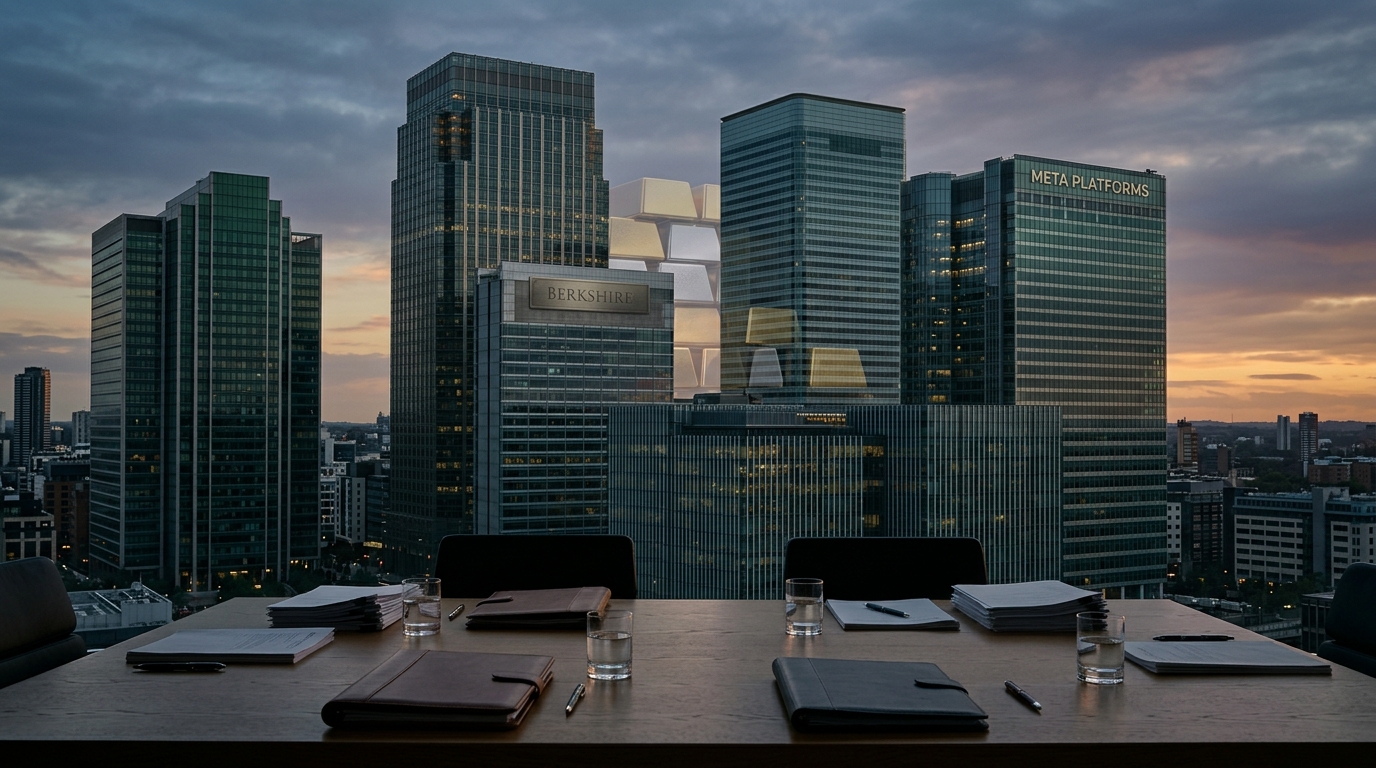
The scoreboard right now is extraordinary. Berkshire Hathaway sits at the top by a distance that defies comparison. At the end of Q2 2026, Berkshire held $365.5 billion in cash, cash equivalents, and short-term U.S. Treasury bills, down from $397.4 billion at the end of March. Even after Berkshire agreed to buy homebuilder Taylor Morrison for about $6.8 billion in equity value (about $8.5 billion enterprise value), the reserve remains so large it still rivals the combined cash and marketable securities of several mega-cap peers. That is not a defensive cushion. That is a franchise-buying fund.
The tech giants are a tier below but still formidable. What makes those figures interesting is what they can buy in a downturn, not what they represent today. Alphabet ended Q1 2026 with $127 billion in cash and marketable securities. Amazon reported $123.0 billion in cash, cash equivalents, and marketable securities as of June 30, 2026. Meta ended Q1 2026 with $81.2 billion in cash and marketable securities, setting it apart from smaller rivals, particularly in digital advertising, where a 20% stock market correction could compress Snap or Pinterest to acquisition-friendly prices within weeks.
The 3 Stocks Behind Elon Musk’s Sixth Venture
The biggest winners are not always the companies making headlines.
Enphase did not make solar panels. Yet its enabling technology helped send the stock as much as 520 times higher within six years.
Now Matt McCall believes he has found three small companies that could become essential to Elon’s next major venture.
The broader context matters here. Nonfinancial corporate balance sheets still show unusually large liquid-asset cushions by recent historical standards, reflecting a posture that hardened after the 2020 liquidity shock and the 2022 rate surge: hold more, borrow less, and wait.
The strongest companies can invest precisely when weaker competitors are forced to retrench. History validates that pattern. JPMorgan agreed to buy Bear Stearns in March 2008 at an implied $2 a share in the initial deal terms. Bank of America completed its purchase of Countrywide on July 1, 2008. The mechanism is always the same: the cash-rich predator moves when the prey cannot raise capital.
NASA Is Paying Elon Musk $843 Million to DESTROY a $150 Billion Space Station
It cost $150 billion and took 16 nations 13 years to build.
It is the most expensive object human beings have ever made.
Now SpaceX has been hired for what one outlet calls “the most expensive demolition job ever commissioned.”
But here is the part almost nobody has caught yet.
Elon is NOT building the replacement.
That job is poised to go to a company less than half a percent the size of SpaceX.
It is the real winner in this deal.
Former Wall Street CEO Dylan Jovine has laid out the whole story, including the tiny firm’s name.
Berkshire is the most watched case. Greg Abel became CEO on January 1, 2026, and the war chest heading into his tenure equaled roughly a third of the company’s roughly $1.1 trillion market value in late September 2026. Potential targets in energy, infrastructure, and healthcare are being discussed by analysts as Abel seeks to put the liquidity to work.
For investors, the practical takeaway is not to own Berkshire, Meta, or Alphabet because of their cash alone. It is to recognize that a downturn reshuffles industry structure in favor of whoever can write the largest check on the shortest notice. Many public companies have already suffered sharp peak-to-trough declines in 2026, meaning stressed sellers and discounted targets are closer than the index level suggests. The companies above are not waiting for conditions to improve. They are waiting for conditions to worsen.