Investors watching the desalination boom tend to focus on the plant builders: the firms designing and pouring concrete for massive seawater reverse osmosis facilities from Mumbai to Riyadh. That framing misses where the durable margin actually lives.
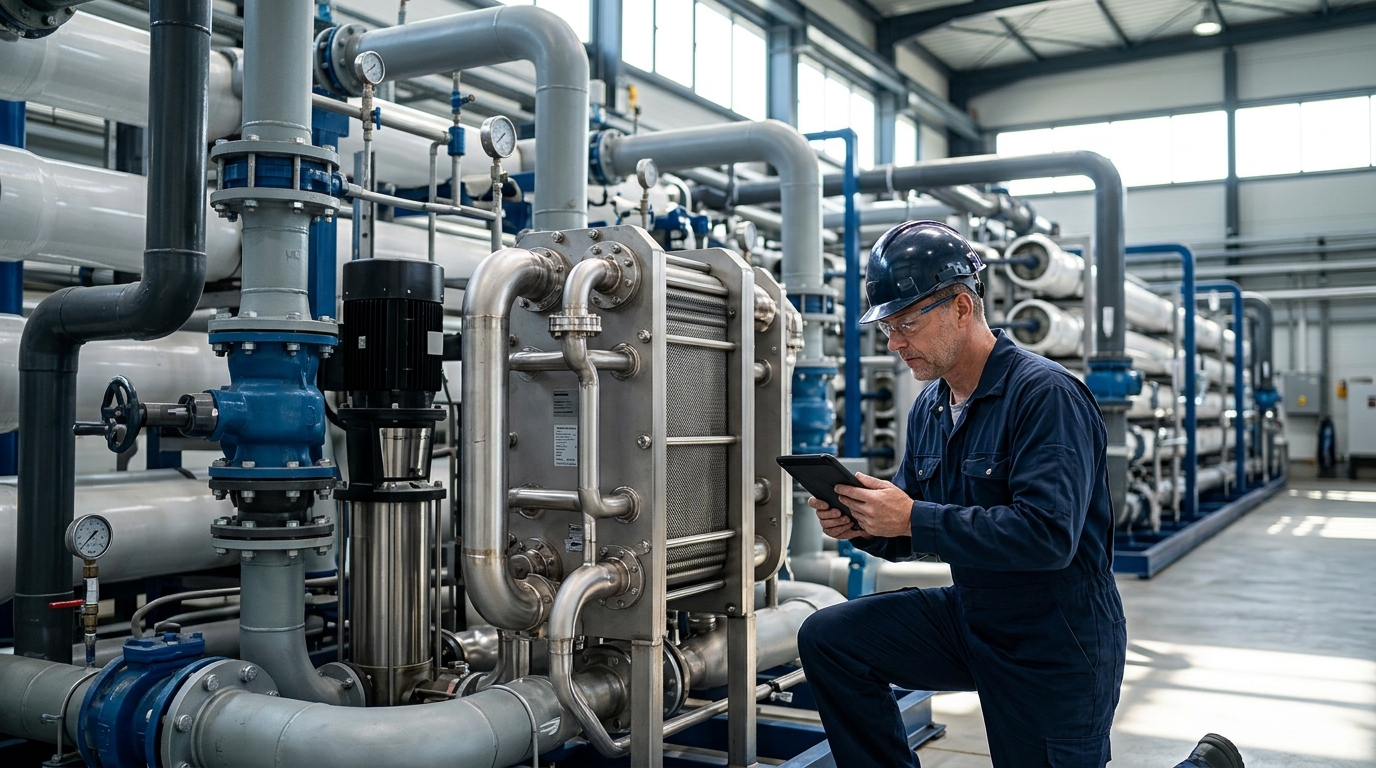
Inside every large reverse osmosis plant sits a pressure exchanger, a device that captures hydraulic energy from the high-pressure brine stream and recycles it back into the feedwater. Without it, energy costs make municipal desalination economically marginal. With it, the economics shift decisively. Energy Recovery Inc. (Nasdaq: ERII) says its PX technology can reduce seawater reverse osmosis energy usage by up to 60 percent versus systems without energy recovery, and the company says its devices operate in facilities that collectively clean about 48.5 million cubic meters of water each day worldwide.
On October 8, the company announced a new contract to supply its PX Q650 devices to a major new seawater reverse osmosis plant in Saudi Arabia that will rank among the top 10 largest desalination facilities in the world when completed. Saudi Arabia relies on desalination for roughly 70 percent of its potable urban water supply and has no permanent rivers or lakes, making energy-efficient desalination central to the Kingdom’s water security. The contract adds to a portfolio of PX Q650 orders secured across Asia and the Middle East earlier this year.
Energy Recovery launched the PX Q650 Pressure Exchanger in March 2026, describing it as the highest-capacity device in its Pressure Exchanger line and saying it delivers best-in-class performance on the market. Alongside the launch, the company said it doubled warranty coverage for high-pressure desalination pressure exchangers sold and shipped on or after March 9, 2026, including a 10-year warranty on ceramic components. The company also says the PX design has a single moving part and a design life of approximately 30 years, helping to reduce operating costs over the lifetime of a desalination plant. That durability matters because it embeds ERII into the operating cost structure of each plant for decades, not just its construction cycle.
The broader build-out driving demand is not slowing. Acwa, the world’s largest private water desalination company, said this year it had 32 projects under construction representing about 2.0 million cubic meters per day of water desalination capacity. IDE Technologies secured a contract from Mumbai’s municipal corporation to design and build a large-scale seawater reverse osmosis plant, and also signed a 20-year operations and maintenance agreement to manage the facility after commissioning. Those long-dated O&M contracts are significant: they lock in recurring membrane and component replacement revenue for technology suppliers over the life of the plant.
Long-dated operations and maintenance agreements follow the same logic across capital-intensive infrastructure. Liquid-cooling component suppliers face an identical dynamic, where qualifying a new vendor takes years and the installed base compounds.
In the U.S., the pressure is building from a different direction. The Colorado River region is heading into further supply reductions in 2026, reinforcing that imported water alone cannot offer long-term predictability for the Southwest. A memorandum of understanding signed June 3, 2026 by water authorities in Arizona, California, Nevada, and the federal Bureau of Reclamation sets a framework to explore how desalination and advanced water purification could strengthen long-term water reliability across the Southwest. If implemented, federal officials said it would be the first mechanism to facilitate interstate movement of desalinated or purified water within the seven-state Colorado River Basin. More municipal contracts for modular, energy-efficient plants may follow that political momentum.
The investment tension with ERII is real. Analysts have turned more cautious after the company reported a weaker second quarter. One firm cut its price target to $8.00. The stock is down sharply over the past year, and at a current price around $6.86, ERII remains well below where it traded a year ago. Insider selling over the past 12 months tempers that read.
Valuation compression on a structurally advantaged supplier is not unique to ERII. Transformer OEMs with record backlogs and compounding pricing power have also traded at discounts the market has been slow to close.
Desalination output is purchased under long-dated take-or-pay agreements, with governments and industrial anchors committing to purchase minimum quantities at predetermined rates, de-risking the revenue stream. Companies supplying the hardware those contracts depend on inherit a piece of that certainty. The question for investors is not whether desalination capacity will keep expanding. The data is unambiguous on that. The question is which layer of the value chain captures the most durable cash flow as it does.
The plant builders win the headline contracts. The pressure exchanger inside wins the next 30 years of operating savings.