A Denver startup called American Supercritical emerged from stealth last month with $8 million to commercialize factory-built supercritical CO2 power blocks. The pitch is straightforward: bolt an sCO2 system onto a gas turbine’s exhaust stack and extract up to 50% more electricity from fuel you are already burning, at one-tenth the footprint of a comparable steam system. No turbine modification. No re-permitting.
What the press release skipped was the valve problem.
Supercritical CO2 operates above 31°C and 74 bar, where the fluid behaves like a gas but carries the density of a liquid. At power-generation scale, the conditions get far more extreme. The DOE-backed STEP Demo plant in San Antonio is designed to test turbine inlet temperatures starting at 500°C and working up to at least 700°C, at pressures near 250 bar. At those conditions, the fluid finds every leak path a conventional valve has, and it can punish soft goods through swelling, blistering, and rapid decompression effects. That is why many designs push toward metal-to-metal sealing and carefully qualified materials rather than relying on standard PTFE- or graphite-based sealing in direct contact with the flow.
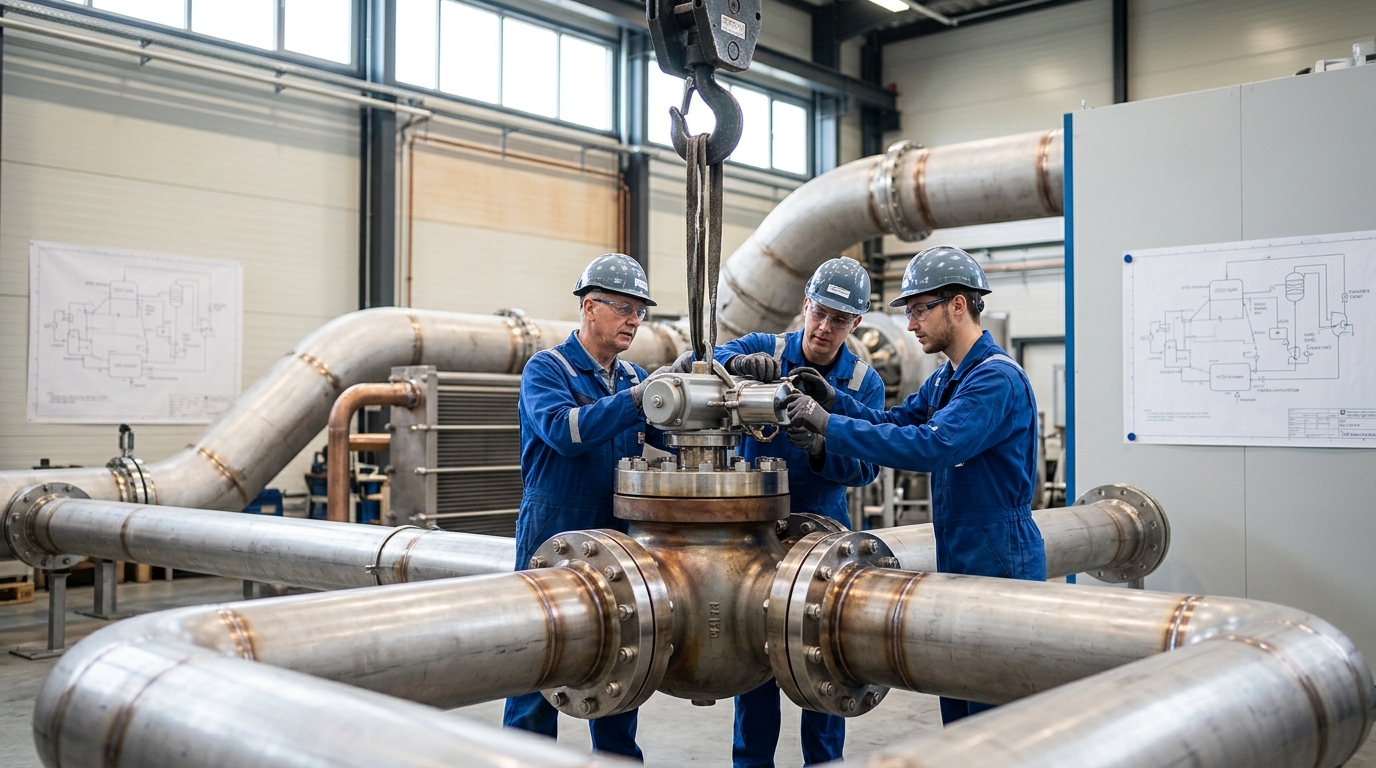
That forces the entire valve body into exotic nickel alloys. The turbine stop valve at the STEP facility was cast from Haynes 282, a high-temperature nickel alloy suited to high-temperature structural service. The finished casting weighed roughly five tons, described by the Department of Energy as the world’s largest Haynes 282 valve body casting. Engineers still encountered surface inclusions requiring grinding, weld repair, and re-machining before it could be installed. That single valve, for a 10-megawatt pilot plant, took years to certify.
Scale that problem to the 100-to-300 megawatt commercial plants the industry is now designing and the scarcity becomes obvious. Only a limited number of foundries can produce large, code-compliant nickel-alloy castings for valve bodies, and only a limited number of valve manufacturers have the test infrastructure to certify all-metal, gas-tight valves at Class 1500 pressures across sustained high-temperature sCO2 cycles.
Flowserve (NYSE: FLS) has spent the past two years assembling exactly that capability. It closed a $290 million acquisition of MOGAS Industries on October 15, 2024, adding severe-service isolation valves for power and process industries, then closed its all-cash $490 million acquisition of Trillium Flow Technologies’ Valves Division on June 30, 2026, adding a portfolio with long-established engineered-valve history and nuclear and power generation credentials. IMI Critical Engineering, meanwhile, has been winning large combined-cycle power plant valve contracts in the U.S., building the installed base and application data that can shorten qualification timelines for adjacent high-temperature, high-pressure services.
The same supply-chain logic applies one step upstream. Turbine blade and combustor lead times measured in years create the same gating dynamic for conventional gas turbines powering AI data centers.
The investment angle is not in the sCO2 turbine makers themselves, most of which remain pre-revenue. It is in the valve and alloy suppliers who gate every project. A developer choosing a turbine manufacturer can switch suppliers. A developer who needs a certified, all-metal sCO2 stop valve at 250 bar and 700°C has only a few realistic options globally, and switching can mean restarting a qualification process measured in years.
Haynes International (NASDAQ: HAYN), whose 282 alloy is associated with this class of high-temperature applications, and Flowserve, which has broadened its severe-service valve portfolio through acquisitions, sit close to that bottleneck. Neither is priced as an sCO2 play. Both benefit whether American Supercritical’s vision or NET Power’s Allam cycle or the DOE’s STEP successor reaches commercial scale first.
The turbine gets the headlines. The valve collects the toll.