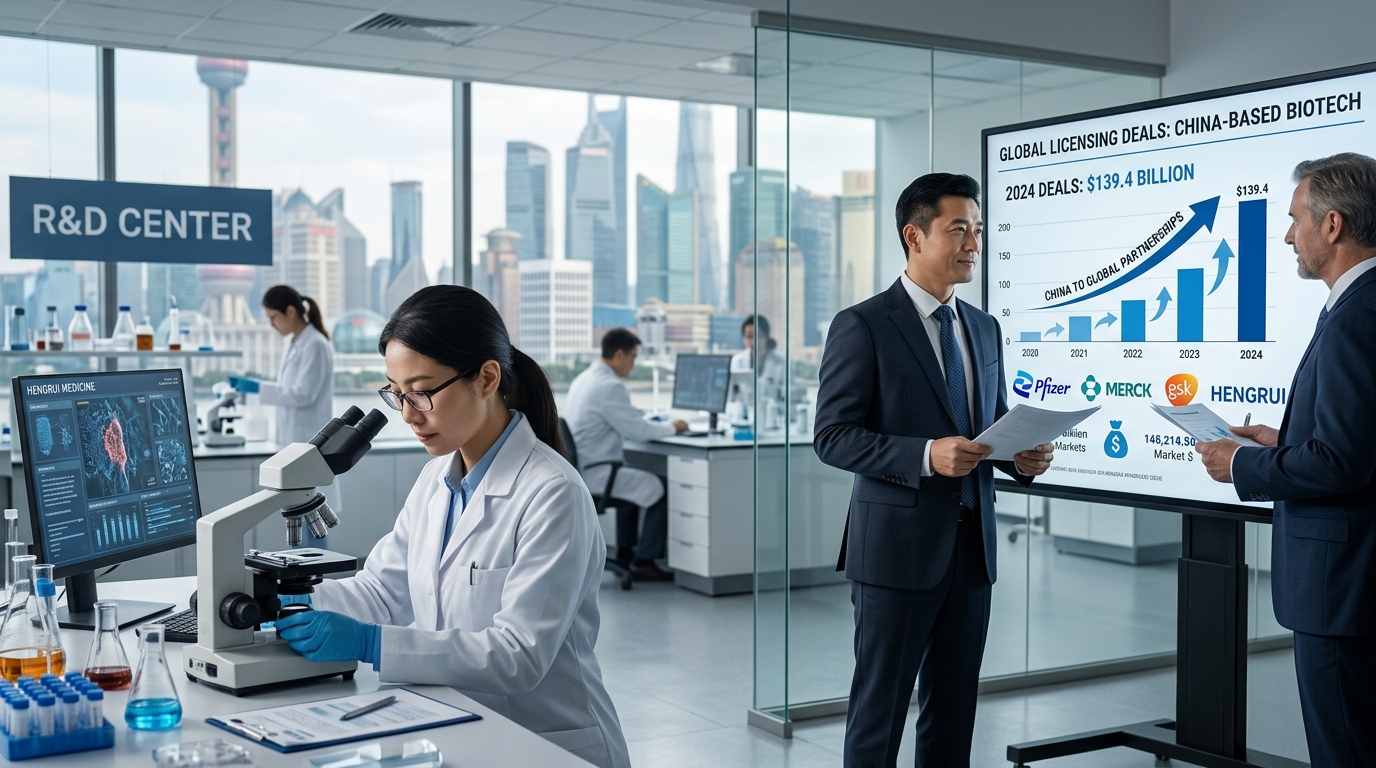
China-based biotech companies’ deals to license commercialisation of their drugs in overseas markets reached $139.4 billion for the year to October 8, according to PharmCube data reported Friday by Reuters Breakingviews, surpassing last year’s record with nearly three months still to run. The volume alone would be striking. The deal structure is the real story.
The investment committee debate worth having right now is not whether Chinese labs can produce drugs. That argument is settled. The question is whether Big Pharma’s research multiple still makes sense when a company like Hengrui is supplying the pipeline and has learned to keep the equity, the royalties, and the milestone upside for itself.
How the Terms Shifted
A few years ago, Western pharma bought Chinese molecules cheaply and kept nearly all of the value creation. That era ended quietly. Upfront payments and average deal values have climbed sharply, according to 2025 and 2026 market summaries from PharmCube and other banks and advisers tracking cross-border licensing. Chinese sellers are no longer accepting the same terms they accepted during the 2022 funding drought.
The Hengrui-BMS agreement, announced May 12, moved beyond a simple pipeline transfer: it involved not only the overseas licensing of four Hengrui oncology and hematology programs but also in-licensing of rights to four BMS immunology assets in the Greater China region, alongside five jointly discovered and developed programs. That is a structurally different negotiation than what Western pharma conducted with Chinese labs four years ago.
The Kailera Model
The Hengrui-Kailera transaction illustrates where the economics are heading. Hengrui licensed global rights (excluding Greater China) to three GLP-1 programs to Hercules CM Newco, a newly formed U.S. entity backed by investors including Bain Capital, in a package that included $110 million in upfront and near-term payments, up to $5.925 billion in development and sales milestones, and a 19.9% equity stake. Renamed Kailera Therapeutics, the company listed on Nasdaq in April.
Kailera raised $625 million in an upsized IPO, making it the largest U.S. biotech IPO in years, not the largest biotech IPO on record. Hengrui collected an upfront, locked in milestones, and retained equity that could benefit if the platform works. That is a different risk profile than licensing out a molecule and waiting for milestone triggers that may never arrive.
The same week, Hengrui entered a $2.6 billion out-licensing agreement with Novo Nordisk for the oral weight-loss drug HRS-1596, announced September 29. Novo Nordisk obtained exclusive rights outside Greater China, with the $2.6 billion potential value including a $300 million upfront payment and additional milestone-contingent amounts. Hengrui also retained royalties on net sales.
What This Means for Western Pharma
China-origin biopharma assets represented 50% of global large-cap pharma deals with upfronts above $50 million in the first quarter of 2026, and 75% of total upfront dollars in that group, according to a J.P. Morgan analysis of DealForma data. ING has estimated that China will account for about a third of all new innovative molecules in global pipelines in 2026, up from 4% in 2014. At some point, that concentration raises a question institutional investors are only beginning to ask aloud: if Pfizer, AstraZeneca, and Merck are sourcing this much of their innovation from Chinese labs, what exactly is their internal R&D budget paying for?
Companies that had no leverage during the 2022 funding drought now face a genuine choice: license out for near-term cash or hold an asset and develop it alone. The firms with real late-stage execution will increasingly choose to hold, which raises an uncomfortable possibility for buyers. If Hengrui decides the next obesity program is worth running to approval internally, AstraZeneca and Pfizer compete for whatever it chooses to share.
Stocks to Watch
Hengrui Pharma is the clearest beneficiary of the structural shift. It is simultaneously a licensor, an equity holder in U.S. vehicles, and a royalty recipient across multiple programs in oncology, metabolic disease, and respiratory. Recent market-cap estimates put Hengrui in the low-to-mid $40 billions.
Pfizer (PFE) and AstraZeneca (AZN) have made the largest commitments to Chinese-sourced pipelines. AstraZeneca’s $18.5 billion collaboration with CSPC on long-acting weight-management peptides and Pfizer’s $10.5 billion oncology deal with Innovent Biologics each rank among the largest transactions of 2026. Both companies now carry meaningful exposure to deal execution risk in Beijing.
Merck (MRK) has been more selective but not absent. Merck paid $588 million upfront to enter the PD-1/VEGF space through LaNova Medicines. Merck has also disclosed an upfront payment related to a license agreement with Jiangsu Hengrui Pharmaceutical, but the company has not consistently detailed the program or the upfront amount in public summaries, so investors should treat deal-size shorthand with caution.
XBI, the U.S. small-cap biotech ETF, faces a less obvious but more systemic pressure. If the most competitive early-stage molecules are originating in Jiangsu and Shanghai rather than Boston and San Diego, the premium historically assigned to U.S.-based discovery-stage companies needs rethinking. Capital that once funded American preclinical programs is now funding NewCo vehicles built around Chinese IP. That is the reallocation worth watching.