The concrete industry is on the verge of a biological revolution, and nobody talks about the gas company making it possible.
Self-healing concrete, seeded with dormant Bacillus bacteria that wake when water enters a crack, seal it with calcium carbonate, and go dormant again, is moving from research panels to real infrastructure. In one widely cited field trial tied to the Materials for Life (M4L) project, researchers from the Universities of Cardiff, Bath, and Cambridge constructed multiple in-situ concrete panels at the A465 Heads of the Valleys Highway upgrading project, including panels using bacterial self-healing technology developed at the University of Bath. Life-cycle assessment work on carbonate-precipitation approaches suggests meaningful emissions savings are possible under certain assumptions, but the exact percentage varies by pathway, inputs, and boundary conditions. Multiple market-research firms now put the global self-healing concrete market in the neighborhood of $100 billion in 2026, with forecast growth rates often quoted above 20% annually.
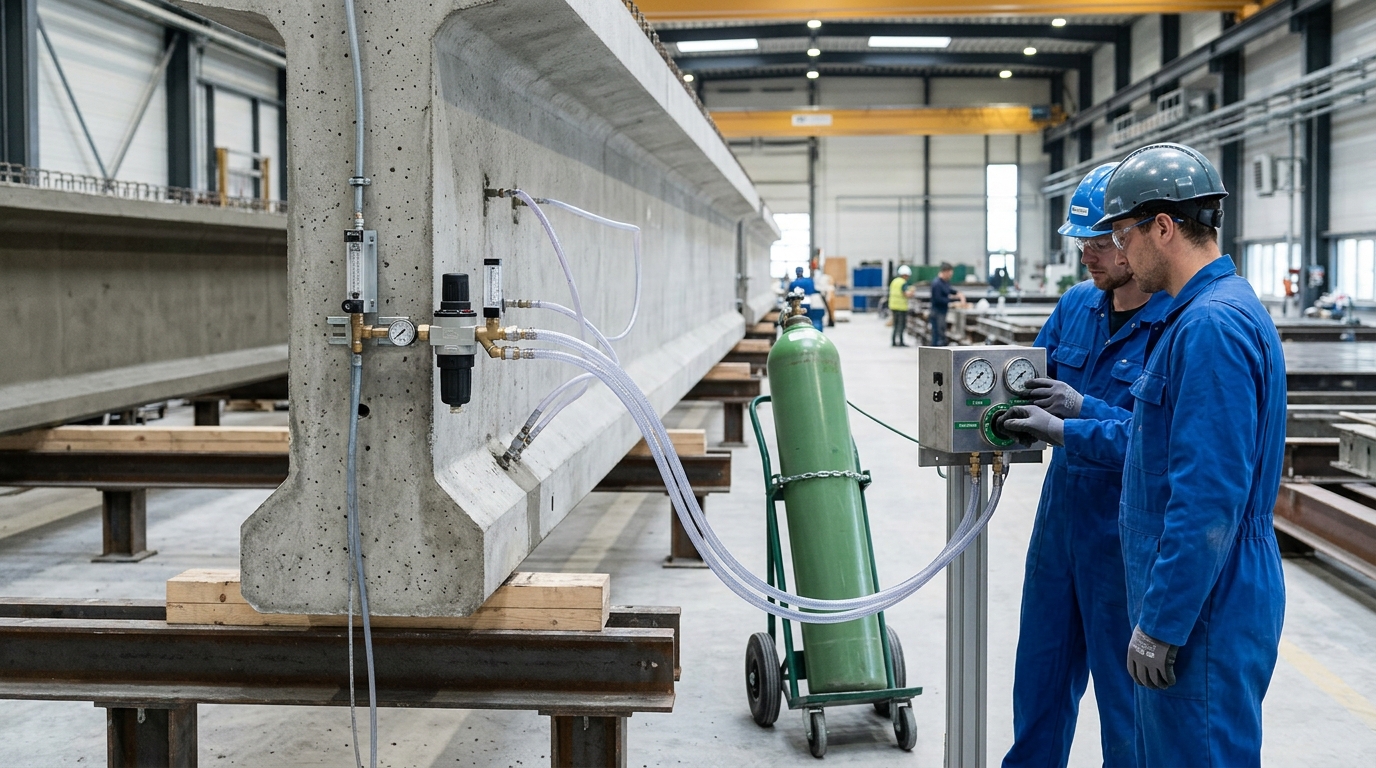
Here is what gets overlooked. Every step of bacterial concrete production, from the bioreactor fermentation that cultures Bacillus spores to the curing environment required for calcium carbonate precipitation, can depend on precisely controlled industrial gases. Oxygen is required for many aerobic carbonate-precipitation pathways, while classical denitrification-based routes proceed under anoxic conditions, and oxygen can suppress parts of the denitrification enzyme system. When organic calcium sources such as calcium lactate are oxidized, carbon dioxide is generated and can convert to CaCO3 in the presence of calcium ions under alkaline conditions. Nitrogen can be used to blanket parts of industrial fermentation and handling to limit unwanted contamination or oxidation. These are not peripheral inputs. Without them, the biology fails.
That is where Linde plc (LIN) enters. Linde supplies atmospheric and process gases, including oxygen, nitrogen, argon, and carbon dioxide, along with technologies and engineering solutions aimed at improving customer productivity and efficiency. The company also markets construction-focused gas applications including concrete curing, concrete cooling, cryogenic ground freezing, and water treatment. Extending that footprint into biomanufactured building materials is less a strategic leap than a natural adjacency.
The financial case for LIN does not rest on bioconcrete alone. Linde reported second-quarter 2026 sales of $9.289 billion, up 9% year over year, and an adjusted operating profit margin of 29.5%, according to its July 31, 2026 earnings release. In its Q2 discussion of growth investments, management highlighted a record $8.1 billion sale-of-gas project backlog. Q3 earnings are scheduled for October 29, 2026. Wall Street consensus estimates cluster around earnings of $4.52 per share on revenue of about $9.16 billion, based on widely used earnings calendars.
What construction biotechnology adds to that picture is a durable new end market still in early innings. Some market reports claim infrastructure is the largest slice of self-healing concrete demand, but the precise 2026 share is not something investors should treat as settled fact without seeing the underlying methodology. Separately, regulators in Europe have been pushing harder on whole-life carbon and embodied-carbon accounting, and decarbonization pressure on cement and concrete is rising through policy, standards, and procurement guidance. Every new bioconcrete batch plant that scales is a potential long-term gas supply customer.
Risks are real. The market faces high upfront costs compared to traditional concrete, slowing adoption especially in cost-sensitive regions. The major engineering challenge is protecting bacteria during mixing and curing, since concrete’s high pH and mechanical shearing can be lethal to many organisms unless they are shielded or encapsulated. And Linde’s construction exposure is still small relative to its electronics or healthcare end markets.
For investors tracking where specialty gas demand grows next, the link between Linde’s existing infrastructure and the biomanufacturing supply chain for next-generation building materials is worth watching. The quiet enabler of tomorrow’s self-repairing bridges is already publicly traded.