AMD’s data center segment more than doubled year-over-year in Q2 2026 to $6.7 billion, representing 58% of the company’s $11.5 billion in total revenue. The Helios rack-scale platform, which AMD has said is on track to begin production shipments in the second half of 2026, is positioned to drive that second-half acceleration. But inside those 246-kilowatt enclosures sits an engineering problem that the revenue figures do not yet reflect.
The Spike Nobody Shows in the Slides
Raw thermal design power figures can mask a vulnerability specific to Transformer workloads: voltage emergencies driven by rate-of-current-change events. The highly synchronous, bursty execution of Attention layers can create microsecond-scale power spikes that destabilize power delivery networks, forcing conservative static guard-band throttling that degrades energy-to-solution margin. At rack densities AMD is targeting with Helios, that problem does not stay academic.
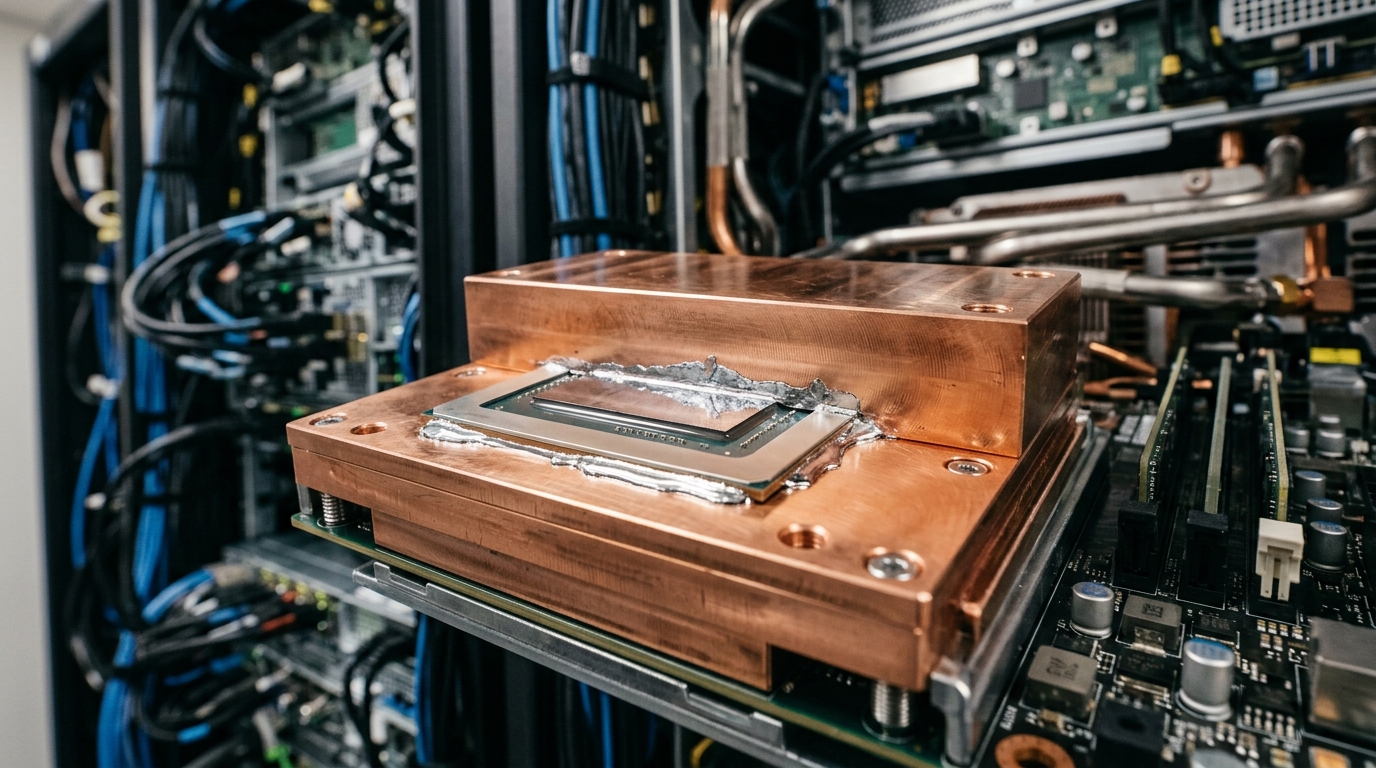
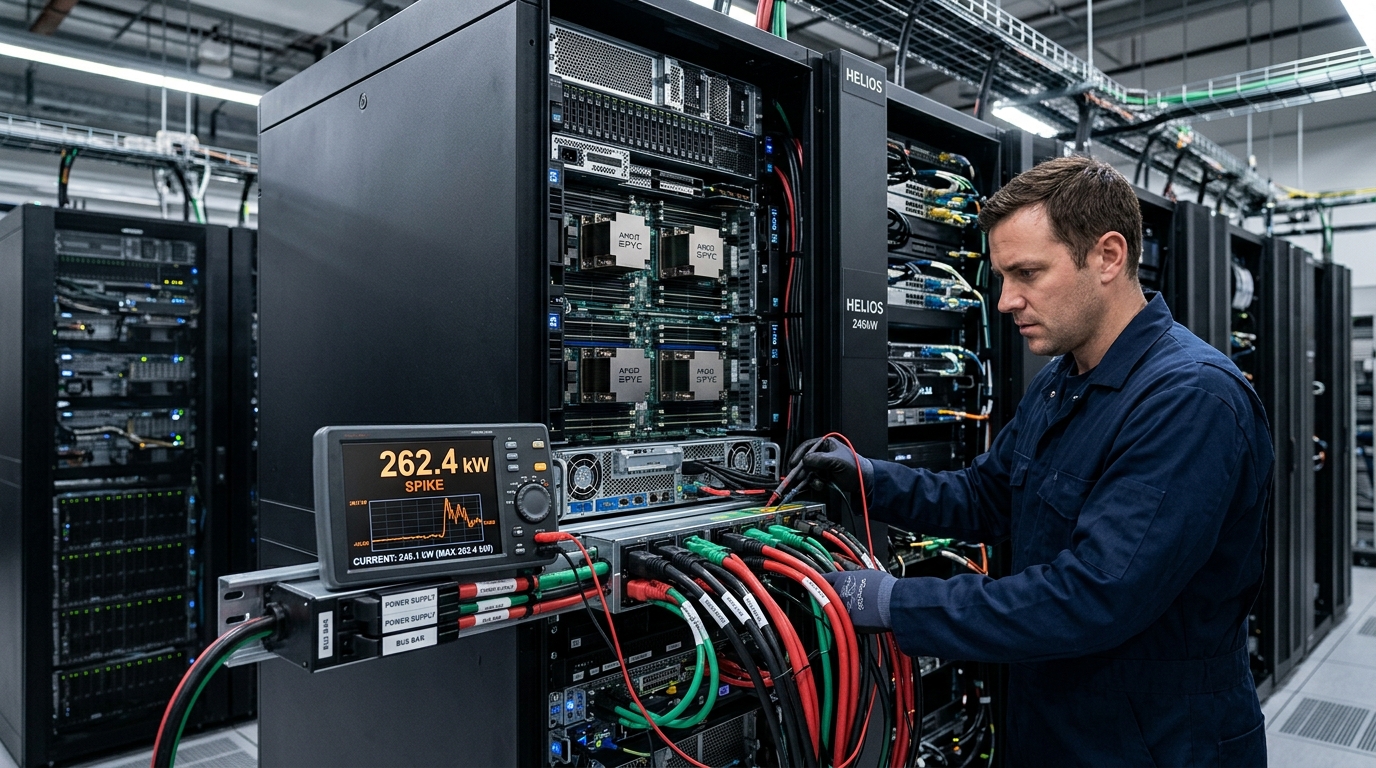
Each Helios rack integrates 72 GPUs, 31 TB of HBM4, and up to 2.9 exaflops of claimed AI compute. All of this is powered by a 50-volt liquid-cooled DC bus bar at the back of the system that under load can deliver between 225 and 245 kW of power. The MI455X GPU at the center of that rack carries a per-chip power draw estimated north of 2 kilowatts, a figure derived from Helios rack power budgets and the reason AMD limits Helios compute trays to just four MI455X units rather than packing in more.
What the Architecture Actually Does
Power for the system is provided by a 50-volt busbar, mirroring the broader industry trend toward busbars for rackmount servers, which simplify assembly and maintenance by streamlining power delivery to each rack while reducing cable clutter. Schneider Electric’s jointly developed Helios reference design is built around high-density liquid-cooled racks up to 246 kW, with modular AI clusters scaling to as much as 10.4 MW, integrating medium- and low-voltage electrical distribution, cooling, and physical infrastructure around the AMD platform.
The EPYC 9006 SP7 platform is positioned by AMD for high-density agent sandbox execution, with up to 256 cores and 512 threads to support greater numbers of agents per watt of energy. That CPU acts as host for each quartet of MI455X GPUs inside the compute tray. AMD’s Helios management software stack includes components such as AMD Fabric Manager for GPU partitioning and isolation, alongside health monitoring, telemetry, RAS, and automation. The software layer matters here: telemetry-driven power coordination is the primary tool for managing burst events that static hardware guard-bands miss.
Scenarios and Stock Implications
Bull case: AMD validates firmware-level power capping across the full Helios stack before it reports fiscal Q3 2026 results on November 3, 2026. Customers including Anthropic, which AMD says has committed to deploying up to 2 gigawatts of AMD Instinct MI450 Series GPUs in Helios rack-scale solutions with the first gigawatt starting in the first half of 2027, begin cluster-scale rollouts without facility derating incidents. Company revenue lands at the high end of the $13.0 billion ± $0.3 billion Q3 revenue outlook AMD gave with Q2 results. The forward multiple, recently shown around the low-80s on Yahoo Finance, holds on execution.
Base case: Power management stabilizes across single-rack deployments but multi-rack cluster configurations require facility-side buffers that add three to six months of qualification time. AMD enters the second half with momentum as Helios ramps, and its Q3 outlook of about $13.0 billion (plus or minus $0.3 billion) reflects the ramp cadence, not a clean vertical step. The software gap in ROCm’s attention kernel support extends the qualification timeline.
Bear case: Voltage emergencies tied to Attention layer execution surface at scale in multi-rack deployments, requiring firmware throttling that cuts effective utilization. Customers defer orders to the Instinct MI500 series, which AMD has said is coming in 2027. AMD’s Q3 revenue comes in below the midpoint of its guidance range, and the stock revisits levels seen before the July Advancing AI event.
What Traders Should Watch
AMD reports fiscal Q3 2026 on November 3, 2026. The data center margin line, not the revenue headline, is the tell. A 31% segment operating margin in Q2 on $6.7 billion of data center revenue is strong; any sequential compression will signal that power qualification costs are running through cost of goods sold. Watch commentary on Helios deployment velocity and whether Lisa Su quantifies booked gigawatts versus installed gigawatts. That gap is where the power management question lives.