
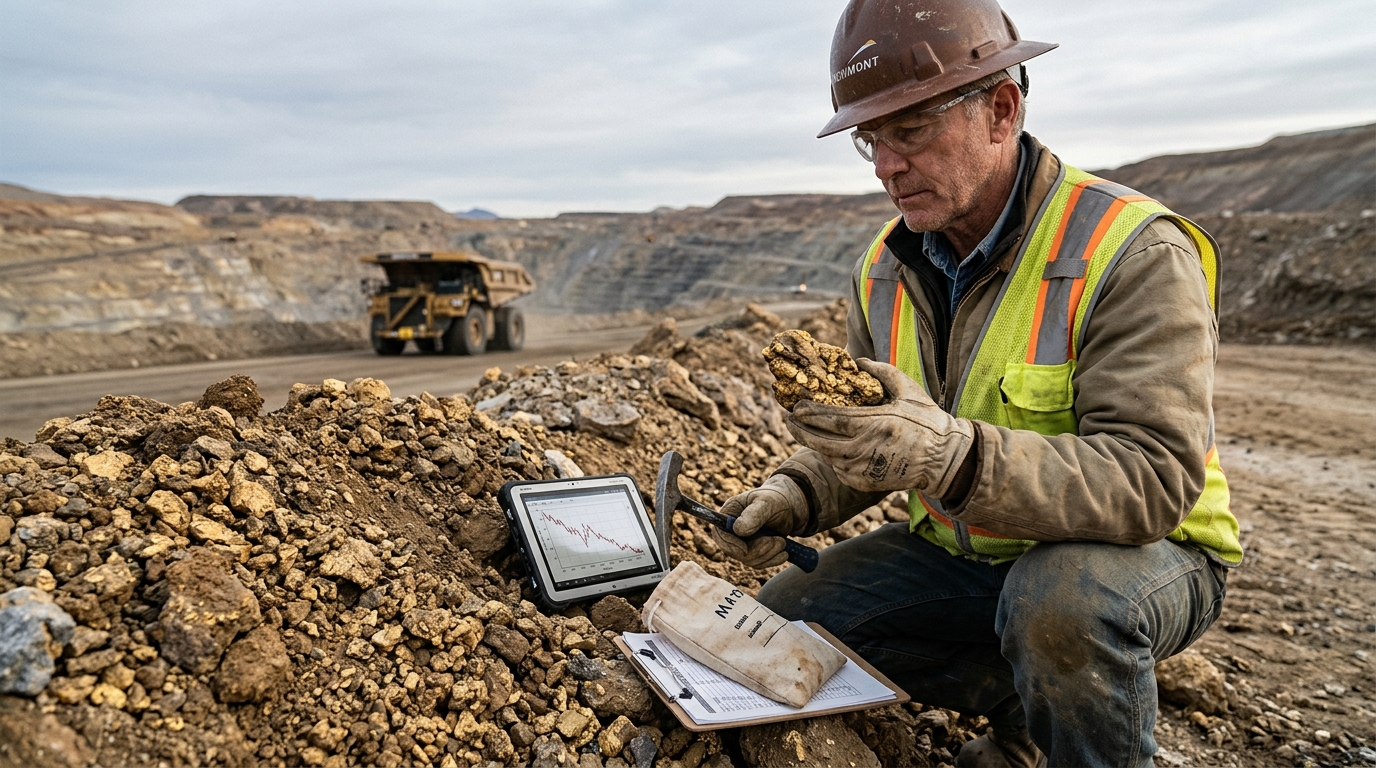
Gold has cooled. Spot prices have been lower in recent weeks, including around the mid-$4,000s per ounce in mid-October. That alone would be a manageable footnote for Newmont Corporation (NEM). The complication is that NEM also hit its all-time high closing price of $134.86 on August 25, 2026, and the shares have since retreated into the low $110s before recovering to the $118 range. Thursday’s Q3 report, due after the close on October 22, 2026, arrives with the Street watching two numbers closely: how far costs have climbed, and whether Newmont’s buyback pace can hold.
The Business
Newmont is the world’s largest gold miner by output, operating assets across North America, Australia, Africa, Latin America, and Papua New Guinea. The production model is straightforward: dig gold, sell it at spot, control the cost per ounce well below the realized price, and return the difference to shareholders. That math worked spectacularly in Q1 and Q2. Adjusted EBITDA reached $3.8 billion in Q2 2026, with adjusted net income of $2.10 per share, while gold all-in sustaining cost (AISC) came in at $1,621 per ounce against an average realized price of $4,414 per ounce. The spread was nearly $2,800. Newmont returned $1.9 billion to shareholders via dividends and share repurchases in Q2 2026, and the company has said it has reduced its share count by more than 100 million shares since February 2024.
Why Wall Street Is Paying Attention
Q3 matters because Newmont is trying to prove that this is not just a gold-price story. Investors will be looking for confirmation that higher prices are still flowing through to free cash flow while costs stay within guidance, and that capital returns remain intact even if the gold price is no longer rising.
What’s Driving the Opportunity
Even with spot having retreated from earlier highs, Q3 was still a far richer pricing environment than any quarter in 2025. The structural case for owning NEM rests on two things beyond Q3: the production trough and the buyback program. Production guidance for 2026 stands at approximately 5.26 million attributable ounces, a planned step-down due to mine sequencing, a trough year before the expected rebound in 2027. Longer-term production growth is supported by the completion of a Boddington stripping campaign in 2026, enabling access to higher gold and copper grades beginning in 2027, and the completion of Tanami Expansion 2 in the second half of 2027. If investors can tolerate the trough, the 2027 cost profile should improve materially. The $6 billion buyback, authorized in early 2026, adds a return-of-capital floor under the thesis.
What Could Go Wrong
Three things deserve honest scrutiny before Thursday. First, costs. Newmont’s full-year AISC guidance is $1,680 per ounce, a notable jump from 2025 levels. Management has flagged that costs can move quarter to quarter with mine sequencing and sustaining capital timing, so an ugly AISC number can hit sentiment quickly even in a strong gold tape. If AISC prints above $1,800 on a co-product basis, the margin story softens fast. Second, production. Q2 saw attributable gold production of about 1.3 million ounces, and the company has been clear that 2026 is weighted to the second half. If Q3 is muted again, the market may start treating the 2027 rebound as farther away than it looks on paper. Third, the buyback’s sustainability at a softer spot price. If gold stays materially below its earlier-year high, the free cash flow engine that funds buybacks runs at lower pressure.
The Bottom Line
NEM at roughly $118 trades at about 11.6 times forward earnings, which is cheap for a company that generated $2.2 billion of free cash flow in a single quarter. But cheap relative to what? Newmont heads into Q3 earnings with higher gold prices supporting revenues and margins, but weaker production and higher costs could weigh on results. The stock is worth buying on Thursday’s report if management can demonstrate two things: AISC tracking toward the $1,680 full-year guidance rather than above it, and buyback continuity despite the softer gold backdrop. If co-product AISC runs above $1,900 again or the buyback pace slows materially, the margin-and-returns story that has driven NEM higher over the past year will need a reset. Thursday decides which version of Newmont investors are actually owning.