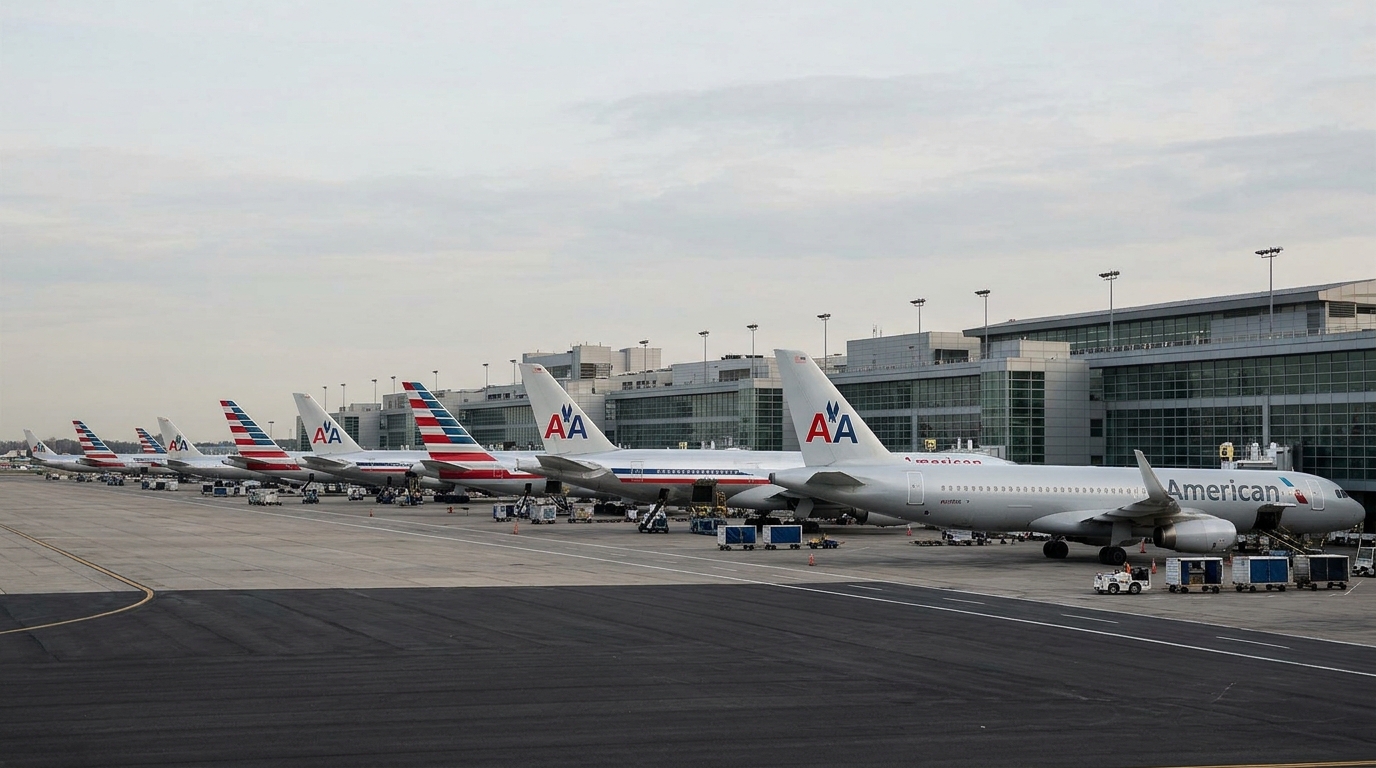
American Airlines posted a revenue record on Thursday and still managed to deepen its full-year loss forecast. That combination tells you everything about the trade developing right now: long energy producers, short the carriers writing them the biggest checks.
The Numbers Behind the Thesis
American’s total revenue reached $16.3 billion in the third quarter, growing 19.3% year over year and exceeding the high end of previous guidance. That is genuinely impressive. Fuel expense increased by $1.9 billion year over year, with an average fuel price of $3.85 per gallon compared to $2.37 per gallon in the prior year. The airline has said it does not hedge fuel. Every dollar of Brent’s move falls directly to the income statement.
American now expects to lose between $1.00 and $1.60 a share on an adjusted basis in 2026. In July, it had forecast a range spanning from a loss of 65 cents to a profit of 65 cents. The company said fuel expense for the full year is expected to be more than $7 billion above 2025 levels. Management also signaled restraint ahead: CEO Robert Isom said American expects network growth in 2027 to slow from 2026 levels given elevated fuel prices.
This Is Not an American Airlines Story. It Is a Sector Story.
American is the fourth major U.S. carrier to cut its 2026 forecast this month because of a spike in fuel costs. The sequence matters. Delta reported an all-in fuel cost of $3.61 per gallon for the September quarter, with adjusted fuel expense of about $4.1 billion, up 62% year over year, and then cut its full-year earnings guidance to $5.10 to $5.60 from a July range of $6.50 to $7.50. Southwest was the third major carrier to lower its 2026 outlook, alongside Delta and United, with United CEO Scott Kirby saying carriers should prepare for fuel prices to remain elevated through 2027. United is guiding to about $4.80 a gallon in the fourth quarter. Southwest expects about $4.55 a gallon in the fourth quarter, based on the forward fuel curve as of October 15.
Four carriers. Four guidance cuts. One cause.
The Commodity Backdrop Is Not Softening
Oil prices climbed about 4% to a five-month high on Thursday after Houthi attacks in Saudi Arabia stoked concerns of further supply disruption. Brent futures settled at $113.17 a barrel while WTI closed at $99.47. Separately, reports said Saudi Aramco instructed staff to evacuate its headquarters in Dhahran as the situation intensified. That is not a geopolitical footnote. That is a supply-risk premium with legs.
Brent’s Thursday close was its highest since May 4. Overbought conditions that recur without reversing are continuation signals, not exhaustion signals.
The Trade
Airlines are the most direct, most leveraged expression of higher crude on the short side. They cannot hedge quickly, they cannot cut capacity overnight without destroying revenue, and demand is just strong enough that management keeps promising a fuel recovery that Brent keeps denying. American, with no hedges and a full-year loss now forecast at the midpoint of $1.30 per share, is the clearest expression of that dynamic.
The pair is straightforward: the same Houthi-driven supply fear that lifts energy producers crushes unhedged carriers. Jet fuel is airlines’ biggest expense after labor, and at $113 Brent, the math does not work for AAL or LUV regardless of how strong passenger volumes are. DAL and UAL fare better structurally but are still being dragged lower by the same cost structure.
Watch $115 Brent as the next level. A break there likely forces another round of guidance reductions before year-end. Airlines confirm the short; energy producers confirm the long. That is the sector rotation in one sentence.