Most investors following Trane Technologies (NYSE: TT) know the data center angle. Fewer are tracking where that story gets significantly more defensible: the semiconductor fabrication plant.
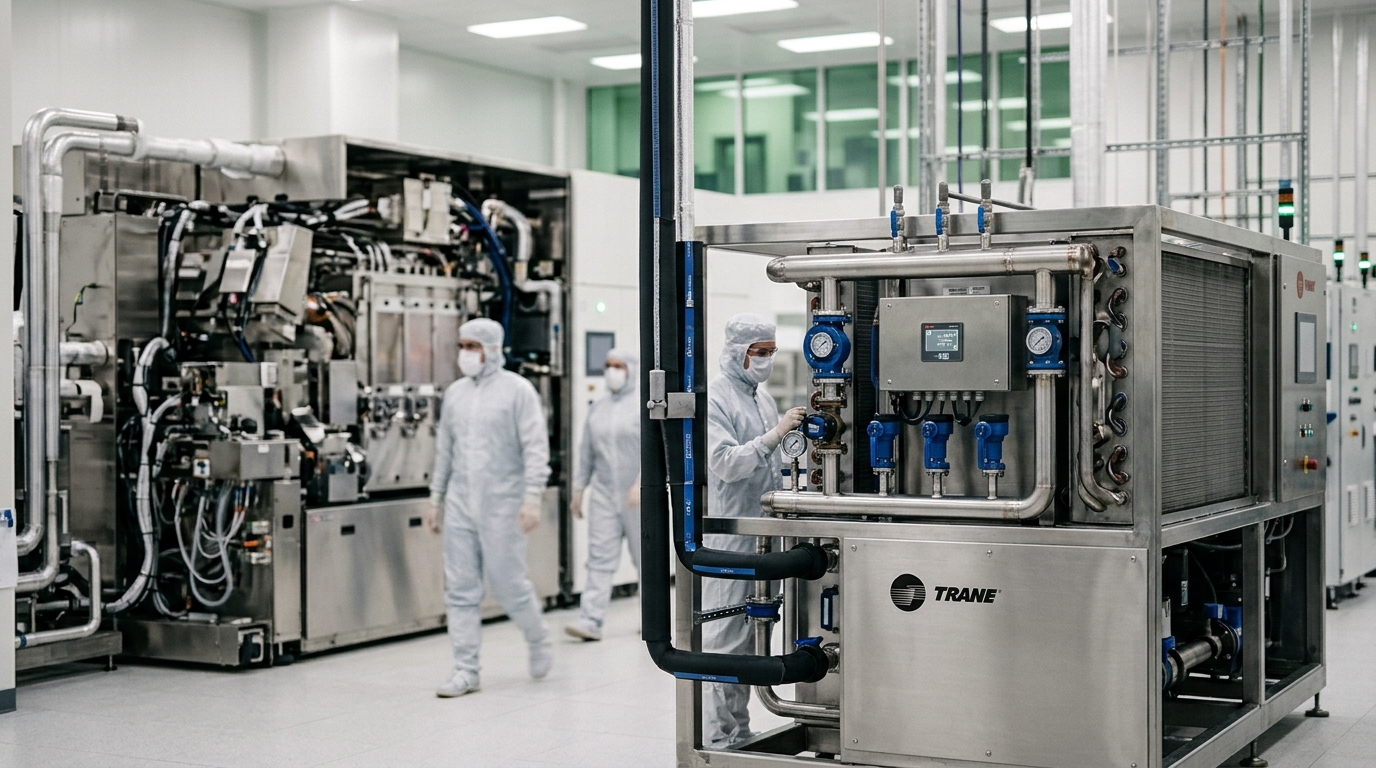
Every extreme-ultraviolet lithography machine ASML ships requires a dedicated, high-precision thermal management system operating at tolerances consumer-grade HVAC cannot approach. EUV exposure must occur in a high-vacuum environment, because EUV light at about 13.5 nanometers is absorbed by almost everything, including air. That vacuum environment eliminates conventional convective cooling, making active thermal control of the optics, reticle, and wafer stage extraordinarily complex. Chillers serving the most temperature-sensitive parts of advanced lithography and metrology systems are often specified for millikelvin-level stability under steady-state conditions.
Each EUV lithography tool relies on multiple cooling loops and temperature-control subsystems. With ASML reporting record Q3 2026 total net sales of €11.7 billion and customers already signaling long-dated demand for EUV capacity, the upstream equipment demand feeding those fabs is compounding quickly. TSMC has said its Arizona plans bring its total investment in the state to $265 billion, covering 10 fabs, two advanced packaging facilities, and an R&D center. That volume of advanced fab construction is a structural order book for whoever supplies precision cooling.
Trane is positioning itself to be that supplier. The company already markets cleanroom HVAC systems directly to semiconductor fabs, advertising ultra-stable temperature and humidity conditions for process stability. Its Q2 2026 results showed applied equipment bookings up 130%, marking the fourth consecutive quarter above 100%, driving a record $12.1 billion backlog, up 70% year over year. Management has raised full-year organic revenue growth guidance to about 9%.
The semiconductor angle is structurally different from the AI data center story Wall Street is already rewarding. Data center chillers cool IT equipment in relatively accessible environments. Fab thermal-control systems support vacuum-based lithography, metrology, and process tools built to tolerances measured in fractions of a nanometer, on contracts that are specification-locked years in advance. Switching costs are among the highest in industrial equipment. An incumbent supplier qualified for a cleanroom process does not get replaced at a competitor’s price.
Specification-lock and switching costs are not the only structural advantages protecting incumbent fab suppliers. Advanced semiconductor manufacturing depends on a narrow set of qualified materials and inputs that geopolitical pressure can disrupt faster than fabs can requalify alternatives.
The semiconductor chiller market was valued at roughly $856 million in 2026 and is projected to reach $1.38 billion by 2035. If those figures hold, they still may not fully reflect the pull from the High-NA EUV ramp and the U.S. CHIPS-era fab wave. Precision cooling is also emerging as a longer lead-time constraint than many fab buyers expect, a dynamic that rewards suppliers with designs already in customer qualification.
Trane’s $550 analyst price targets from JPMorgan rest primarily on the AI data center case. Wells Fargo’s recent initiation came with a $536 price target, not $550. The fab cooling case, quieter and stickier, is not fully in the math yet. For long-term investors, that gap is worth understanding.