November 4, 2026
33 new warehouses, a 92% renewal rate, and free cash flow that funds it all before a supplier invoice is paid.
When a company closes its fiscal year with about $9.4 billion in free cash flow and immediately announces a $7.5 billion capital plan for the year ahead, the right question is not whether it can afford the spending. The right question is whether the spending makes the business harder to displace.
“Market Wizard” Who Made Hundreds of Millions for Clients Reveals Two-Rule Strategy
Trading legend reveals how any American can go for their first $1,000 using his simple two-rule system.
For Costco, the answer tilts clearly toward yes.
On its September 24, 2026 earnings call, management described the $7.5 billion outlay as part of a three-year stretch of outsized capital growth that began in fiscal 2025, with spending rising about 17% from the $6.4 billion Costco deployed in fiscal 2026. CFO Gary Millerchip confirmed the allocation is earmarked primarily for new warehouse construction and related infrastructure.
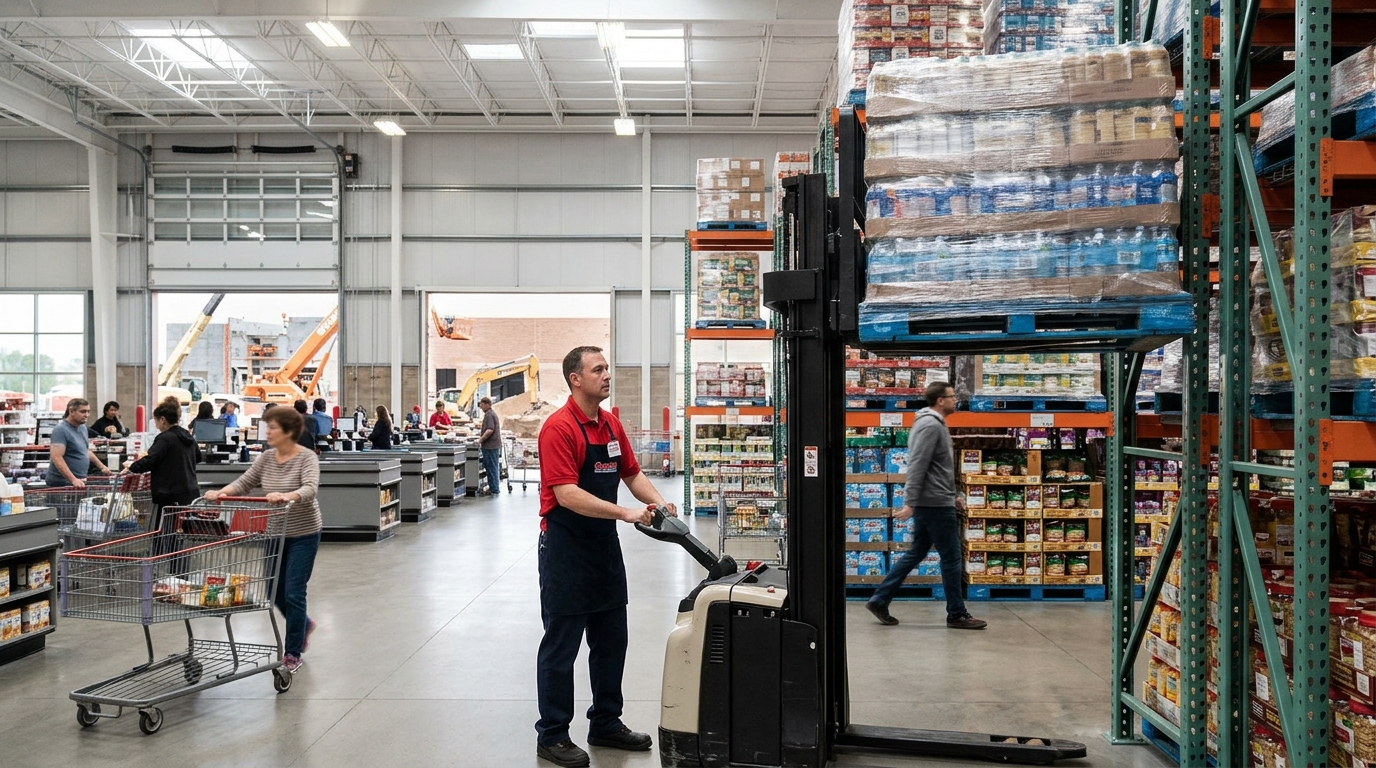
CEO Ron Vachris committed to 33 openings in fiscal 2027, five of them relocations, citing new U.S. markets such as Buffalo, New York and Lawrence, Kansas, alongside infills in mature markets and international expansion. The international pipeline includes four openings in Europe, five in Canada, and one in Mexico.
Former Congressman Ron Paul’s Biggest Warning Yet
They mocked him for warning about the housing bubble. Then 2008 happened. They called his predictions about the dollar crazy. Now groceries cost double what they did in 2020. Today, at 91 years old, Dr. Ron Paul is stepping forward with what may be the most important warning of his life: a crisis he believes could wipe out the savings of millions of Americans.
What makes this worth more attention than a typical retail build-out is where the money is actually coming from. In fiscal 2026, Costco’s $5.9 billion in membership fees equaled roughly 51% of its $11.7 billion in operating income, meaning the company essentially funds its expansion off a revenue stream that requires no inventory, no markdown risk, and renews at a 92.3% rate in the U.S. and Canada. Rapid inventory turnover combined with upfront membership collection helps create a working-capital model where Costco can receive customer payments before it pays many supplier invoices. The warehouses can begin paying for themselves quickly, long before they feel like mature assets.
Free cash flow rose to about $9.4 billion in fiscal 2026. Consensus estimates still point to a decline in fiscal 2027 as the capital surge absorbs more cash, but that expected dip is planned, not distressed. Costco expects capital expenditure growth to slow after fiscal 2027 even as warehouse openings continue at roughly 30 net new locations annually over the next five to ten years.
Costco closed October 2026 at $1,012.28 per share, a price that itself reveals something about how the market prices this business. Over the last five years, COST has climbed 97.2%. At those levels, the stock demands near-flawless execution and offers little margin for error on valuation.
5 Stocks Built for a Strong Finish to 2026
Higher interest rates, a reshuffled Washington and a market that wants proof of AI profits will all test stocks before the year is out. These 5 companies have the earnings to handle it. Download our free report for the catalysts, recent results and analyst price targets behind each one.
Valuation at these levels has been a recurring tension for Costco shareholders. An earlier pullback from Costco’s all-time high raised the same question about whether the stock’s premium was justified by its fundamentals.
That tension is the honest risk. The expansion is disciplined and cash-funded, but investors paying above $1,000 per share are not getting a discount. They are buying confidence that each new warehouse compounds the membership flywheel further. Digitally enabled sales exceeded $33 billion in fiscal 2026, growing more than 20%, adding another lever beyond the physical footprint that the market is beginning to price in.
The wealth takeaway is straightforward. Costco is not growing recklessly. It is converting a structurally advantaged cash machine into physical real estate, one warehouse at a time, in markets competitors have underserved for years. For long-term investors, the question is not whether Costco can build 33 warehouses. It clearly can. The question is whether a stock already priced for excellence still has room to compound wealth from here, and that answer depends entirely on how patiently you are willing to wait.