Investment committees were already debating Texas before the votes were counted. Now they have an answer, and it is the uncomfortable one.
Gina Hinojosa swept into the Texas governor’s office Tuesday night, becoming the state’s first Democratic governor since 1990 as Greg Abbott conceded late, telling his supporters “There are still votes to be counted, but mathematically, we are not going to be able to win this election.” Her platform calls for a moratorium on new data center construction, stricter rules on water and power usage, and an end to tax breaks. Markets did not wait for the opening bell.
Why This Is Not Just Political Noise
The number that frames the debate is not in dispute, but the attribution in the draft was off. Public reporting and industry research circulating into Election Day has generally put Texas at about a quarter of planned U.S. data center build, not 27% attributed to Wells Fargo here.
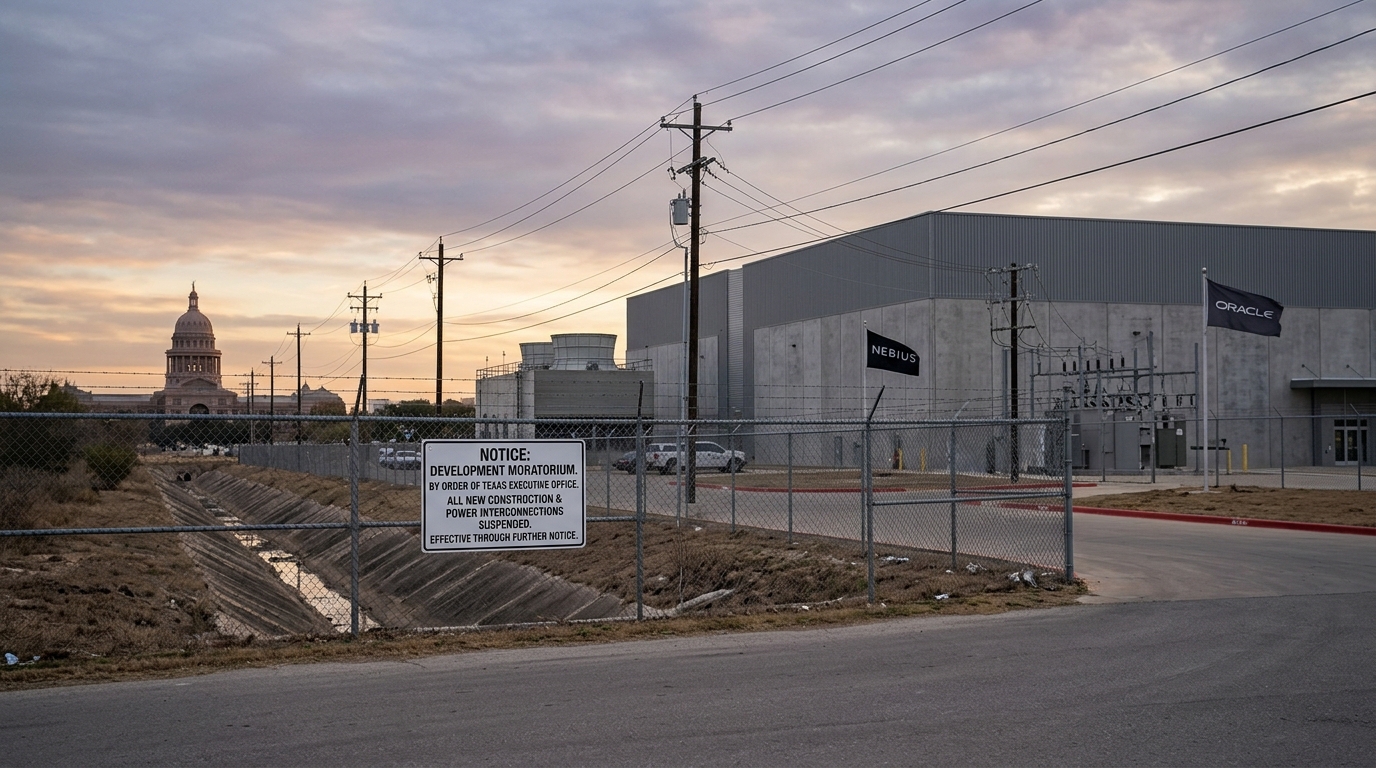
The election result also did not arrive in a vacuum. Abbott had already, on September 21, directed the Texas Commission on Environmental Quality to halt all permits sought by data centers until ERCOT completes its audit, an extension of his August 3 directive ordering a comprehensive verification and audit of all data centers advancing through ERCOT’s interconnection process. Based on recent public statements, ERCOT expects to conclude this audit and verification on or around December 10, 2026. ERCOT is expected to file both the Batch Zero Eligibility Verification Report and a separate community-impact report on December 10, with a PUCT open meeting set for December 17.
So the investment question is not simply whether Hinojosa wants a moratorium. It is whether the institutional and regulatory machinery already in place, now controlled by a governor far more hostile to the industry than Abbott was in his final months, turns a temporary audit into a durable constraint on new capacity.
The Bull and Bear Cases
The bull case rests on gubernatorial limits. Winning the governor’s mansion does not give Hinojosa carte blanche, and a statewide moratorium could also encounter legal obstacles. The Texas legislature does not reconvene until January, and projects already under construction with prior approvals are generally excluded from the existing pause. Contracts signed before the freeze, like Vistra’s 20-year nuclear supply deal for AWS at Comanche Peak, appear insulated. Vistra has said it doubts the pause will affect that 1.2-gigawatt deal, with the Comanche Peak plant set to begin delivering power in 2027.
The bear case is structural. The draft cited a “Data Center Watch” dataset and percentages that could not be verified. But the broader point holds: across the 2026 cycle, data center restrictions have moved from local zoning fights into statewide politics, and Texas is the state the market is watching most closely.
What Investors Are Missing
The most underappreciated dynamic here is Oracle’s compounding exposure. Oracle’s filings show capital expenditures of about $39.2 billion in the first nine months of fiscal 2026, up from about $12.1 billion in the comparable fiscal 2025 period, largely tied to cloud and data center buildout. Separately, Bloomberg reported that JPMorgan and Mitsubishi UFJ were among banks leading a roughly $38 billion debt package tied to data centers connected to Oracle in Wisconsin and Texas. With its credit rating now one notch above junk after an S&P downgrade in July 2026, any protracted permitting freeze that pushes Texas timelines into 2028 or beyond lands on a balance sheet with limited slack.
NRG’s position is more nuanced. NRG has said its previously announced proposed 1.2-gigawatt natural-gas generation project supporting a Texas data center development was conditionally included as a Studied Load in ERCOT’s Batch Zero process, and it has been explicit about a “bring your own power” approach. Its CEO Robert Gaudette has argued that a customer-backed capacity model should hold up better if interconnection becomes more restrictive. That framing deserves scrutiny, but the contracted-capacity logic is the right place to look.
Stocks to Watch
Oracle (ORCL) carries the most direct balance-sheet risk. Its Texas data center commitments are massive, its debt load is substantial, and a multi-year permitting freeze would pressure the construction timeline underpinning its OpenAI-related buildout.
CoreWeave (CRWV) relies on leverage to build, so any delay that pushes revenue out compounds the cost of carry.
Nebius (NBIS) fell alongside Oracle, though its Texas exposure is less clearly defined than its peers. Watch whether management addresses siting alternatives on its next call.
Vistra (VST) is probably the most defensible name on this list. Contracted nuclear capacity serving AWS is not at risk from a permitting pause on new projects. Investors should monitor the ERCOT reports expected on December 10 as a critical checkpoint. If those filings clear a path forward for Batch Zero projects, Vistra’s generation assets become more valuable, not less.
NRG (NRG) sits in a similar position. Its contracted capacity provides a floor. What investment committees should be asking is how much incremental demand growth depends on new Texas data center loads arriving on schedule, and whether Hinojosa’s first legislative session changes that answer.