
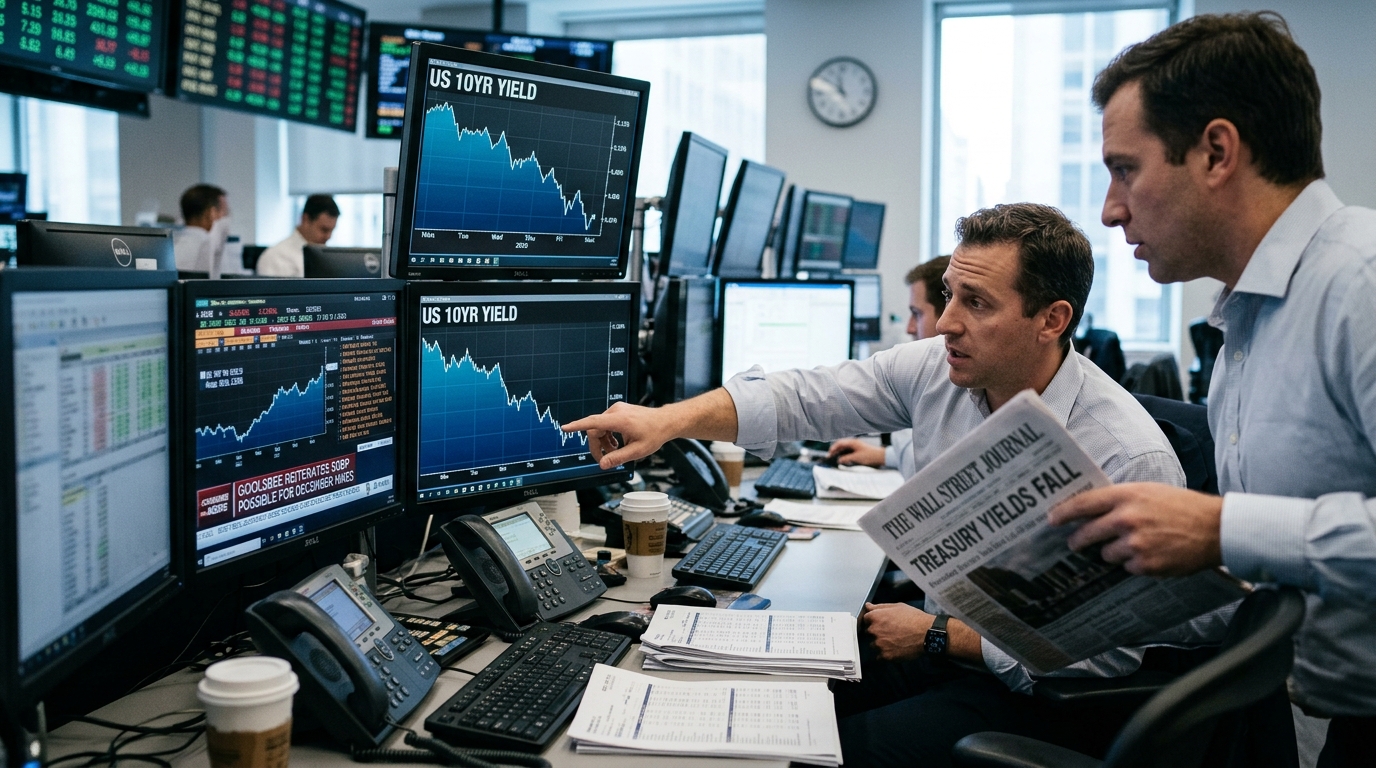
The bond market is not waiting for the Fed to blink. The 10-year Treasury yield dropped about 4 to 5 basis points to roughly 5.01% on Friday morning, extending a streak that began last Monday. On Thursday, the benchmark closed at 5.046%, slipping 1.9 basis points, while the 30-year shed 0.6 basis points to settle at 5.406%. The 2-year, more sensitive to near-term Fed decisions, dropped 3 basis points to 4.770%.
The driver is not a change in rate expectations. It is fear. Deteriorating equity market sentiment has driven a flight to safety in Treasuries this week, pushing yields lower across the curve despite persistent inflation concerns and expectations of further Fed tightening. The benchmark 10-year has slid from the week’s peak near 5.15% to around 5.0%, while the 2-year and 30-year are also modestly lower over the same stretch. Market participants have flocked to the safety of government debt amid an ongoing rout in parts of the artificial intelligence trade on Wall Street.
Meanwhile, the Fed is not retreating. Chicago Fed President Austan Goolsbee, who becomes a voter in January, has kept the door open to a larger move in December, and Governor Christopher Waller has also refused to rule it out. Goolsbee said in a televised interview earlier this month that “everything is always on the table” for the December FOMC meeting, arguing the rate path comes down to whether price growth can return to the 2% target on its own, and the evidence so far does not point that way. Core inflation has been running around the mid-3% range on a three-month annualized basis, keeping pressure on the Fed’s interest-rate policy.
The market is not buying the hawkish tone at face value. A December hike remains priced in, and futures markets continue to assign a low probability to a 50 basis point move, even after Waller’s comments this week. Waller told CNBC earlier this week that inflation is “headed in the wrong direction and it’s spreading out” into more goods and services, but futures traders have not moved decisively in his direction.
This divergence is the trade. When bonds rally into a Fed that is openly discussing a 50bp move, one of two things is happening: either the equity-driven safe-haven demand is temporary and yields revert sharply higher once the selloff stabilizes, or the market has concluded the economy cannot absorb the cumulative tightening already priced. Treasury yields remain constrained by hawkish Federal Reserve expectations ahead of next Wednesday’s October PCE reading. That print, more than anything said this week, will decide which side of this tension wins.
For rate-sensitive sectors, the conflict creates a tricky setup. Real estate sits underweight at Neuberger Berman, among the sectors most hurt by higher real yields, as fiscal strain and bond volatility keep long-term financing costs high. Utilities, which act as bond proxies, tend to struggle as yields and bond volatility rise. The 30-year fixed mortgage rate sat at 7.11% as of November 12, down for a fourth straight week but still far above the 6.24% of a year earlier. Homebuilders are likely to suffer if Treasury yields remain elevated, with Raymond James CIO Larry Adam noting that higher mortgage rates would continue reducing housing affordability.
A brief yield decline from 5.15% to around 5% does not change the structural picture for these sectors. It offers a breather, not a bottom. If PCE confirms that inflation is broadening further and the Fed follows through with 25bp in December while flagging more to come, the rally in Treasuries stalls and homebuilders, REITs, and utilities face renewed pressure. The tactical opportunity sits in that outcome: use any strength in rate-sensitive names this week as a fade rather than a signal.
Governor Waller speaks again today. Watch whether he softens or doubles down. His exact phrasing on the pace of hikes into 2027 will matter more than any single basis-point move in December. The bond market has been right to buy this week. Whether it stays right depends entirely on what the data says next Wednesday.