
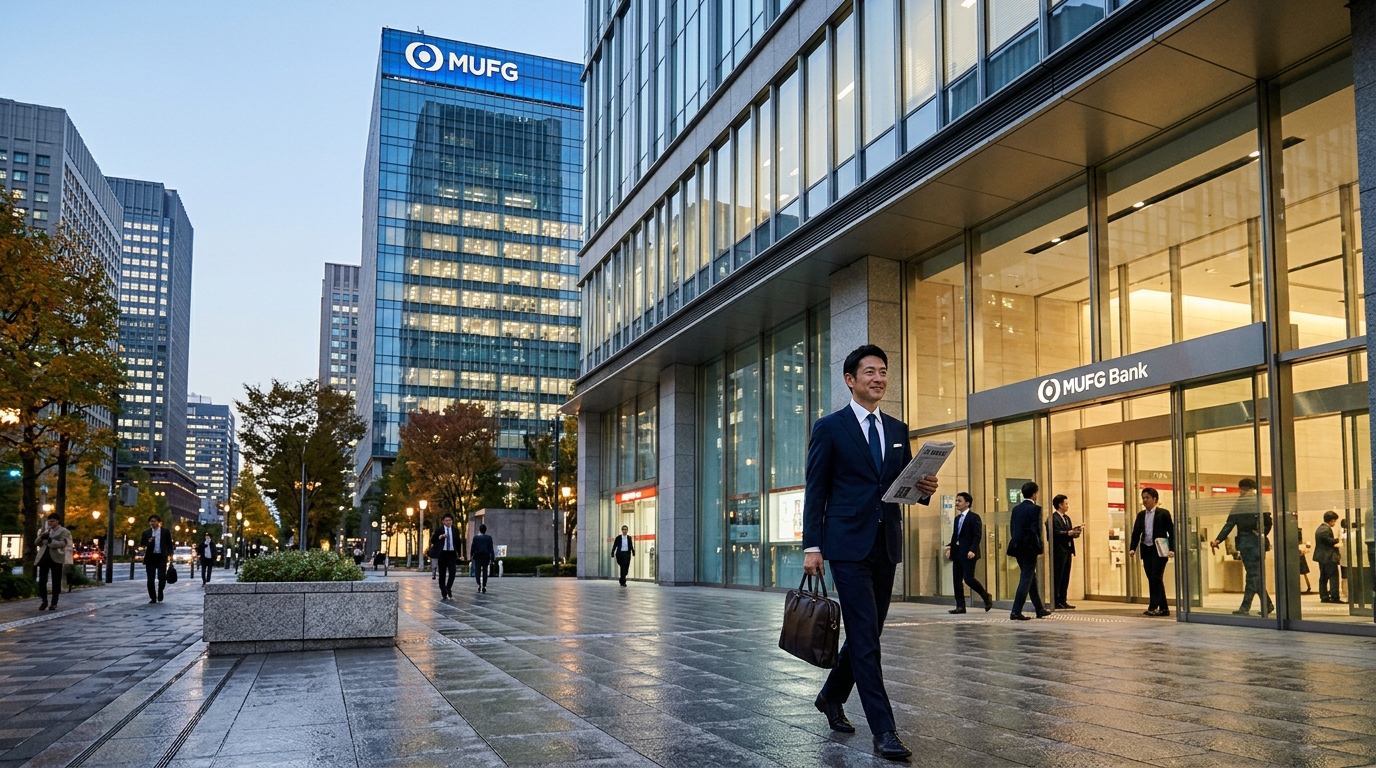
For most of the past decade, buying MUFG meant betting on Japan’s economic recovery while receiving a dividend too modest to matter. That calculation changed decisively this morning.
Mitsubishi UFJ Financial Group reported a record first-half net profit of ¥1.63 trillion ($10.4 billion), up 26% from a year earlier, and raised its full-year net profit target to ¥2.8 trillion from ¥2.7 trillion. The group also announced a share buyback of up to ¥200 billion for the second half and raised its annual dividend forecast to ¥100 per share. These are not incremental upgrades. They are the numbers of a bank that has decided it can afford to pay shareholders rather than stockpile capital indefinitely.
What Changed and Why
Net operating profit rose 26% to ¥1.62 trillion, driven by higher loan and deposit income and fee income. Net interest income rose 29% to ¥1.85 trillion, helped by higher Japanese interest rates, which added about ¥140 billion to net operating profit, and by loan growth at home and abroad. Fee income rose 14% to ¥1.23 trillion.
The rate environment is the structural engine. The BOJ raised rates in September, moving its operating target to around 1.25% effective September 24, 2026. As of November 13, OIS pricing implies roughly an 83% chance of a hike at the December 17-18 meeting. Each hike expands the spread between what MUFG pays depositors and what it earns on loans and securities. The bank said higher Japanese rates contributed roughly ¥140 billion to first-half operating profit. A December move would add further in the second half.
The Dividend Arc Is the Point
Income-focused investors should look at what MUFG’s dividend schedule actually shows. The annual dividend per share was ¥41 for the year ended March 2024, ¥32 for March 2023, and ¥28 for March 2022. Today’s forecast calls for ¥100 for the current fiscal year. That is more than a tripling in three years, and management has set its dividend policy at a payout ratio around 40%, which links future dividends directly to earnings growth rather than to board discretion.
The ¥200 billion buyback running alongside the dividend adds a second channel of capital return and reduces the share count against which future earnings are measured.
The Yen Is a Real Variable
None of this comes without a complication. USD/JPY traded around 160 on November 13, 2026, after briefly trading above 160 on November 12. A weaker yen cuts the dollar value of MUFG’s dividends and ADR price for U.S. holders. A weaker yen can also lift yen-reported earnings, so the currency can be a tailwind on results but a headwind on repatriated returns.
The partially offsetting factor: a BOJ rate hike in December, which markets currently price as likely, would tend to put modest upward pressure on the yen by narrowing the gap with U.S. rates. It would simultaneously lift MUFG’s net interest income further. The two effects point in the same direction for the bank’s fundamentals.
Portfolio Fit and What to Watch
MUFG fits an international income sleeve rather than a core domestic holding. Position size should reflect yen exposure honestly: a 3% to 5% allocation captures the yield and buyback without letting currency swings dominate a portfolio’s income stream. Sumitomo Mitsui and Mizuho report results today as well, and their guidance will show whether the profit upgrade is sector-wide or specific to MUFG’s Morgan Stanley earnings contribution and global fee business.
The single most important question for the thesis is whether Japan’s rate cycle has years to run or quarters. If the BOJ reaches 1.5% by year-end and pauses, the spread expansion story slows. If it keeps hiking toward a higher neutral rate, MUFG’s earnings base will keep rising, and so will the dividend. For an income investor, that is a thesis worth owning carefully.