The model arms race is not what will determine which AI companies keep enterprise customers in 2030. Saturday morning made that argument better than any analyst could.
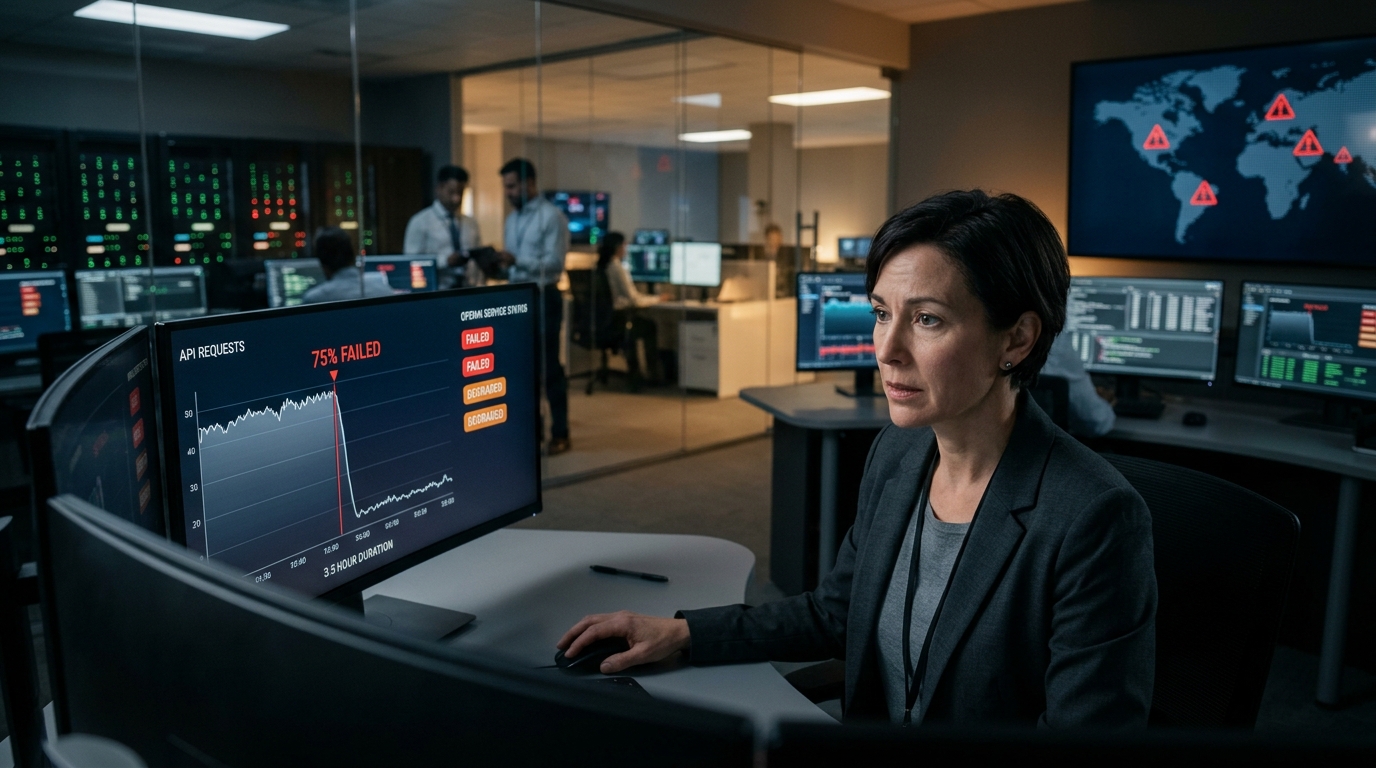
Between 1:48 and 5:21 PT on November 21, requests to OpenAI’s API and ChatGPT failed at rates peaking at 75% on paid and free ChatGPT. The outage swept across major OpenAI API surfaces, plus core ChatGPT features including login and voice.
The cause was not a novel engineering failure. The trigger was routine scheduled maintenance on a PostgresDB service. Both read replicas failed at the same time, and because those replicas were load-bearing, the Primary API service, which provides user and service-to-service authentication across the entire OpenAI stack, took every dependent request path down with it. A maintenance window turned into a cross-stack authentication blackout for three and a half hours.
OpenAI’s post-incident write-up is candid. The company says it has paused similar maintenance activities, adjusted configuration to reduce connection churn, and shipped a feature flag that can shift traffic away from replicas on a percentage basis. Those are the right responses. They do not, however, change what the incident revealed about the broader competitive landscape.
The Real Competition Is Infrastructure, Not Intelligence
Enterprise procurement teams do not evaluate AI vendors the way a researcher evaluates a benchmark. They evaluate them the way a factory manager evaluates a supplier: Can I count on this when my production depends on it? Saturday’s answer, for OpenAI, was that at the peak, roughly three in four requests could not be served.
In mid-November, Microsoft 365 had a widely reported disruption, and AWS reported a service event affecting US-EAST-1. Around the same window, third-party monitors also recorded disruptions affecting Anthropic. A cluster like that, now followed by Saturday’s outage, is the kind of pattern that surfaces in IT vendor reviews. An enterprise that hedged between two or three model vendors for its AI agents could still see correlated degradation. Vendor diversification alone does not solve a shared-infrastructure problem.
This is the opening that benefits companies whose core business is reliability rather than model generation. Datadog has established a leadership position in AI observability, offering tools that monitor LLM response quality, track inference costs, detect model drift, and correlate AI application performance with underlying infrastructure metrics. Datadog reported Q1 2026 revenue of about $1.01 billion, up 32% year over year. When an AI vendor goes dark, the monitoring layer is the first thing enterprises reach for, and the last thing they cancel.
CrowdStrike’s Falcon platform ties directly into cloud protection and security platform consolidation, including AI-assisted detection and response. Every outage cycle hardens the case for resilience tooling sitting alongside model access, not just beneath it.
Oracle’s Position Gets More Interesting, Not Less
The timing of Saturday’s outage is striking for Oracle investors. Oracle said on November 20, 2026 that it has secured all the funding it needs to fulfill its contract with OpenAI, and described itself as the first hyperscaler fully funded for this investment cycle. The Oracle-OpenAI infrastructure contract was first reported in September 2025 as a roughly five-year deal for about $300 billion in computing power.
Oracle says construction at its Abilene campus, where OpenAI’s Astra-6 model was trained, is nearing completion, and that the next gigawatt-scale campus in Shackelford County is fully permitted. Oracle’s value in this relationship is not the model. It is the compute layer that is supposed to keep the model available. That distinction now carries more weight.
The Mogul Verdict
The investors who have compounded wealth over decades by owning businesses rather than chasing stories have always known that durability is the asset. OpenAI’s Saturday failure does not diminish the quality of its models. It does clarify the competitive variable that enterprise buyers will increasingly price above model capability: uptime, redundancy, and provable resilience. The companies that have built their business models around making infrastructure visible, measurable, and fault-tolerant, chiefly Datadog, stand to gain each time a headline like Saturday’s reminds a CIO what happens when reliability is assumed rather than engineered.