September 12, 2026
Grid bottlenecks are turning fuel cells into baseload power, and Bloom’s contract book shows why.
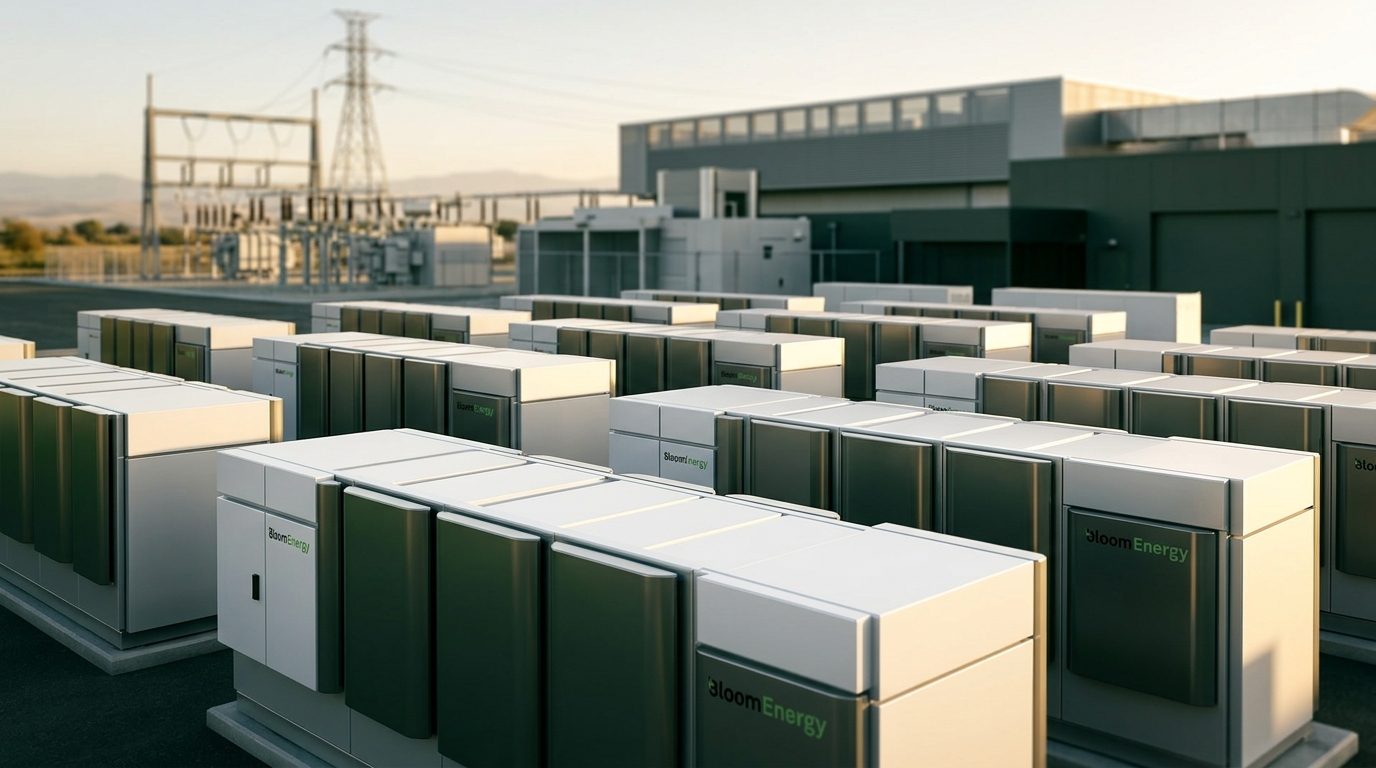
For years, the knock on Bloom Energy was straightforward: interesting technology, unimpressive finances. That argument is getting harder to make. Bloom reported record quarterly revenue of $1.065 billion in Q2 2026, surpassing $1 billion for the first time, on 166% year-over-year growth driven by 215% product revenue growth. The company then raised full-year guidance to $3.9 billion to $4.2 billion, which management said represents about 100% year-over-year growth at the midpoint. That is not an incremental improvement. That is a business in a different gear.
Big Tech is bidding against itself for dead mines
Google quietly backstopped a bitcoin miner for 1.8 billion dollars.
Amazon signed 5.5 billion with a second one. Microsoft wired 9.7 billion to a third.
Roughly 63 billion dollars of Big Tech money landed on bitcoin miners inside a single year.
None of it is about bitcoin.
They are bidding for something the miners picked up cheap in 2021, and once a site is taken it is gone for twenty years.
The engine behind it is a structural problem the grid cannot solve fast enough. U.S. data center electricity demand is rising quickly, and multiple recent industry analyses now put total U.S. data center capacity at well over 50 GW by the end of 2025, with further growth expected as AI expands. AI racks can require roughly 50 to 100 kilowatts of power, compared to 5 to 10 kilowatts for traditional racks. Meanwhile, in Northern Virginia, the largest data center market globally, grid connection wait times for large loads have been cited as roughly seven years in several recent reports. Hyperscalers cannot wait that long. Bloom’s solid oxide fuel cells can be deployed faster than major grid upgrades, which is precisely why the contract pipeline has grown.
The company has pointed to a surge in AI and data center demand, highlighted by large, recently announced agreements. The landmark $2.65 billion agreement with American Electric Power covers the deployment of up to 1 GW of solid oxide fuel cells. The Bloom-Oracle master services agreement, covering up to 2.8 GW, gives Oracle a framework to secure power capacity at speed across its global operations. Bloom has also said it exited 2025 with roughly $20 billion of total backlog, including about $6 billion of product backlog.
The $16 Trillion Rare Earth Discovery
The Guardian calls it “the beginning of the biggest gold rush in history”… and one stock under $5 owns exclusive rights to harvest these rare earths.
Elon Musk and his companies need these minerals before a January 1 Pentagon deadline.
What makes this more than a revenue story is the margin trajectory. Non-GAAP gross margin expanded to 34.3% in Q2, and non-GAAP operating income rose from $28.6 million to $239.6 million year-over-year. Scale is doing what it was supposed to do, and the company’s technology, which converts natural gas or hydrogen into electricity through an electrochemical process rather than combustion, is earning its credibility at the gigawatt level.
There is also a symbolic milestone worth noting for investors. S&P Dow Jones Indices said Bloom Energy, along with Everpure and Illumina, will join the S&P 500 effective prior to the open of trading on Monday, September 21, 2026, as part of its quarterly rebalance. Index inclusion forces passive fund managers to buy, but more importantly it signals that Wall Street has stopped treating Bloom as a speculative bet on future energy trends and started treating it as infrastructure.
Wall Street Sees Big Upside in These 5 Stocks Under $10
There’s a reason each of these stocks caught our attention. Important developments are already underway, and if they play out favorably, Wall Street may have reason to reconsider what these companies are worth.
Our new free report covers 5 stocks trading below $10 that analysts believe could have plenty of room to run.
The risks are real. To own Bloom Energy today, you need to believe that solid oxide fuel cells can remain a compelling answer to AI data center power needs despite competing clean energy options and the company’s reliance on natural gas. The stock is also unusually volatile, with several market data services flagging it as among the most volatile names in the U.S. market. Execution at this scale, manufacturing, financing, installation across dozens of campuses simultaneously, is genuinely hard.
But the core thesis has shifted from hope to evidence. The core value proposition has changed from redundancy to speed. The grid cannot keep up. Bloom’s contract announcements and its disclosed backlog suggest that some of the largest technology and infrastructure buyers are already placing real dollars on who fills that gap. That is a different kind of investment case than the one that existed two years ago.