The question fund managers should be asking this week is not whether Trump’s new AI Force will get funded, staffed, or even structured. It is this: what happens to a $500 billion annual infrastructure buildout when the person whispering in the president’s ear runs the company that sells the chips?
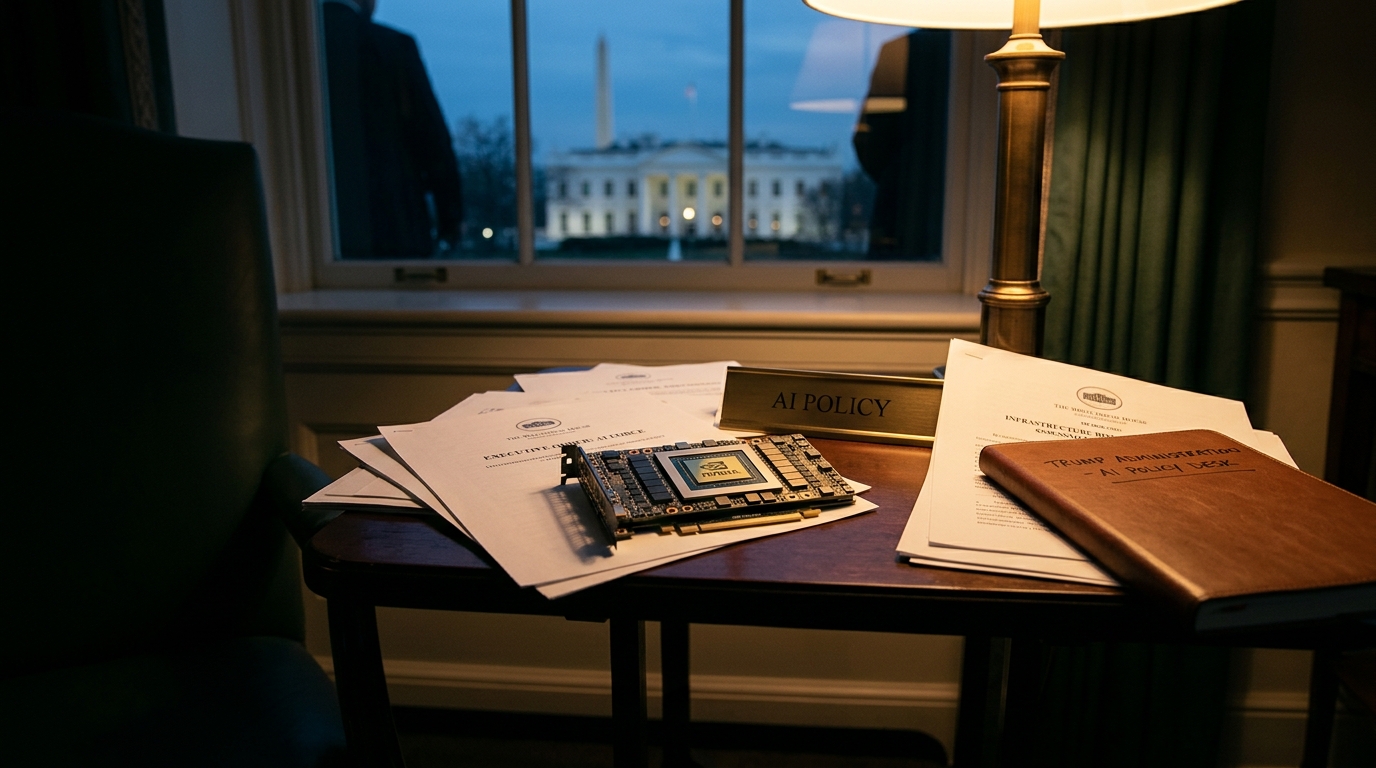
President Trump announced Saturday he is creating an “AI Force” modeled on the Space Force and will soon name a new AI czar, doubling down on his push to accelerate artificial intelligence development with limited regulation. Trump offered few details on what this AI Force would actually do, what budget it would have, or where it would be placed in the federal government. That absence of detail is itself the tell. This is not a regulatory architecture. It is a political statement, timed for maximum effect four days before Xi Jinping arrives in Washington.
AI safety is confirmed to be on the agenda for the Trump-Xi bilateral meeting, per reporting on the state visit. Executives including Nvidia’s Jensen Huang, Amazon’s Jeff Bezos, OpenAI’s Sam Altman, and Google’s Sundar Pichai are scheduled to attend the state dinner Thursday, according to the White House and wire reports. The guest list tells you more than the press release.
The Huang Problem
With the debate about regulating artificial intelligence raging in Washington, President Trump picked up the phone to call Nvidia CEO Jensen Huang. “The robots are not going to be taking over the world,” Trump told Huang, in a call Huang took on stage at the All-In Summit in Los Angeles and put on speaker. Trump has also called mounting AI and data center concerns a “hoax.” The symbolism was not accidental.
Treasury Secretary Scott Bessent, when asked during a House hearing whether Trump understands the threat AI presents, said: “I would just say the president is completely aligned with Jensen Huang, the CEO of Nvidia.” That is an extraordinary statement for a Treasury Secretary to make. It does not describe a president who has weighed competing interests. It describes one who has outsourced his priors to a single CEO whose company saw revenue surge to about $216 billion in its latest fiscal year, driven by the very GPU demand that AI safety guardrails might constrain.
Huang has argued AI safety can be managed through engineering approaches and existing legal frameworks rather than a new, specialized regulatory regime, which is close to the framework Trump adopted in his social media announcement. Trump wrote that “we will also be looking for BAD, and we can do that, very easily, with our already existing Criminal and Civil Justice System.” That is not an AI policy. It is Nvidia’s preferred outcome dressed in executive authority.
The Number Nobody Is Running
Here is the risk that institutional models have not assigned a probability to. Sixty-one percent of likely U.S. voters oppose construction of AI data centers, according to a New York Times/Siena University poll of 1,503 voters conducted in early September. Only 14 percent of respondents said they strongly support building these facilities. In Festus, Missouri, voters removed four city council members one week after they backed a $6 billion data center. A Fortune report, citing a tracker run by a political risk analyst, said local opposition blocked or slowed at least 48 U.S. data center projects representing about $156 billion in investment in 2025.
The bull case on AI capex assumes permitting friction is manageable. That assumption is increasingly hard to defend. Pressure is likely to appear first in local permitting, water management, environmental reviews, and negotiations with communities rather than as a single national campaign issue. That is exactly the kind of slow-motion cost increase that does not show up in a quarterly earnings beat but does erode IRR on a $750 billion buildout over five years.
Stocks to Watch
Nvidia (NVDA) is the most exposed to a single-point-of-failure in Washington. Bipartisan security concerns and Chinese regulatory restrictions introduce ongoing uncertainty regarding Nvidia’s export revenues and competitive positioning in the global market. Huang’s proximity to Trump is a moat until it isn’t.
Microsoft (MSFT) and Alphabet (GOOGL) have more insulation. Selling has been concentrated in the AI buildout chain, the companies that profit from capital spending on data centers and chips. The buying sits with companies seen as less dependent on that spending continuing. Alphabet, Microsoft and Meta are on the second side. If permitting backlash slows new capacity, incumbents with existing infrastructure gain relative advantage.
Vistra (VST) and Constellation Energy (CEG) face the same voter math. Power demand from data centers is central to their AI-driven rerating, and that demand curve assumes projects get built. Data centers could account for roughly 9% of total U.S. electricity consumption by 2030 in some widely cited projections, and higher in others. The political path to that outcome is narrower than their valuations suggest.
Palantir (PLTR) is the quiet winner in a scenario where government AI spending routes through defense-adjacent structures rather than commercial hyperscalers. An AI Force with a budget, however vague today, eventually has procurement contracts. Palantir has spent a decade positioning for exactly that conversation.
The AI Force announcement is easy to dismiss as political theater. The smarter read is that it codifies a policy posture with real consequences: no new regulation, existing law as the only guardrail, and a chipmaker CEO as the president’s principal outside counsel. Portfolio managers who have not stress-tested their AI positions against that concentration of influence should probably do it before Thursday’s state dinner.