
September 22, 2026
New Mac minis and Mac Studios ship today, and Apple says local AI beats paying per token.
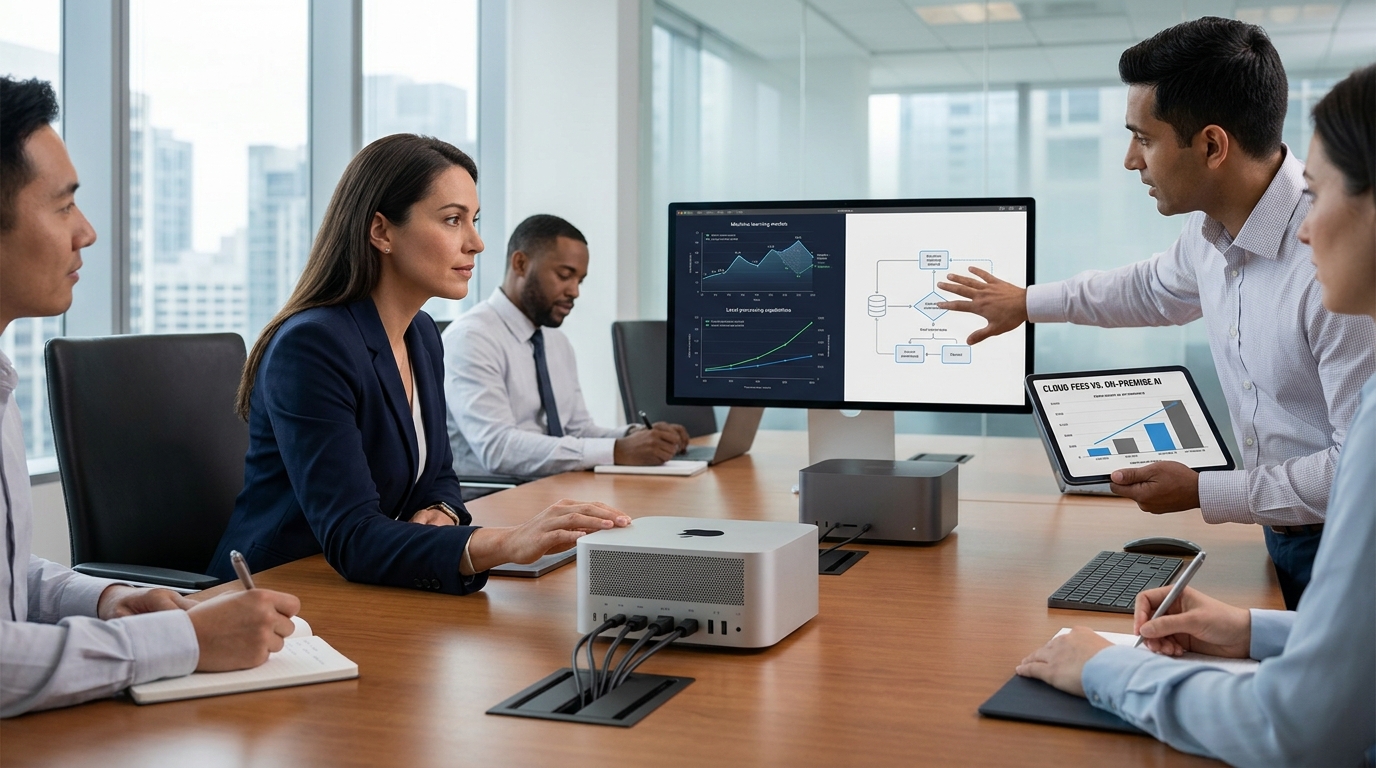
The machines started shipping this morning, and Apple’s sales argument to corporate buyers is blunt: stop renting intelligence by the token and own the hardware instead.
Oil Surge Predicted…But Are You Ready?
Do you own oil and gas stocks? Or are you thinking about buying some?
If so, you need to see my #1 oil play for 2026 But it’s NOT oil stocks, futures, or anything you’ve likely heard about.
Rather, it’s an unusual way to potentially bank monthly income from the oil and gas markets.
As Apple’s upgraded Mac minis and Mac Studios began shipping Tuesday, the company pitched corporate buyers on local AI hardware that avoids costly data center fees and per-token cloud charges, positioning the devices for intensive workloads including writing code and complex business operations. High-end configurations can approach $20,000, while Apple has demonstrated four Mac Studios working together to run a one-trillion-parameter model, using RDMA-over-Thunderbolt 5 to link the machines into a low-latency cluster.
Why Token Costs Make Apple’s Math Work
Businesses typically pay cloud providers according to usage, meaning inference costs increase as employees or customers generate more tokens. Apple argues that owning sufficiently powerful hardware can change that equation for workloads that can run locally.
The underlying architecture is what makes the argument credible. Apple Silicon’s advantage comes partly from unified memory, which allows CPUs and GPUs to access the same memory pool, making large AI models easier to run without relying on separate high-end graphics memory. Some local-AI practitioners argue Apple Silicon can be slower per token than Nvidia on smaller models, but can win on model capacity per dollar because unified memory can hold larger models than many consumer GPUs can fit in dedicated VRAM.
The new lineup reflects that advantage more forcefully than any previous generation. The Mac mini can be configured with M6 and M5 Pro chips, with the M6 being Apple’s first chip produced using TSMC’s 2-nanometer process. Apple said a Mac mini equipped with an M5 Pro can process large language model prompts up to 8.5 times faster than a Mac mini with M2 Pro in LM Studio.
After “33X” call, Hall of Fame Trader Jon Najarian reveals NEW Tesla prediction…
Jon Najarian put his neck out on national TV for Tesla in 2014… Before Tesla stock flew to peak gains of 3,392% today! But this “33X” call on Tesla might pale in comparison to Jon’s newest prediction about Elon Musk… That a potential $44 TRILLION plan could be coming next.
What the Competition Is Actually Doing
Microsoft CEO Satya Nadella has emphasized the market for “unmetered intelligence” on desktop hardware, with plans to integrate numerous AI capabilities into Windows. However, Microsoft’s dominant market share requires supporting a vast ecosystem of third-party hardware vendors, which can complicate optimization for developers.
Nvidia declined to comment, but in public discussions this year Jensen Huang has framed Nvidia’s PC push around expanding what Windows PCs can accomplish. That is a sensible position: Nvidia’s stronghold remains the data center. The two companies are not really fighting over the same turf yet. Apple is targeting the space between a developer’s desk and the cloud, where Nvidia has little presence and Microsoft’s advantage is primarily software, not silicon.
The Enterprise Gap Apple Has to Climb
The strategic problem is distribution. Apple’s push into corporate computing comes despite its relatively small share of the enterprise PC market. Some industry trackers have consistently shown Windows holding the overwhelming majority of enterprise PC shipments, with Apple in the low single digits, but the specific IDC percentages cited here could not be verified.
Apple is pitching corporate buyers on the idea that on-device AI models developed on its devices can scale up to its priciest Mac Studios or down to its cheapest iPhones and iPads, because their chips share common principles and designs. That unified architecture is the real product. A model built and tested on a developer’s MacBook can run on a cluster of Mac Studios without rearchitecting anything. That continuity matters to enterprise IT teams who have already suffered through enough cloud migration projects.
The Market Doesn’t Have to Cooperate
Up one day. Down the next. Then nowhere at all. That kind of market can make consistent trading tough. Dave Aquino built his Ultimate Income System for exactly these conditions. After 971 trade setups and 910 reported winners, he’s revealing the strategy and what he says separates profitable traders from the losing 90%.
What Investors Should Watch
Apple’s cash-generation profile and relatively low capital spending continue to stand out next to the surge in data center investment across the rest of big tech. However, the specific projection here, approximately $140 billion in free cash flow with less than $13 billion in capital expenditures, could not be verified from primary Apple filings or company guidance.
The company has also been reported in recent weeks to be developing enterprise AI servers powered by future Apple chips, potentially expanding the same efficiency argument into data centers.
The stock gained around 0.8% to $341.53 on Tuesday. That reaction is modest relative to the strategic ambition on display. The token-cost argument is real, the hardware is competitive, and the free-cash-flow profile is exceptional. Whether low single-digit enterprise market share can become 10% or 15% is the question worth monitoring over the next four quarters.