September 25, 2026
Four new factories, a doubled chiller line in Italy, and a $15 billion backlog. The constraint was never demand.
The conversation around Vertiv Holdings (VRT) almost always starts with demand. It should probably start with capacity.
After “33X” call, Hall of Fame Trader Jon Najarian reveals NEW Tesla prediction…
Jon Najarian put his neck out on national TV for Tesla in 2014… Before Tesla stock flew to peak gains of 3,392% today! But this “33X” call on Tesla might pale in comparison to Jon’s newest prediction about Elon Musk… That a potential $44 TRILLION plan could be coming next.
Orders momentum accelerated sharply, with fourth-quarter 2025 organic orders up approximately 252% compared to the prior year period and up 117% sequentially from the third quarter. That kind of velocity does not resolve itself through better sales execution. It demands factories, and Vertiv has been spending accordingly.
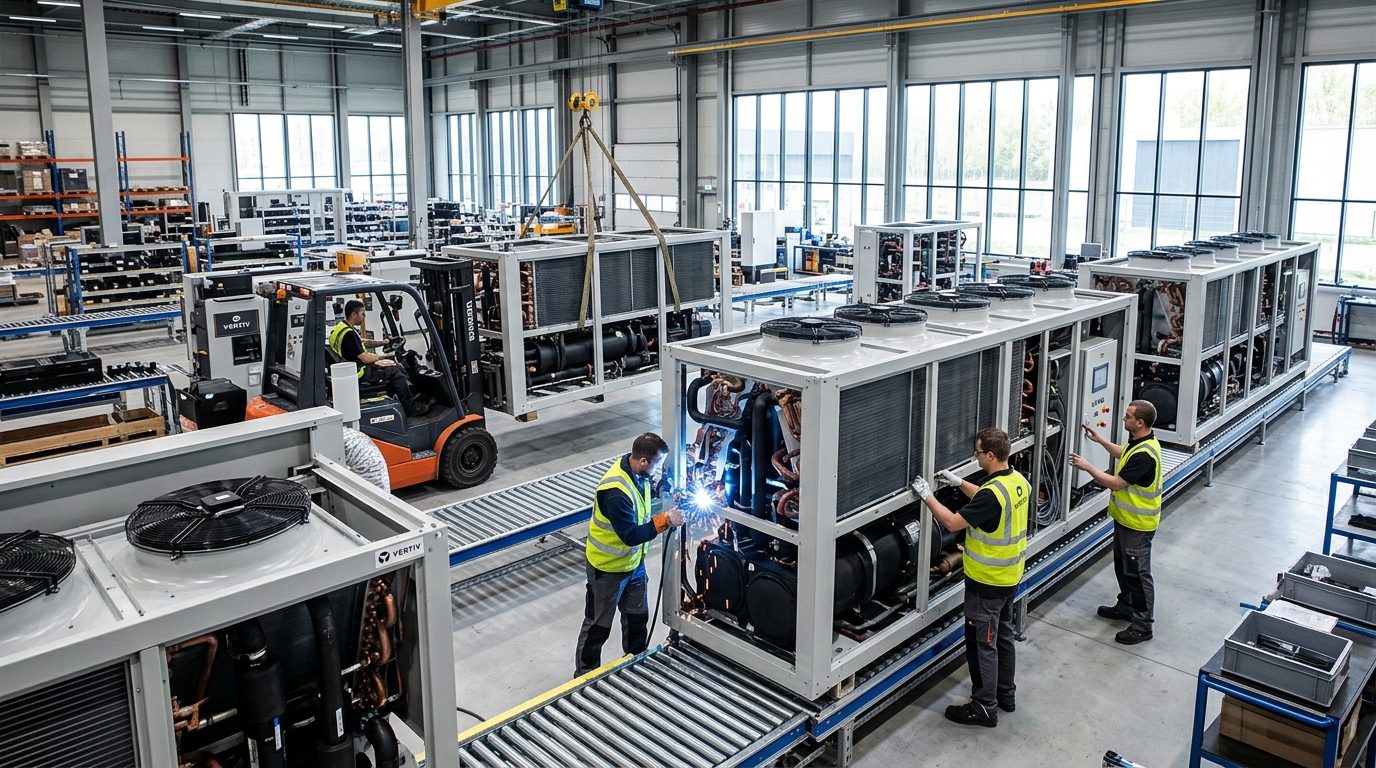
In March 2026, Vertiv announced four new or expanding manufacturing facilities in the Americas, growing production capacity for infrastructure solutions, power management, and integrated cabinets. Three months later, the company moved on Europe. Vertiv is expanding chiller manufacturing and integrated testing operations at its Tognana campus near Padua, Italy, with investments expected to double regional chiller production capacity by the end of 2026 and deliver a new large-scale testing laboratory by early 2027.
Why does a testing laboratory matter as much as the production floor? Because the systems being ordered are no longer interchangeable modules. Cooling infrastructure has become one of the fastest-growing segments of AI data center investment as GPU clusters push rack power densities into the hundreds of kilowatts, and operators increasingly evaluate integrated thermal platforms that can be validated before deployment. Shipping a chiller that has never been proven under the actual load profile of a customer’s site introduces commissioning delays that hyperscalers will not tolerate.
The power and cooling crunch Vertiv is racing to address does not exist in isolation — it is part of a broader infrastructure constraint that is reshaping capital allocation across the entire AI buildout. how the AI power bottleneck is redirecting investment across utilities and infrastructure provides useful context for understanding why hyperscalers are signing long-lead commitments with suppliers like Vertiv rather than waiting for spot availability.
THE STARLINK OF ENERGY
This little-known stock could benefit from a major government catalyst this August
A single “Energy Cube” can be delivered by truck… dropped next to a data center, military base, or industrial site… and provide reliable electricity for decades.
Think of it as the “Starlink of Energy.” A government milestone expected this August could shine a spotlight on one little-known company at the center of the Energy Cube story.
The financial results confirm the pressure is real. First-quarter 2026 net sales reached $2.65 billion, up 30% year over year, with the Americas region expanding 44% organically on strong data center demand. Second-quarter net sales came in at $3.27 billion, up 24%, reflecting 18% organic sales growth plus a 5% contribution from acquisitions. Revenue reflected minor timing shifts, primarily due to temporary supply chain congestion and multi-phased project execution as deployments scale in size and complexity.
That supply chain note is the honest part of the story. Growth at this pace creates its own friction. Some analysts have raised their price targets on Vertiv alongside higher growth and margin assumptions. That implies continued execution in an environment where timing shifts are already visible, even as growing pipelines and continual capacity expansions give Vertiv confidence to raise full-year guidance.
Vertiv is not the only infrastructure supplier discovering that hyperscaler demand creates as many operational headaches as it does revenue opportunities. Jabil, which manufactures hardware for three of the largest cloud operators, is navigating the same dynamic — and its upcoming earnings report offers a useful read on whether the supply chain congestion Vertiv flagged is isolated or industry-wide. what Jabil’s AI revenue outlook and FY2027 guidance signal for the broader buildout is worth tracking alongside Vertiv’s own execution.
The full-year outlook is now for net sales of $13.5 billion to $14.0 billion, with diluted EPS of $5.60 to $5.70.
Major Buy Alert Issued for September 30th
Keith Kaplan has invested $17 million into his own AI research and tools. He’s built a platform that 180,000 people worldwide use in the stock market. Now he says there’s a handful of stocks you need to buy before September 30th, to set yourself up for 1,000% potential returns in the near future.
Here are the stocks you need to buy for the chance to profit.
The reported project backlog was about $15.0 billion as of December 31, 2025, and Vertiv has said the majority of that backlog is expected to be delivered within 12 to 18 months.
The practical takeaway for investors: Vertiv is not simply riding a demand wave. It is in a manufacturing race against its own order book. CEO Gio Albertazzi put it plainly: “AI is driving thermal demands that didn’t exist two years ago, with higher densities, faster deployment demands, and no room to compromise on reliability.” Investors watching VRT should track not just revenue but factory output timelines. The backlog converts to earnings only as fast as the production lines allow.
The thermal demands Albertazzi describes are not abstract — they are a direct consequence of the custom silicon clusters that Broadcom and its hyperscaler partners are deploying at accelerating scale. Understanding the chip-level roadmap helps clarify why Vertiv’s backlog keeps growing even as the company expands capacity. Broadcom’s $230 billion AI revenue roadmap and what it means for infrastructure demand through 2028 puts the density problem in sharper relief.