October 11, 2026
Lab records are piling up. The commercial gap to bankable panels is where the real bet is placed.
The headline numbers keep arriving. In July 2026, LONGi announced its crystalline silicon-perovskite tandem solar cell had reached a certified conversion efficiency of 35.5%, verified by the European Solar Test Installation (ESTI), a new world record. Weeks earlier, U.S.-based Tandem PV reported a 30.4% efficient demonstration module built from a proprietary perovskite glass layer stacked atop a Maxeon silicon cell, with its CEO saying the result paves the way for full-size modules targeting the utility-scale market later this year. The efficiency story is compelling. The investment story is more complicated.
The Overlooked SpaceX Play
The opportunity right now is NOT to buy SpaceX – it’s to own the small, overlooked stocks that could rip triple digits as Elon expands his empire. That’s according to Tim Bohen, self-made millionaire who called Tesla at $37.
Why the Gap Between Cell and Module Matters
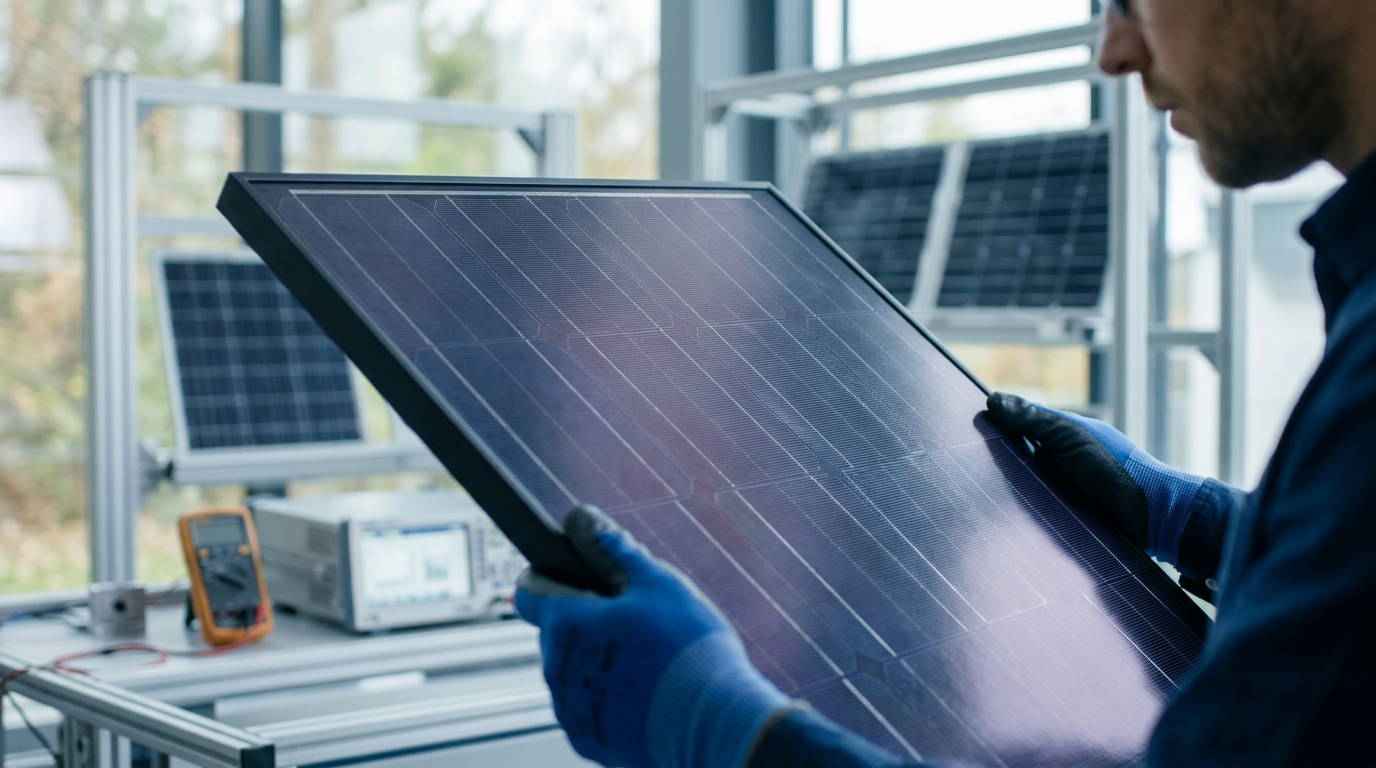
Efficiency records are measured on cells roughly the size of a thumbnail. The widely cited 33.9% record was achieved on about 1 cm². A commercial solar module uses cells covering roughly 1.6 to 2 square meters in total area, and as cell area increases, maintaining uniform film deposition becomes harder and efficiency drops. This is not a minor footnote. Oxford PV’s 26.9% certified module efficiency illustrates the persistent cell-to-module efficiency gap that manufacturing scale must close. Getting from a lab champion cell to a bankable panel is where most clean-tech breakthroughs either grow up or stall out.
The tandem architecture captures a broader slice of the solar spectrum by stacking a wide-bandgap perovskite top cell over a silicon bottom cell, enabling energy extraction from photons that a single-junction cell would waste as heat. The physics are elegant. The manufacturing is not. Stability challenges cluster around familiar degradation vectors: moisture and oxygen ingress, thermally driven phase changes and ion migration, photo-induced halide segregation in mixed-halide systems, and interface degradation at charge-transport layer boundaries.
“The World’s Best Gold Mine Combined with up to 10% Yields”
Fed Chair Kevin Warsh just raised rates…
The irony: higher rates aren’t stopping inflation.
The biggest winner from this inflation: Very specific gold securities.
For example, the world’s best gold mine is yielding up to 10%.
That’s real income that can help any investor protect their wealth from inflation…
Caveat:
The longer you wait to own this security, the more you’ll get crushed by inflation.
The Warranty Problem Is the Investment Problem
For investors evaluating this space, one number matters more than any efficiency record: 25. That is the warranty standard, in years, that silicon modules routinely meet (especially on performance) and that project finance underwriters expect. Oxford PV currently advertises a 10-year product and performance warranty on its Gen 2 modules. UtmoLight has marketed commercial perovskite modules with a 25-year linear degradation warranty. Watching producers cross the 20-year mark in credible, financeable terms is the inflection point for bankability.
Oxford PV’s CEO has said a 20-year lifetime will be critical for commercialization. Developers are less concerned about 40-year panels and more focused on levelized cost of energy. As long as the price premium is offset by increased power production, interest will rise significantly. That framing is useful for investors: the question is not whether perovskite-silicon tandems work, but whether they work long enough to clear the LCOE bar for a utility signing a 20-year offtake agreement.
Encapsulated modules have passed the IEC 61215 damp-heat test at 85°C and 85% humidity for 1,000 hours, with some devices retaining over 95% of initial efficiency after 1,500-plus hours. GCL has reported perovskite modules that obtained IEC 61215 and IEC 61730 certification. Progress, but still below what a pension fund managing infrastructure assets needs to see.
A Forgotten Energy Source Is Powering Back Up
While investors chase the next tech story, one long-ignored sector is quietly heating up. A mix of global policy, rising demand, and tightening supply could reignite this market before 2026. See what the latest research reveals.
Where the Opportunity Sits Now
The most likely near-term winners are the silicon incumbents who already have the factories, customer relationships, and bankability to convert existing production lines to tandem. Hanwha Q CELLS, JinkoSolar, Trina Solar, and LONGi each have manufacturing infrastructure that a pure-play startup cannot replicate quickly. Trinasolar has announced a tandem module delivering 907 watts and 29.2% full-area efficiency, verified by TÜV SÜD.
For growth investors willing to hold a five-year view, the efficiency records signal that the physics problem is largely solved. The durability clock is running, and the companies closing the warranty gap first will own the commercial inflection. Watch the 20-year milestone, not the next lab record.