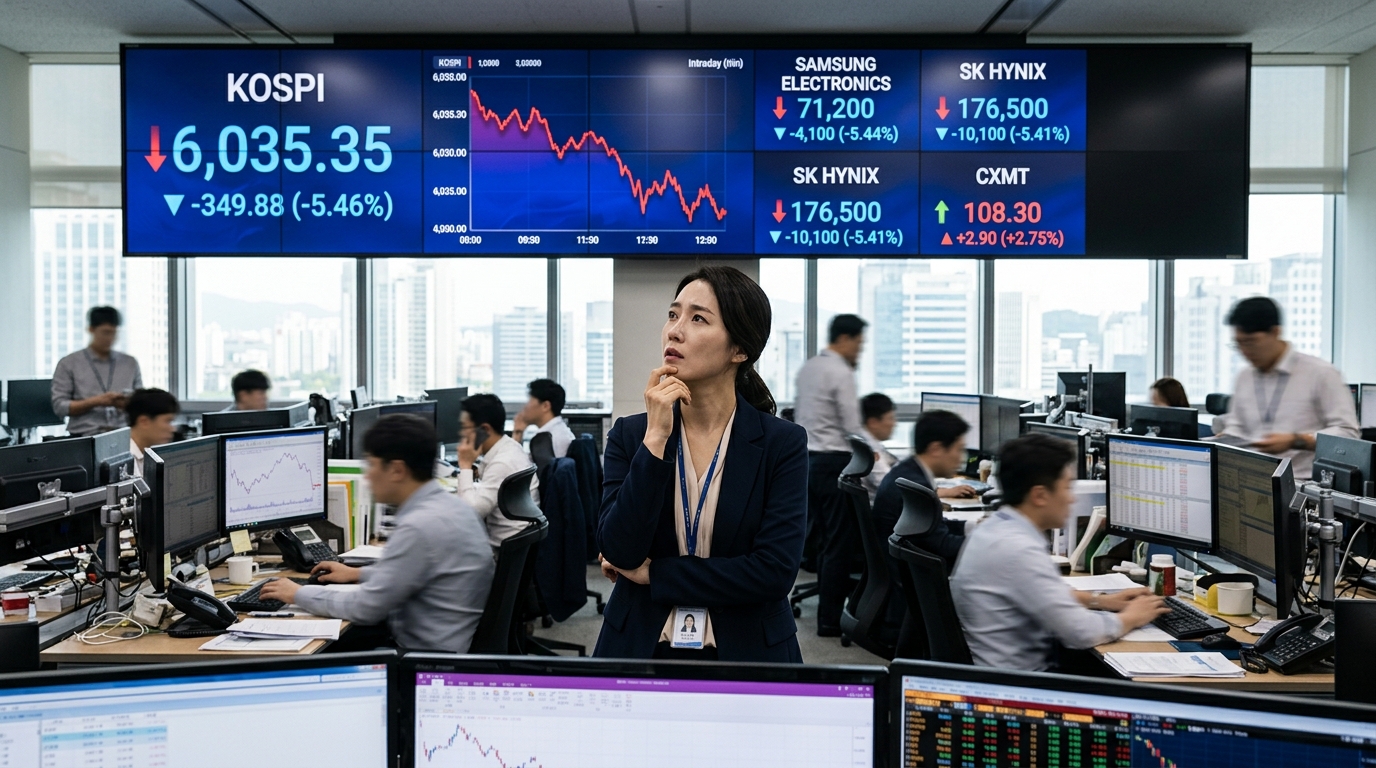
The KOSPI broke below 6,000 intraday on Tuesday for the first time in roughly two and a half months. Yonhap and other local outlets reported the index opened 3.10 percent lower and fell as much as 7.41 percent to an intraday low of 5,911.11 before recovering to close down 5.46 percent at 6,035.35. The trigger that dominated headlines was ChangXin Memory Technologies. The more important story is who was actually selling, and why a Samsung quarter for the record books did nothing to stop them.
Several trade publications reported that CXMT President Cao Kanyu introduced the company’s 4F² DRAM architecture at the Oct. 9-10 Integrated Circuits and Chiplet Conference in Shanghai, and said the company aimed to launch next-generation DDR5 RDIMMs based on the approach by year-end. If CXMT has succeeded, it got there before Samsung and SK Hynix, despite U.S. restrictions that limit Chinese firms’ access to certain advanced chipmaking tools. That last point is what spooked markets. The technological claim has not been independently verified, and the company has not disclosed detailed specifications.
During the Asian session on October 13, chip-linked names sank across the region. Reuters reported Kioxia dropped more than 10% intraday, while South Korea’s largest memory stocks were hit even harder. In the U.S. session Monday, SanDisk closed down 5.97%, Micron fell 3.88%, Seagate fell 3.80%, and Western Digital fell 2.60%. The Roundhill Memory ETF was not spared either: the fund was down about 7.4% for the prior week, according to market data services.
Here is where the analysis diverges from the headline. Korean market coverage pointed to foreigners as the decisive sellers, with net selling of about 4.5 trillion won, roughly $3.4 billion, in KOSPI-listed shares. Retail investors were net buyers of roughly 2.25 trillion won and institutional investors bought about 1.69 trillion won, but their combined buying failed to offset the foreign selloff. CXMT was the excuse. The foreign exit had been building for weeks, and local brokerage commentary has framed the move as part of a broader derisking tied to global rates and AI-linked positioning.
Korean market coverage tied the move to a familiar mix: rising U.S. long-term yields and a fresh fear catalyst in memory. Rising yields reduce the present value of future earnings, and Korean memory stocks are priced for an AI boom that extends years out. The CXMT announcement handed sellers a clean reason to act.
The detail the market ignored entirely: Samsung reported earnings guidance on October 8 estimating Q3 2026 operating profit at about 107.4 trillion won, a record-level quarterly operating profit estimate. Despite the earnings surge, Samsung shares still fell in the following sessions as investors debated whether elevated memory-chip prices and semiconductor margins can hold. The market’s willingness to sell through that number tells you something the CXMT headline alone does not.
On the CXMT claim itself, skepticism is warranted. Some analysts have said a successful 4F² implementation would meaningfully improve CXMT’s competitive position, but they also note that leading memory makers and equipment suppliers have repeatedly described the manufacturing transition as difficult, with a meaningful gap typically separating a conference unveiling from high-yield, high-volume commercialization. And even if products appear, availability does not automatically mean qualification for large-scale server deployments.
In the securities industry, concerns are emerging that if foreign selling continues, the KOSPI could be pushed down to the mid-5,000 level. The data to watch is not CXMT’s next conference slide. It is the direction of U.S. 10-year yields and whether foreign net selling on the KOSPI extends into a sixth consecutive week. Samsung’s full earnings breakdown arrives October 29, when segment-level detail on HBM and server DRAM pricing will either reassert the bull case or confirm that the cycle has already peaked in investors’ minds.