Most coverage of Nvidia’s Vera Rubin platform fixates on transistor counts and exaflop claims. The more durable investment angle sits one layer deeper, at the microscopic junction between silicon and copper where heat either escapes cleanly or backs up and kills performance. That junction is where liquid metal thermal interface materials come in, and the market for them is underpriced relative to what Nvidia’s roadmap now demands.
The numbers make the case directly. Nvidia’s GB200 NVL72 rack is commonly cited at roughly 120 to 132 kilowatts at nominal load, while the Rubin-generation NVL144 CPX has been discussed around 370 kilowatts in some configurations. Air cooling stopped being viable above 50 kilowatts per rack. The Vera Rubin compute and switching trays ship fanless by design, with every chip on a closed liquid loop. That architectural commitment, highlighted at CES in January 2026 when Jensen Huang contrasted 100% liquid-cooling with prior-generation designs, is not reversible. Every rack Nvidia ships from here forward is a thermal engineering problem first.
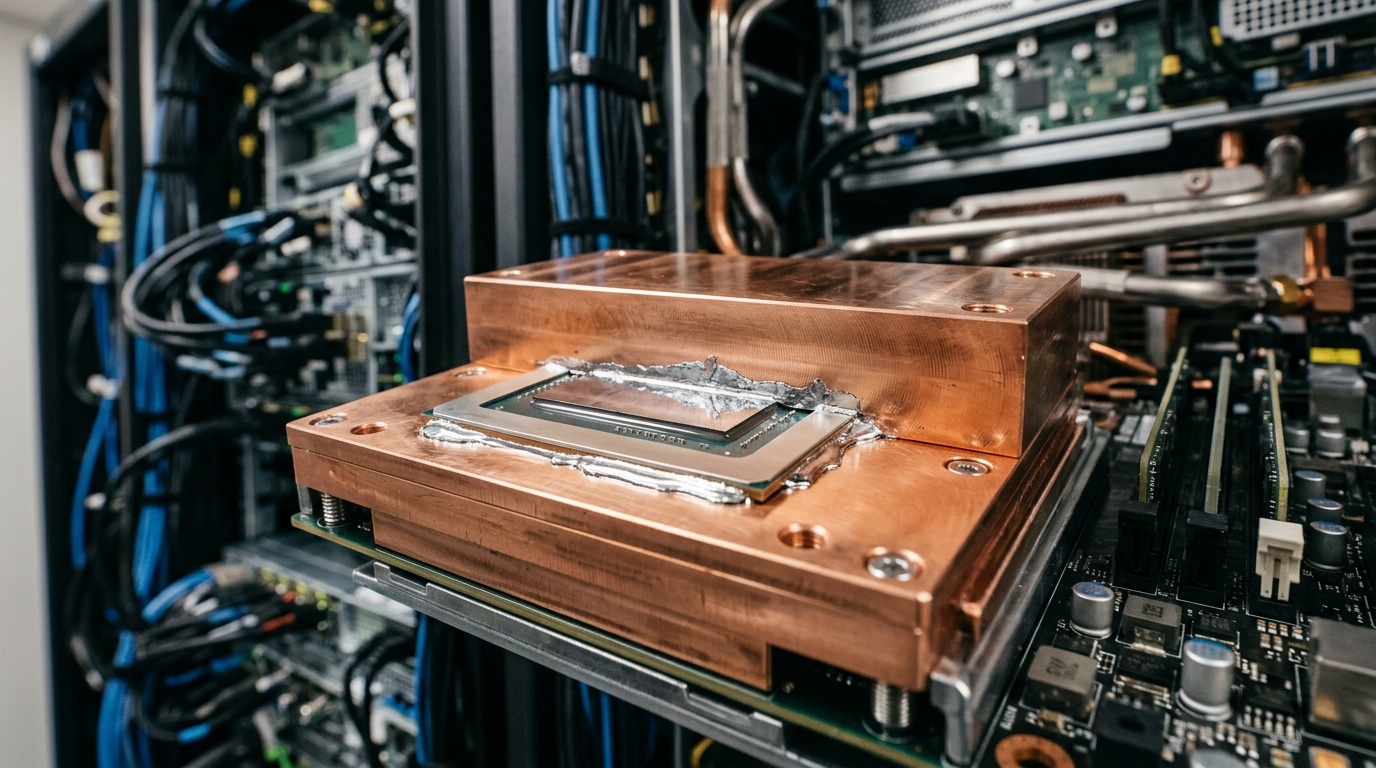
Where liquid metal enters is at the chip package itself. Conventional thermal pastes conduct heat at roughly 5 to 10 watts per meter-kelvin. Gallium-based liquid metal alloys, the same class of material Nvidia used on the GeForce RTX 5090 Founders Edition, are commonly cited around the mid-20s W/mK or higher, depending on the exact formulation and test method, with interface resistance values that standard greases cannot approach. At roughly 1,200 watts per Blackwell B200-class GPU, and with Rubin-generation designs discussed as trending higher in some disclosures and analyst work, that conductivity gap can determine whether a cluster runs at rated throughput or throttles back under sustained inference load.
Nvidia’s own language around Rubin cooling has been precise: the platform targets nearly double the effective rack-level thermal performance versus the prior generation in the same footprint, specifically to sustain performance at higher rack power. That doubling does not happen with paste. It happens with materials that behave like metals because they are metals, gallium-indium-tin alloys that remain liquid at operating temperature and conform to microscopic surface irregularities that solid compounds bridge imperfectly.
Market sizing for liquid metal TIM varies widely by source, with some industry reports placing it at about $92 million in 2025 and projecting roughly $147 million by 2035. Regardless of which forecast one prefers, the direction is consistent with a data center liquid cooling buildout measured in the billions. The TIM layer is a small percentage of total cooling spend, but it is not interchangeable, and switching costs once a platform is qualified are high.
The supply side concentrates the risk. Gallium sourcing runs heavily through China, and specialized formulations for server-grade applications require containment engineering to prevent the alloy from corroding aluminum and creating electrical shorts. That complexity keeps the qualified supplier list short. For investors, Nvidia’s thermal architecture is a forcing function: as Rubin racks ramp through late 2026 and into 2027, the materials upstream of the cold plate matter more, not less.