CAT is trading at $687, down roughly 36% from its all-time high of $1,073 set on June 30. That pullback has happened while the underlying business accelerated. Thursday morning, before the open, Caterpillar reports third-quarter results, and the number that matters most is not earnings per share. It is whether the generator and engine business held its momentum against a roughly $600 million tariff bill.
Why This Stock Now
You do not need to pick a chip winner to own the AI buildout. Caterpillar sells the power equipment that every hyperscale data center needs before a single GPU lights up. The company’s power and energy business benefited from “very strong demand” for large generator sets and turbines used by data centers, with sales of those products to users up 72% in Q2. That kind of growth is happening at a company trading at roughly 29 times trailing earnings, not the 40-plus multiples that semiconductor names command.
The Business
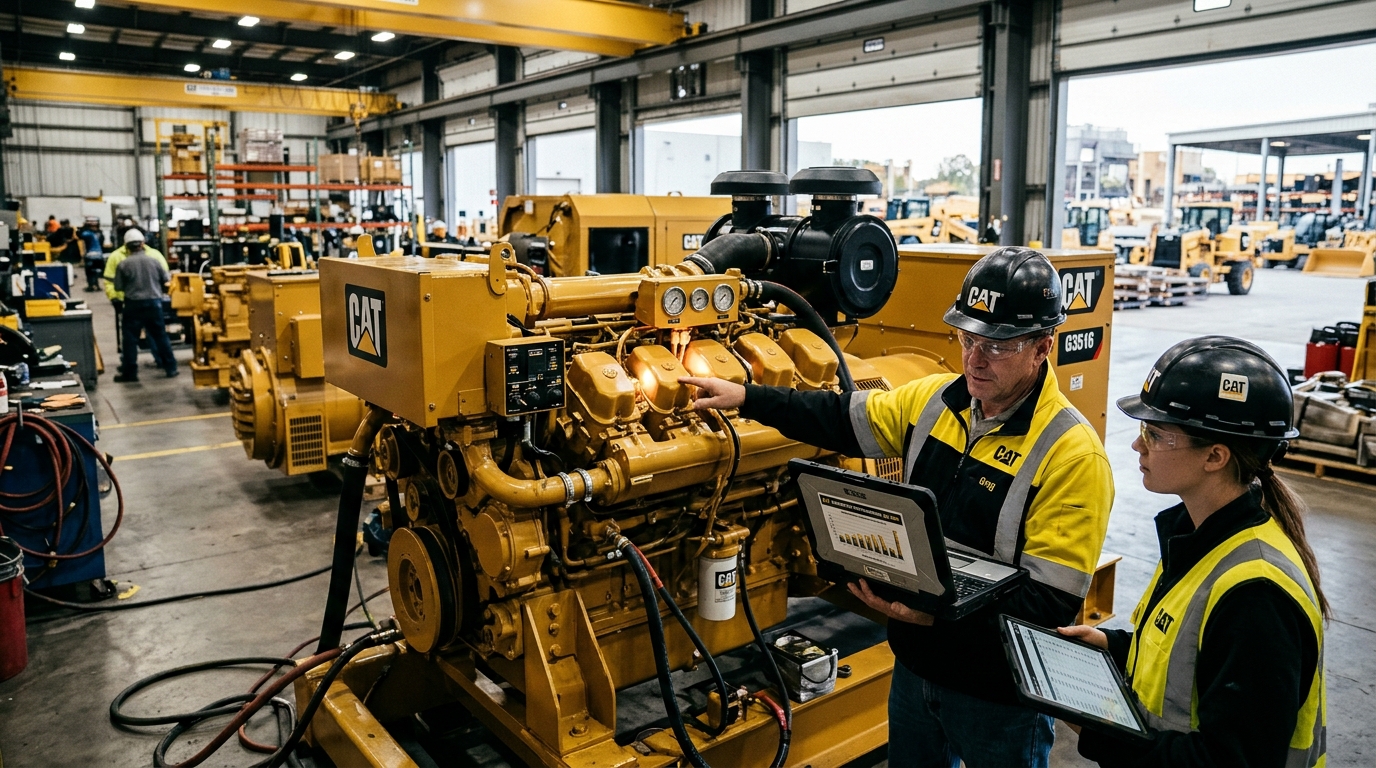
Caterpillar’s power and energy segment is now the company’s biggest and fastest-growing segment. Management continues to anticipate growth in power generation for both reciprocating engines and turbines, driven by increasing energy demand to support data center build-out related to cloud computing and generative AI. The strategic commitment behind that growth is significant: Caterpillar is increasing large reciprocating engine capacity from 2x 2024 levels to nearly 3x 2024 levels. About 1.5 gigawatts of that capacity comes online with first shipments targeted for Q4 2026 over an 18-month ramp, tied directly to AI data center and natural gas power demand behind the record backlog.
Why Wall Street Is Paying Attention
Q2 sales and revenues rose 24% year over year to $20.5 billion. The record backlog is the demand signal institutional money is underwriting. Analysts expect Q3 EPS of about $7.03, up about 42% from the year-ago quarter, and the company has exceeded Wall Street’s EPS estimates in each of its last four quarters. Citi maintains a $950 price target with a Buy rating, implying roughly 38% upside from today’s price. The stock’s 52-week range tells the full story: shares have ranged from roughly $521 to $1,073 over the past year. The current price is closer to the floor than the ceiling.
What’s Driving the Opportunity
Caterpillar is bringing about 1.5 gigawatts of large engine capacity back online, with first shipments in Q4 2026 and an 18-month ramp, a decision tied directly into AI data center and natural gas power demand. That capacity comes with a long order book: turbine orders extend into 2030. Meanwhile, management expects strong growth in the third quarter and mid- to high-teens growth for full-year 2026. For fiscal 2026, analysts project EPS of $27.74, up 45.5% from fiscal 2025. At $687 per share, the forward multiple on those estimates is under 25 times, modest for a company compounding earnings at that rate.
What Could Go Wrong
The tariff line is real and not going away. Caterpillar expects around $2.2 billion of tariff costs for 2026, and about $600 million of that bill lands in Q3. The company’s outlook does not include any further emergency tariff recoveries in the second half of 2026, meaning the Q3 result will not have the $392 million in federal recoveries that flattered Q2 margins. Analyst Jamie Cook also flagged concerns around the durability of power, data-center and AI-related spending, along with infrastructure bottlenecks and higher input costs. And after falling 36% from its peak, CAT lost 18.4% over the three months to October 20 while the S&P 500 gained 3.1%, shares dropped during a rising market. Sentiment is clearly fragile.
The Bottom Line
Caterpillar is not a semiconductor company, and it does not trade like one. That discount is the opportunity. Data center power demand is driving significant growth in power generation sales and has led Caterpillar to raise its long-term sales target to more than 3x 2024 levels by 2030. Thursday’s report tests whether Q3 execution matched that ambition. If it did, the stock’s distance from its June high looks like a valuation gap rather than a fundamental problem. The tariff cost is known, manageable, and mostly priced in. What is not priced in is a continued beat cycle from the fastest-growing segment in industrial America.