
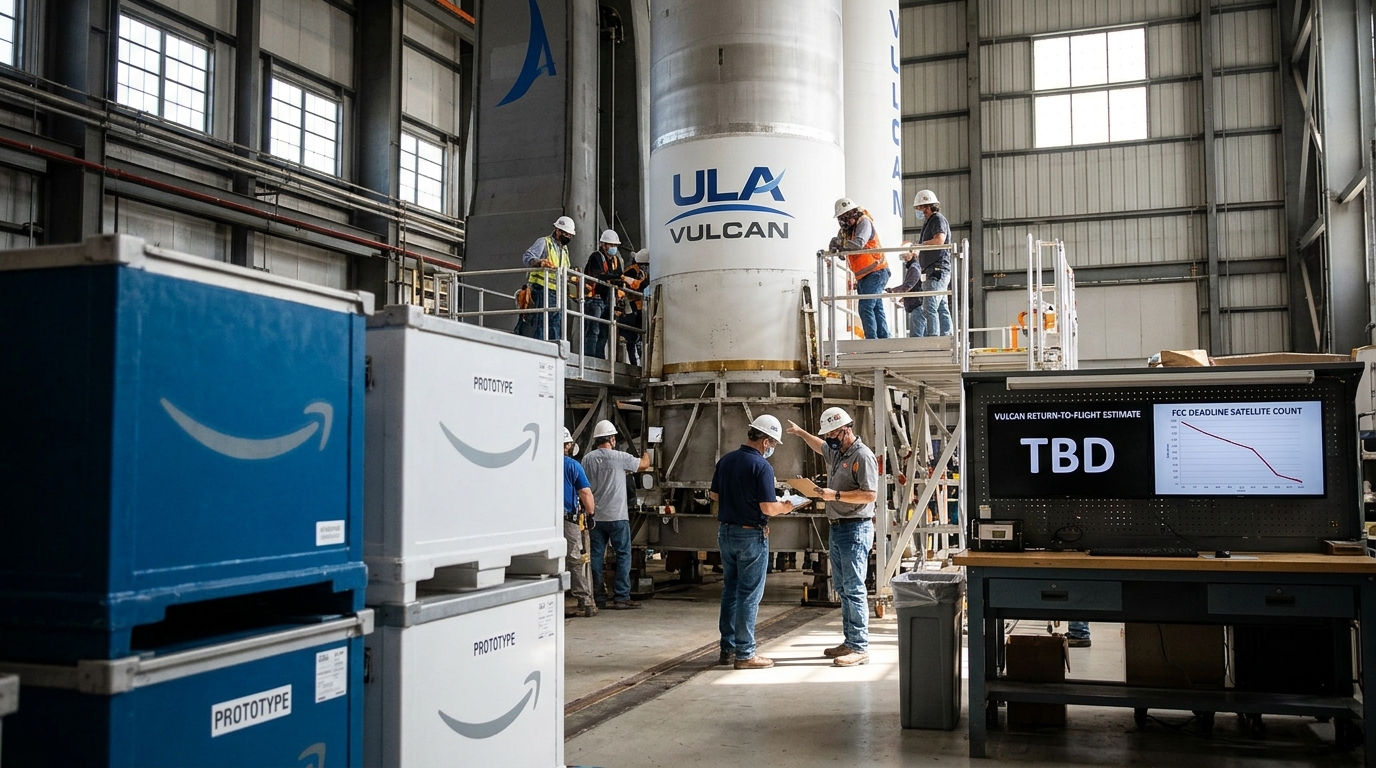
Sunday’s Vulcan failure was not just a bad day for United Launch Alliance. It was a scheduling crisis for Amazon.
The Vulcan Centaur lifted off from Cape Canaveral at 12:40 p.m. ET carrying 40 satellites for the Amazon Leo broadband constellation toward low Earth orbit. They never got there. “Based on data received by our Launch Director, we confirm that the Vulcan vehicle launched from Space Launch Complex 41 suffered an anomaly 10 minutes into the flight and failed to deliver the Amazon mission to orbit,” ULA confirmed in a statement posted about 50 minutes after liftoff.
It was the first outright failure of a United Launch Alliance rocket since the company, a partnership between Boeing and Lockheed Martin, was formed in 2006. Early public indications suggest the problem occurred after stage separation during Centaur operations, but no cause has been confirmed publicly.
What Amazon Actually Lost
The 40 satellites aboard were the largest single launch yet for Amazon Leo. Sunday’s flight was the first of 38 Vulcan missions purchased by Amazon to launch its Leo satellites. That means 37 contracted flights remain, all of them now waiting on an investigation with no timeline. Amazon had said a second Vulcan mission could fly within weeks of the first, and that flight now waits on ULA’s investigation.
The constellation’s current position makes the arithmetic uncomfortable. 392 satellites are in orbit as of November 2026, out of 3,232 licensed for the first generation. Amazon is still required to deploy all 3,232 of its planned Gen 1 satellites by July 30, 2029, as originally mandated. The FCC waived the interim milestone of 1,616 satellites by July 30, 2026, but the final deadline still applies. Missing it could reduce Amazon’s authorization to the number of satellites in use on the milestone date.
A Grounding With No End Date
This is not Vulcan’s first investigation. Vulcan had remained grounded since February 12, 2026, when a solid rocket booster performance anomaly occurred during the USSF-87 mission. The rocket did not return to flight until the Nov. 15, 2026 Amazon mission. Sunday’s failure is a different problem, involving the upper stage rather than the solid boosters, but the precedent is not encouraging. Vulcan faces a potentially significant grounding while engineers review telemetry and implement fixes, and no timeline for a return to flight has been given.
During the February grounding, the Space Force reassigned near-term, time-critical military payloads to SpaceX Falcon 9 and Falcon Heavy rockets, according to Air & Space Forces Magazine. Amazon has no equivalent fallback at the same scale. ULA launched Amazon Leo on Atlas V rockets, but that vehicle is being retired. The next scheduled Amazon launch is an Ariane 6 mission targeting 36 satellites no earlier than November 23, which proceeds on a separate contract.
The Competitive Clock
Amazon’s deployment lag has real consequences. As of late September 2026, SpaceX reported 13.6 million Starlink consumer subscribers, and Starlink is the only LEO broadband service with broad global availability. Every month Vulcan stays grounded is a month Amazon’s commercial service launch slips further, compressing the runway to reach the subscriber base it needs to justify the more than $10 billion it has committed to the program.
What investors should watch is not just when ULA identifies the anomaly, but how long recertification takes and whether Amazon pursues incremental launches on Ariane 6 and New Glenn to hold its pace. Amazon has said it has hundreds of flight-ready satellites ready for launch, so hardware is not the constraint. Getting them to orbit is. With roughly 2,800 satellites still to launch and about 32 months to the FCC’s hard stop, Amazon needs Vulcan flying reliably, and it needs that soon.