The oil market spent most of November selling the idea that Hormuz transits were slowly recovering. Weekend events made that case very hard to hold.
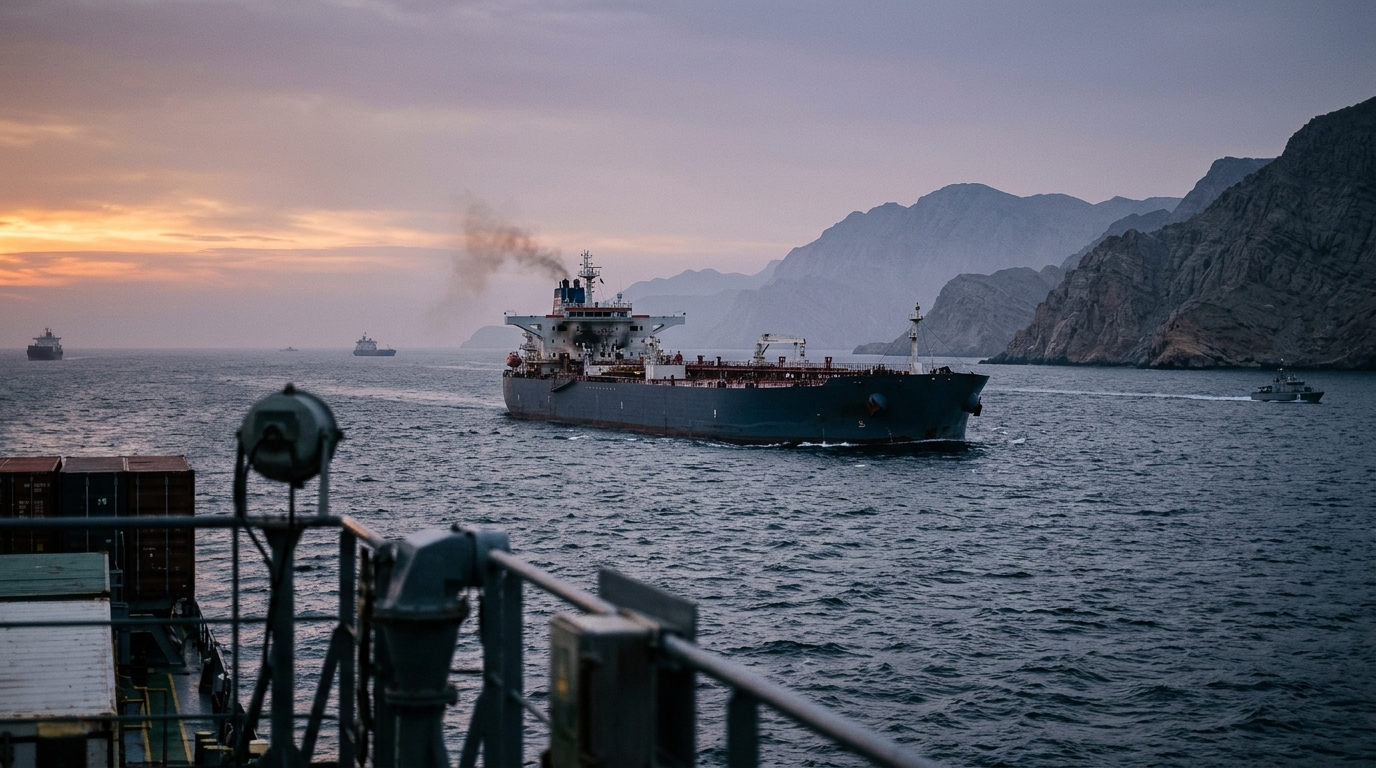
Two tankers sailing outbound through the Strait of Hormuz were hit by unidentified projectiles off Khasab, Oman, UKMTO reported. Within an hour of the first strike, a second outbound tanker was hit in its engine room about 17 nautical miles east of Khasab. Then, separately, Iran’s navy said an oil tanker caught fire after hitting a naval mine in a restricted area east of the Strait of Hormuz. Three incidents, one morning.
These are not isolated events. Reported attacks in and around the Strait of Hormuz have been higher in October and November than in prior months since the U.S.-Israel war with Iran began earlier this year. Iranian statements carried by regional media have also pointed to a sharp increase in reported tanker incidents over the past week.
The freight market registered this escalation before the crude benchmark did. The Baltic Dirty Tanker Index, at 4,812, was up 5.43% on November 19 compared with the day before. Brent, meanwhile, settled Friday at $92.57 for January delivery, down 3.41% on the week, its third consecutive weekly loss, after traders priced a supply surplus and leaned on the idea that alternative routing had largely compensated for Hormuz disruption.
The transit data tells a different story. IMF PortWatch’s most recent published day showed 2 commercial vessel transits on November 15, roughly 2% of the pre-crisis baseline of about 85 vessels per day. Confidence in shipping oil via the Strait of Hormuz has been “shattered,” IEA Executive Director Fatih Birol said on November 19 during the agency’s World Energy Outlook 2026 release.
The divergence between Brent and tanker rates is where the trade lives. Freight markets price physical scarcity and risk in real time. Crude futures price expected supply over weeks. When those two series split this sharply, one of them is wrong. With marine-tracking data showing Hormuz-area crude flows falling sharply in November as attacks intensified, the balance of evidence sits with the tanker market.
Stocks on the Radar
Tanker operators are the most direct expression of this dislocation. Frontline closed at $45.21, and International Seaways closed at $97.10. Both remain well extended above trend, but that premium has been compressing on the de-escalation trade. Teekay Tankers has said it secured fourth-quarter-to-date spot rates averaging $272,000 per day for Suezmaxes and $208,300 per day for Aframax/LR2s, with about 58% of fourth-quarter spot days fixed. Investors sold those stocks anyway, on talk of sanctions relief for shadow-fleet ships that would add supply and on the idea that a deal would drain the freight premium quickly. This weekend’s escalation directly attacks that thesis.
DHT Holdings and International Seaways are among the highest-yielding names in the group, but the exact yield depends on whether you use variable dividends, trailing payouts, or the latest declared quarterly amount. Those payouts are a function of spot rates, and spot rates just moved sharply in the right direction.
The Catalyst: OPEC+ on November 29
OPEC+ meets on Sunday, November 29, with the 2027 production framework expected to be the focus. The bull scenario for Brent, a move toward $97, requires either signals that OPEC+ will hold back supply into 2027, or renewed U.S.-Iran escalation. The weekend’s events handed traders the second condition before the week even opened. If OPEC+ delivers even a mild restraint signal, the gap between $92.57 Brent and a freight market already pricing crisis conditions could close quickly and violently to the upside.
Watch the spread between January and February Brent. February settled at $89.95 on Friday, a $2.62 backwardation that can understate physical tightness if the attack pace holds. The highest-conviction position here is long tanker equities against flat or short Brent, with the OPEC+ decision as the forcing event that resolves the gap one way or the other.