The number that matters most in Amazon’s reported $7.5 billion deal for Decart is not the acquisition price. It is the gap between that price and what Decart was worth six months ago.
Founded in 2023, Decart raised $300 million in May 2026 at a $4 billion valuation, with investors including Nvidia, Sequoia Capital, Benchmark, and Radical Ventures. The startup previously held acquisition discussions with Anthropic at a reported valuation of approximately $6 billion before those negotiations ended. Amazon is now offering nearly double what investors paid for it five months ago. That 88% uplift is a price on urgency, not just on software.
What Amazon Is Actually Buying
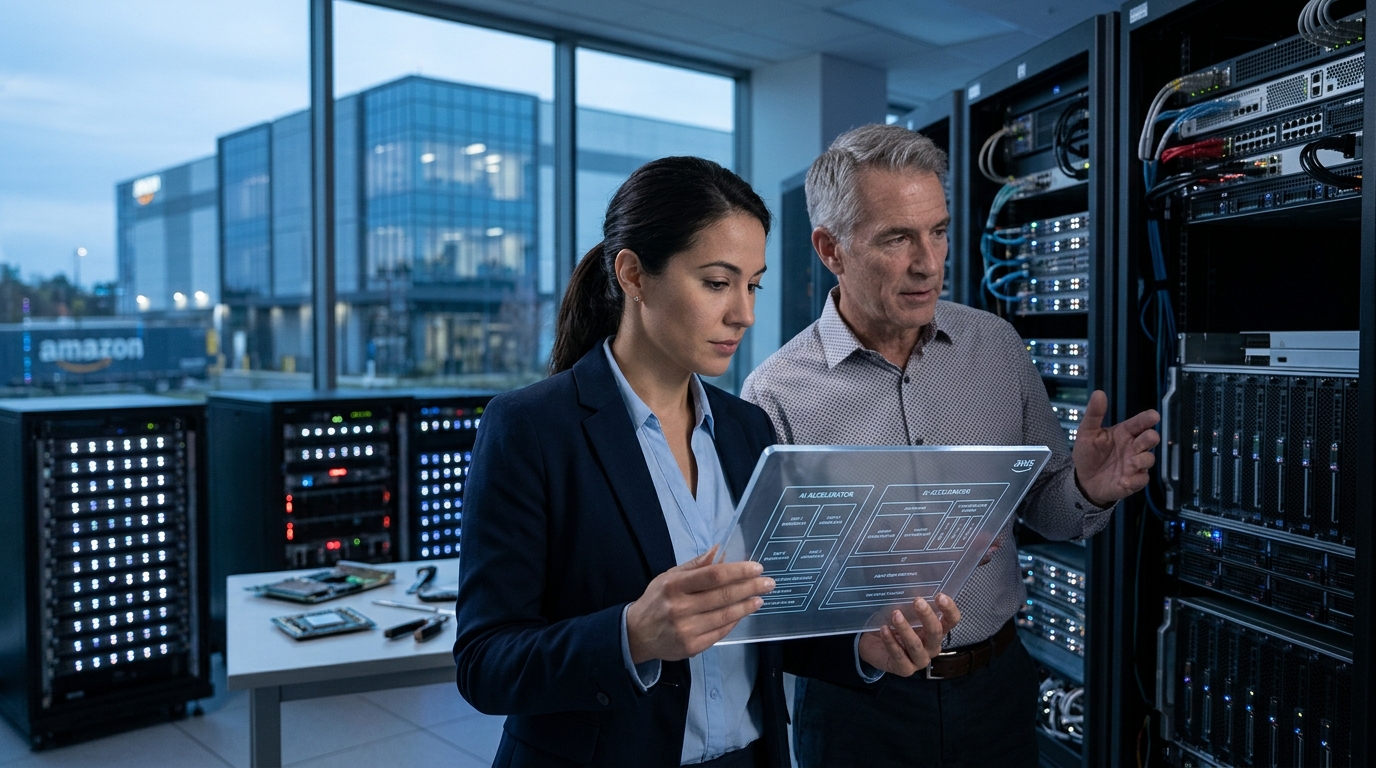
Decart develops the Decart Optimization Stack, or DOS, core software that aims to make AI models run more efficiently across different accelerators. Decart has claimed its DOS optimization stack can make models run up to 8x faster on the same hardware, including Nvidia GPUs, Google TPUs, and Amazon Trainium. The critical word is “including.” DOS is hardware-agnostic by design, which is exactly why AWS wants it.
On Amazon’s Trainium chip family specifically, Decart has publicly pointed to results such as roughly 80% utilization and large gains in throughput on video workloads. AWS has highlighted Decart on its Trainium customer page, citing early testing that showed up to 4x higher frame throughput and 2x better cost efficiency compared with top GPUs. DOS may also shorten the porting process for some teams by reducing low-level optimization work, but the timeline varies by workload and maturity of the surrounding software stack. If DOS becomes a first-party AWS tool, every Trainium customer could gain access to an optimization layer that currently requires engaging with Decart separately, potentially driving meaningful pull toward Trainium adoption across AWS’s enterprise base.
The Bull Case for NVDA Skeptics
Fund managers who have spent 2026 arguing that Nvidia’s software advantage is eroding now have a data point. J.P. Morgan’s Eye on the Market note says Nvidia has a 28% share of announced frontier lab compute agreements, and contrasts that with a prior period when Nvidia’s share was far higher. Separately, Anthropic told IPO investors that its Claude Mythos model helped get an Anthropic model running on AMD Instinct hardware in around three days, a development that, if it generalizes, would lessen switching costs that have historically reinforced CUDA’s moat.
These are forward-looking contract shares, not current revenue. Nvidia reported revenue of $96.2 billion in its second fiscal quarter, up 106% from a year ago. The quarter is unambiguously strong. The debate is about what happens to the next three years of pricing power when switching costs fall.
The Bear Case for NVDA Bulls
The CUDA moat will not vanish overnight. But the segment where CUDA’s moat is strongest is becoming a smaller share of total compute, while the segment where it is weakest is becoming the larger share. Amazon’s deal does not break that moat today. It funds the engineering effort to make breaking it routine.
Amazon has talked up rapid growth in its chips business, but it has not disclosed a figure of “$225 billion in revenue commitments for Trainium.” Against the scale of AWS’s infrastructure ambitions, $7.5 billion for software that makes Trainium easier to adopt can still look less like a bold bet and more like a tool to reduce friction in a committed platform shift.
Stocks to Watch
Amazon (AMZN) is the obvious one. If Amazon integrates DOS as a first-party tool for AWS customers, it could accelerate Trainium adoption across its cloud base, potentially delivering returns far exceeding the reported acquisition price.
Nvidia (NVDA) faces the clearest long-term pressure. Every dollar of Trainium workload that DOS enables is a dollar that does not renew on Nvidia silicon. The revenue impact is not visible yet. The contract share data says it is coming.
Broadcom (AVGO) is the overlooked beneficiary. J.P. Morgan’s Eye on the Market note puts Nvidia at 28% of announced frontier lab compute agreements, with custom chips from Broadcom at 23% and AMD GPUs at 18%. A world where CUDA lock-in weakens is a world where custom silicon from Broadcom gains ground, regardless of who wins the Amazon-Nvidia contest.
Alphabet (GOOGL) deserves attention for a subtler reason. Decart has said DOS runs on Google TPUs. If Amazon acquires the company and curtails third-party access to that optimization layer, Google could lose a performance lever it did not build itself. That tension will be worth watching in the weeks after a deal closes.