The power purchase agreement was supposed to be a sustainability gesture: a tech company writes a long-term check to a wind farm, accountants log the renewable energy credits, and everyone moves on. That model is dead. What replaced it is something closer to vertical integration in the electricity business.
U.S. utilities and companies signed 96 clean-power contracts totaling 28.1 GW in the first half of 2026, up from roughly 22.4 GW a year earlier. Solar-only agreements covered a little over 10 GW across 46 transactions, with Meta and Google as the two largest buyers. Meta accounted for 9.83 GW of deal volume; Google represented 6.47 GW. Together they claimed more than half of all U.S. clean-power contracting in the period.
The scale alone is striking. The reason behind it is more important.
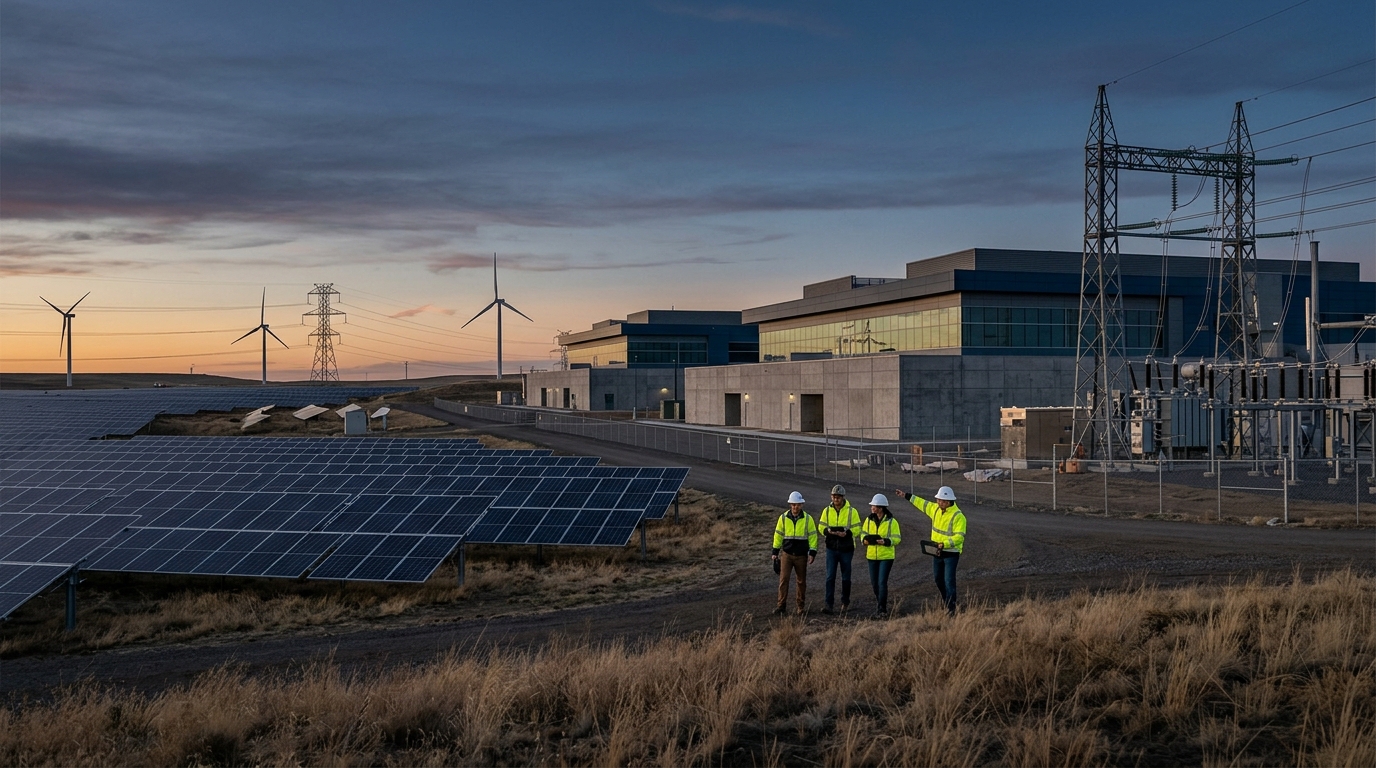
Large-scale data centers now face three to seven year wait times for grid connectivity, forcing a pivot toward behind-the-meter and islanded power configurations. Signing a PPA with a solar developer used to mean buying electrons delivered through the shared grid. Now it increasingly means building a private power plant next to the data center and never touching the public grid at all. Claims of a specific first Google-owned “Energy Park” entering operations in March 2026 with 500 MW of behind-the-meter solar and 2 GWh of battery storage could not be independently verified in primary, on-the-record reporting, so treat that example as unconfirmed.
Google acquired Intersect in late 2025 for $4.75 billion in cash, plus the assumption of debt, giving it in-house energy and data center infrastructure capability, and continued signing additional PPA agreements on top of that. In February 2026, TotalEnergies signed two 15-year PPAs with Google to deliver 1 GW of solar capacity for Google’s Texas data centers, covering the 805 MW Wichita and 195 MW Mustang Creek projects. Then in 2026, Cypress Creek and Google disclosed a major agreement tied to the Steel River Energy Center in Arkansas, with the first two phases delivering 1.6 GWdc of solar capacity and 1.9 GWh of battery storage.
For investors, the clearest opportunity is not in the tech companies themselves. It is in the developers and equipment suppliers who are effectively building a private grid for four customers. These tech giants are accelerating clean energy deployment quickly, and their deep pockets and long-term contracts provide the financial certainty that renewable developers have long needed. A 15-year contract from Google is collateral a bank can underwrite. A renewable energy credit program is not.
The surge in power demand from data centers is reshaping electricity markets across major grid regions. The Natural Resources Defense Council estimates cumulative capacity costs could reach $163 billion through 2033, translating to roughly $70 per month in additional costs for the average household in the PJM region. That is the paradox every retail energy consumer should understand: the same deals lowering compute costs for cloud providers may raise residential electricity bills.
The clean energy PPA started as a corporate responsibility line item. It has become the primary bottleneck determining where AI infrastructure gets built and how fast. Investors who treat this as an environmental story are missing the operational one.