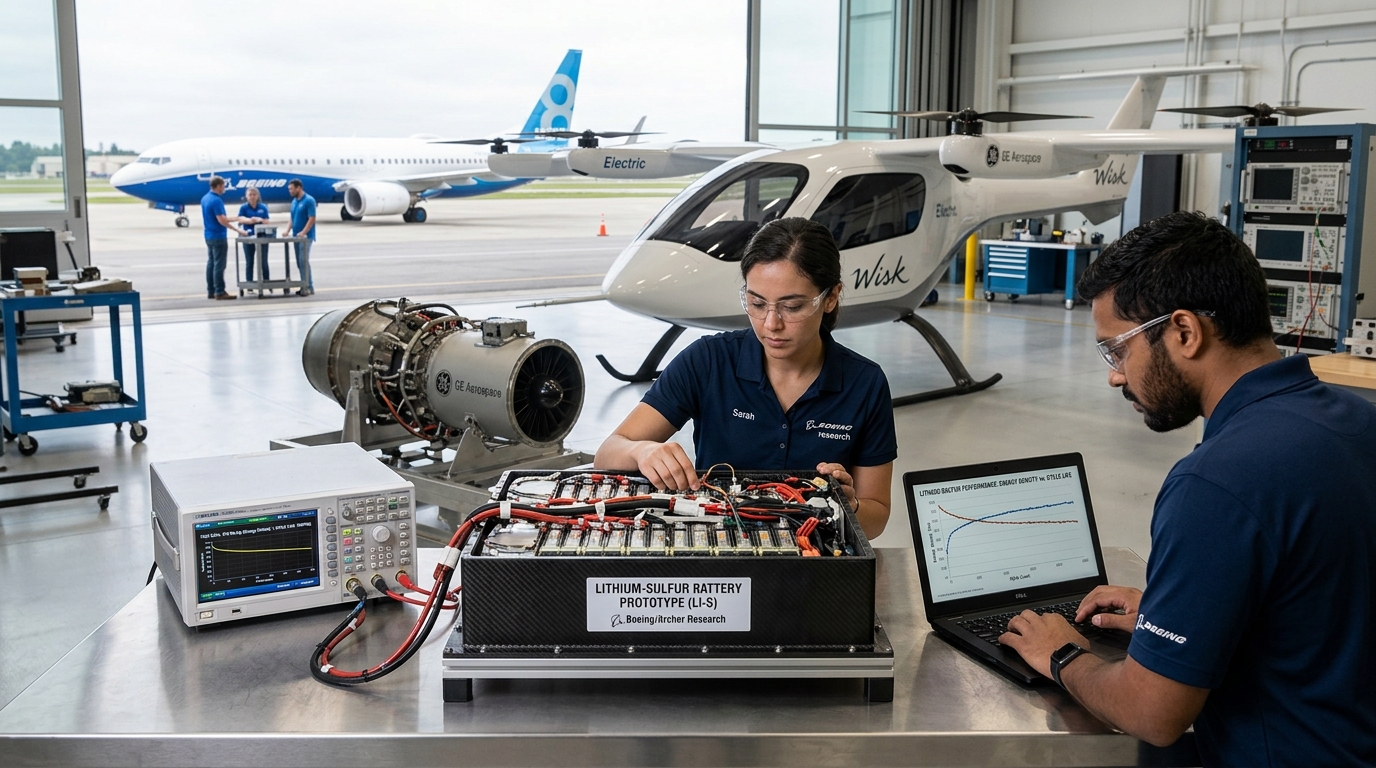
Boeing made a move this past August that reframed how the aerospace industry thinks about electric flight. The company agreed to sell three subsidiaries, including autonomous aircraft maker Wisk Aero, to eVTOL startup Archer Aviation in an all-stock deal, becoming a strategic partner in Archer and taking a roughly 16.5 percent stake in the company. Separately, in collaboration with NASA, GE Aerospace, and BETA Technologies, Boeing took part in the first hybrid-electric-powered flight above 30,000 feet, reaching the same altitude band as passenger commercial aircraft. The direction is unmistakable. Boeing wants a seat at the table when electric regional aviation scales.
The chemistry that could make that vision commercially viable is lithium-sulfur. Lithium-sulfur batteries are often described as having a theoretical specific energy around 2,500 Wh/kg, far higher than today’s lithium-ion packs, and the technology has long been touted as a path to longer-range electric aircraft. For regional routes, the math is compelling. Multiple studies and aerospace roadmaps put all-electric regional aircraft in the neighborhood of 500 Wh/kg at the pack level, a threshold current commercial lithium-ion systems do not reach. Lithium-sulfur, in theory, clears that bar with room to spare.
In practice, the gap between theory and a certified commercial pack is wide. Lithium-ion is widely deployed in aerospace applications, but lithium-sulfur remains closer to early-stage development than to a flight-certified, high-cycle aviation battery. That instability has a precise cause: the polysulfide shuttle effect, where intermediate lithium polysulfide species dissolve into the electrolyte, migrate, and drive rapid capacity fade and loss of active material.
Lyten, the most visible Li-S startup targeting aviation, says its 3D graphene-based approach is designed to suppress the shuttle effect and targets cell-level specific energy beyond 500 Wh/kg while aiming for practical reliability. The company announced plans to build a lithium-sulfur gigafactory near Reno, Nevada, with a stated investment of more than $1 billion and a planned annual capacity of up to 10 gigawatt-hours. The ambition is real. So is the certification wall it still has to climb.
Today’s aviation safety and certification guidance is largely written around lithium battery systems as they exist in service, and new chemistries typically end up certified through aircraft- and installation-specific compliance paths rather than a neat, chemistry-labeled rulebook. That leaves manufacturers navigating uncertainty about what additional test evidence and safety mitigations regulators will require for Li-S at scale. For commercial operators, concerns that battery replacement costs and cycle-life limits could make electric aviation more expensive per seat-mile than turboprops remain a live issue. If electric regional aircraft are going to compete on economics, cycle life at the pack level has to be measured in the thousands, not the hundreds.
The investment angle here is not a binary bet on Li-S winning. It is a more nuanced read: Boeing’s electric pivot accelerates demand for whatever chemistry solves the cycle-life problem first. Lyten, Zeta Energy, and Theion are all racing toward that outcome. The winner supplies the pack Boeing’s partners fly. That is the real bet worth tracking.