
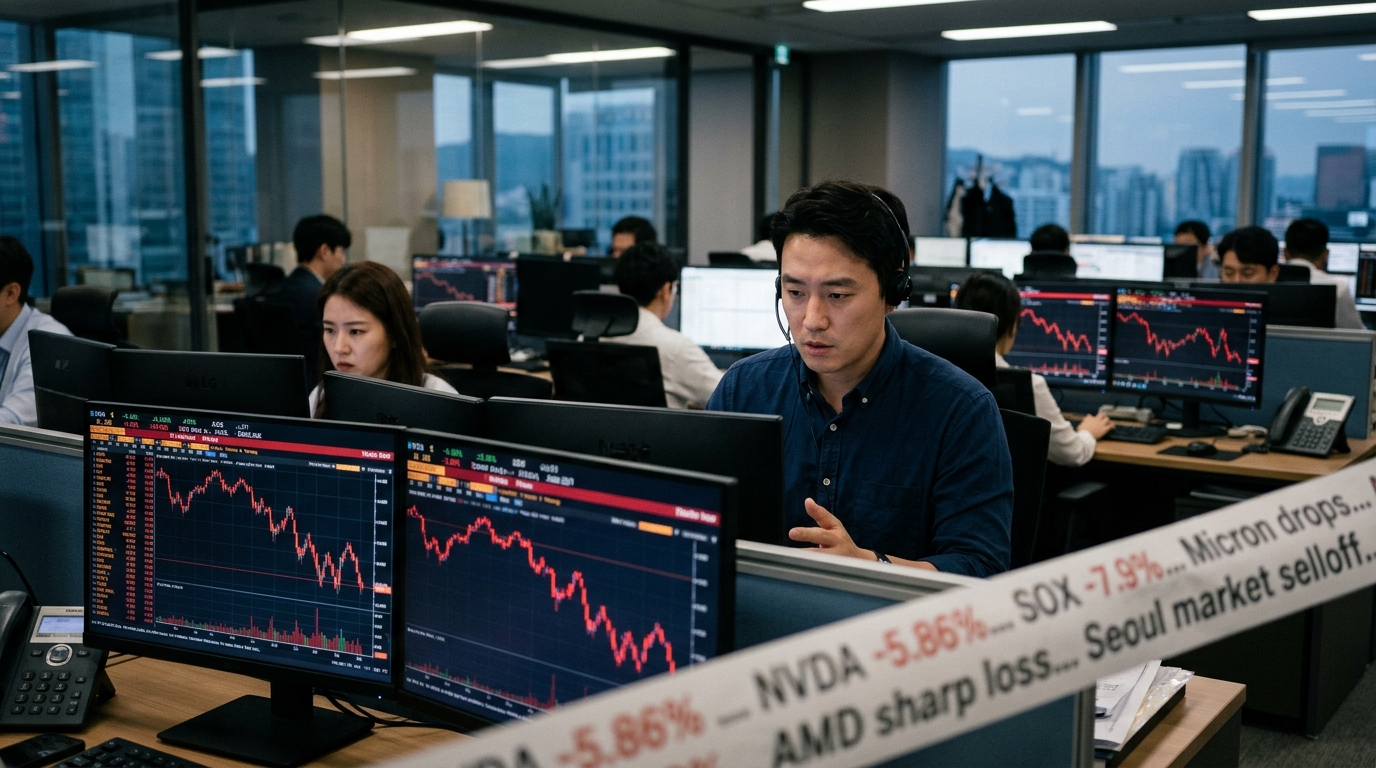
Monday’s 31.5% surge in Nvidia lasted exactly one trading session. Nvidia finished Tuesday at $155.38, a drop of 5.86%, as selling returned to semiconductor shares after the dramatic rebound. The broader damage was sharper: the Philadelphia Semiconductor Index plunged 7.9% on Tuesday, while Nvidia fell 5.9% and Micron and AMD also suffered sharp losses. Micron lost 10.97%, Marvell fell 9.10%, AMD declined 8.86%, and Arm dropped 8.55% during the session.
The Nasdaq Composite dropped 1.5%, although the Dow Jones Industrial Average gained 0.9%, highlighting the concentration of selling in technology and AI-linked shares. That split matters. It is not a risk-off market. It is a rotation.
Asia confirmed it overnight. The Kospi ended at 4,697.51, down 6.16% from the previous session, as large-cap AI chip shares including Samsung Electronics and SK Hynix tumbled, driving the index lower. The Korea Exchange briefly suspended programme trading after futures linked to the Kospi fell more than 5%. SK Hynix dropped 11.1% and Samsung Electronics fell 9.9%, while SoftBank Group lost 14.8% and Kioxia fell 14.2%. The Nikkei 225 closed at 57,011.62, down 1,633 points, or 2.78%.
Goldman Sachs framed it cleanly. Goldman’s technology, media and telecom desk argued that “better sentiment is not the same as a clearing event for semis,” and that fundamental questions around AI investment returns, data-center restrictions, and China-related regulatory exposure remain unresolved. Those questions include the sector’s cost of capital, fears of data center restrictions after the Democratic sweep, China-related regulatory concerns, oversupply worries, and whether AI revenue can justify heavy capital spending. Jensen Huang’s reinstatement removed a headline, not an overhang.
The retreat reflects a swift shift in investor sentiment as the market confronts the reality that Huang’s return, while removing a key leadership overhang, leaves a long list of structural risks entirely intact, including intensifying scrutiny in Washington over chip-export compliance and growing calls from lawmakers for Huang to testify publicly.
Where the Trade Is
The short side: memory and equipment names with the heaviest Asian exposure remain the highest-conviction fades on any bounce. SK Hynix and Samsung are down more than 9% each in Seoul with foreign outflows accelerating. NVDA itself is still approximately 24% below its 50-day moving average of $204.95, and premarket action Wednesday showed another 5.3% decline. AMD and Micron have broken intermediate support with volume.
The long side is across the Atlantic. European stocks traded higher on Wednesday, with all four major indices in positive territory despite a tech-led selloff in Asia and on Wall Street. Automobile stocks led sectoral gains, jumping 3.3% after J.P. Morgan reiterated its preference for truckmakers, tyre makers, and luxury carmakers. Volkswagen and BMW rose 5.2% and 4.9%, respectively.
The personal and household goods sector rose 1.9%, with Swatch Group and Richemont up 6% and 3% respectively. Sentiment toward luxury stocks improved after Remy Cointreau unveiled new sales and profit targets through fiscal 2031/32 and raised its operating margin outlook for the current year. Shares of the French spirits maker jumped 10.2%.
“Investors are looking for increased diversification and value, and European stocks, UK stocks are certainly providing that option because there are industries that people know and understand,” said Danni Hewson, head of financial analysis at AJ Bell.
The Plan
The Dow’s 0.9% gain Tuesday while the Nasdaq dropped 1.5% is the tell. Capital is moving from AI infrastructure into old-economy earnings visibility. European autos and luxury, U.S. healthcare, and consumer staples are absorbing that flow today. Fade strength in NVDA, AMD, and MU on any technical bounce toward prior support levels that have now flipped to resistance. Watch Nasdaq futures closely: premarket Wednesday, Nvidia fell 5.3% to $147.20, Micron dropped 5.9% to $592.88, and AMD slid 5.7% to $389.69. Those are the levels that define whether this is a two-day flush or something that runs into month-end.