October 9, 2026
An $8 billion bet on 800 MHz airwaves tests the toughest claim AT&T, Verizon, and T-Mobile kept making.
For two years, the chief executives of AT&T, Verizon, and T-Mobile had one reliable line of defense against Starlink: walls. Satellites are fine for hiking trails and disaster zones, the argument went, but they cannot push a signal through drywall, concrete, or steel. AT&T CEO John Stankey said on September 9, 2026 that direct-to-cell satellite is “solving the last 2%, not trying to come up with a new way to solve the 98%,” meaning the fraction of Americans in genuinely remote locations. That argument got harder to maintain October 8.
The Stocks That Pop 500% in Days
I’ve spent 25+ years hunting these tiny stocks. They always fire the same 3 signals first. Click here to grab the setup before the next Supernova pops 100%, 500%, or more.
On that date, SpaceX announced a definitive agreement to acquire the nationwide 800 MHz low-band spectrum portfolio held by Grain Management, equipping Starlink Mobile with up to 14 MHz of paired terrestrial low-band airwaves across the United States. The Wall Street Journal reported the price at about $8 billion. The market’s verdict was swift: Verizon closed down about 8.75%. T-Mobile dropped about 13.27% and AT&T fell about 9.81%.
Why 800 MHz Changes Everything
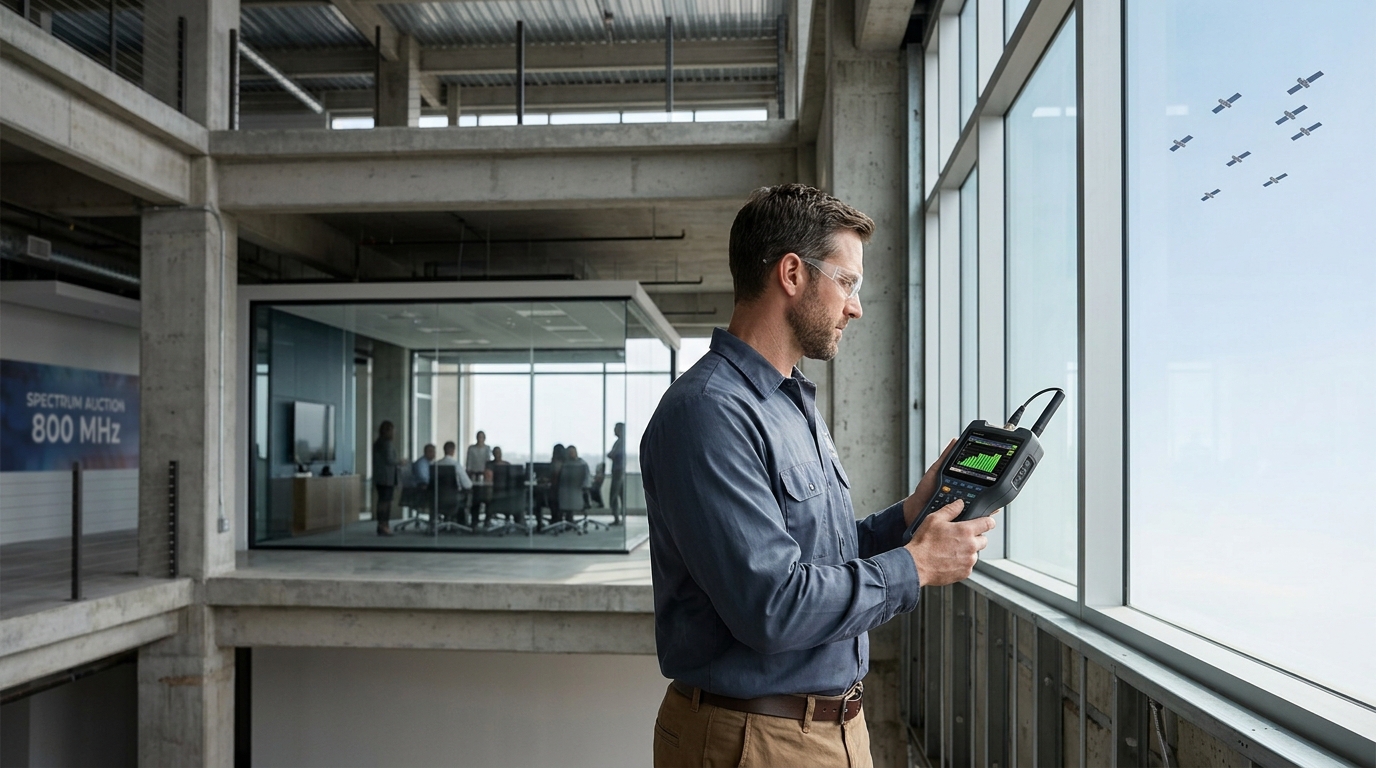
Spectrum is not interchangeable. The 800 MHz band offers wider mobile coverage, especially inside buildings, and lower-frequency signals generally travel farther and penetrate structures more effectively than higher-frequency spectrum. That is the precise technical limitation AT&T spent months pointing to.
Still, it is important not to overstate what was announced. Buying terrestrial 800 MHz licenses does not, by itself, mean satellites can suddenly deliver stable 5G service inside homes and offices with standard phones at scale. SpaceX has said Starlink Mobile will deploy a flexible architecture combining satellite and terrestrial deployment “once we receive final FCC approval.” And the company’s newly authorized 15,000-satellite Starlink Mobile constellation relates to direct-to-device approvals in mobile-satellite spectrum, not an automatic green light to operate a nationwide terrestrial cellular network using the acquired 800 MHz licenses.
Your Power Bill Is Funding the AI Boom
The bulk order that keeps the lights on across 13 states just jumped from $2.2 billion to $14.7 billion – nearly 7x in one year – because data centers are draining the grid. There’s one energy source that runs 24/7 with no fuel, and Washington just preserved its tax credits through 2033 while terminating everyone else’s. Google signed for 15 years. Bill Gates invested $100 million. One company has spent sixty years building it.
The spectrum itself traveled a revealing path. The 800 MHz licenses were originally held by T-Mobile. Grain Management completed an acquisition of the portfolio from T-Mobile in August 2026, paying $2.9 billion in cash plus 600 MHz spectrum licenses. About two months later, Grain agreed to sell those same licenses to SpaceX. In other words, spectrum T-Mobile let go may now be incorporated into the plans of a potential future competitor.
What Investors Should Weigh
The sell-off in carrier shares may be pricing in a worst-case outcome, but the threat is structural rather than immediate. FCC approval is not guaranteed, and SpaceX itself has said Starlink Mobile’s satellite-plus-terrestrial approach will deploy “once we receive final FCC approval.” Second-generation Starlink Mobile satellites capable of handling real capacity are not expected until 2027. Building out ground-level base stations at meaningful density takes years and capital.
Still, concerns have escalated across Wall Street that Starlink could disrupt legacy wireless operators by transitioning from a rural broadband service into a more direct mobile competitor, following its strategic acquisition of terrestrial spectrum and rapid deployment of advanced satellites. KeyBanc analyst Brandon Nispel noted that the spectrum purchase “appears” to make SpaceX’s terrestrial plans more credible, particularly because low-band spectrum helps coverage and in-building reach.
For investors holding AT&T or Verizon for their dividends, the near-term income stream looks intact. Both companies generate substantial free cash flow from long-term contracts and infrastructure that SpaceX cannot replicate overnight. The medium-term risk is customer acquisition cost: if Starlink Mobile can offer competitive pricing without traditional tower overhead, the carriers will have to respond by cutting prices or accelerating their own satellite partnerships.
King of Tech: “New IPO Will CRUSH SpaceX and OpenAI”
SpaceX lost $4 billion in one quarter. OpenAI lost $39 billion last year. But the REAL #1 IPO of 2026 projects a profit of $559 million in one quarter!
The One Counterargument Worth Taking Seriously
Dead zone coverage is one problem. Competing with Verizon or T-Mobile on speed, reliability, and capacity in a city or suburb is a different one. Carriers have spent years building dense tower grids because urban users generate the most traffic. SpaceX has not demonstrated it can match that density with terrestrial deployments plus satellite backhaul.
Satellite beams must cover vast geographic footprints, and thousands of users inside a single cell must share the same pool of spectrum. That makes early direct-to-device links better suited to basic connectivity and coverage extensions than to replacing dense urban cellular networks for high-throughput use cases like video streaming.
The carriers’ dead-zone argument is weaker. Their density argument is not. That distinction, more than today’s stock prices, is the one worth tracking.