The story most investors are watching with FedEx is the cost-cutting one. The company generated $4.7 billion in adjusted free cash flow in fiscal 2026, up $800 million from the prior year, converting nearly 100% of adjusted net income into cash. Capital spending totaled $3.8 billion, a decrease of $246 million from fiscal 2025, with capital spending as a percentage of revenue declining to 4.0%, the lowest annual level in FedEx Corporation history. That discipline is real, and the market has rewarded it.
But there is a second story running underneath the financial engineering, and it is about physical geography.
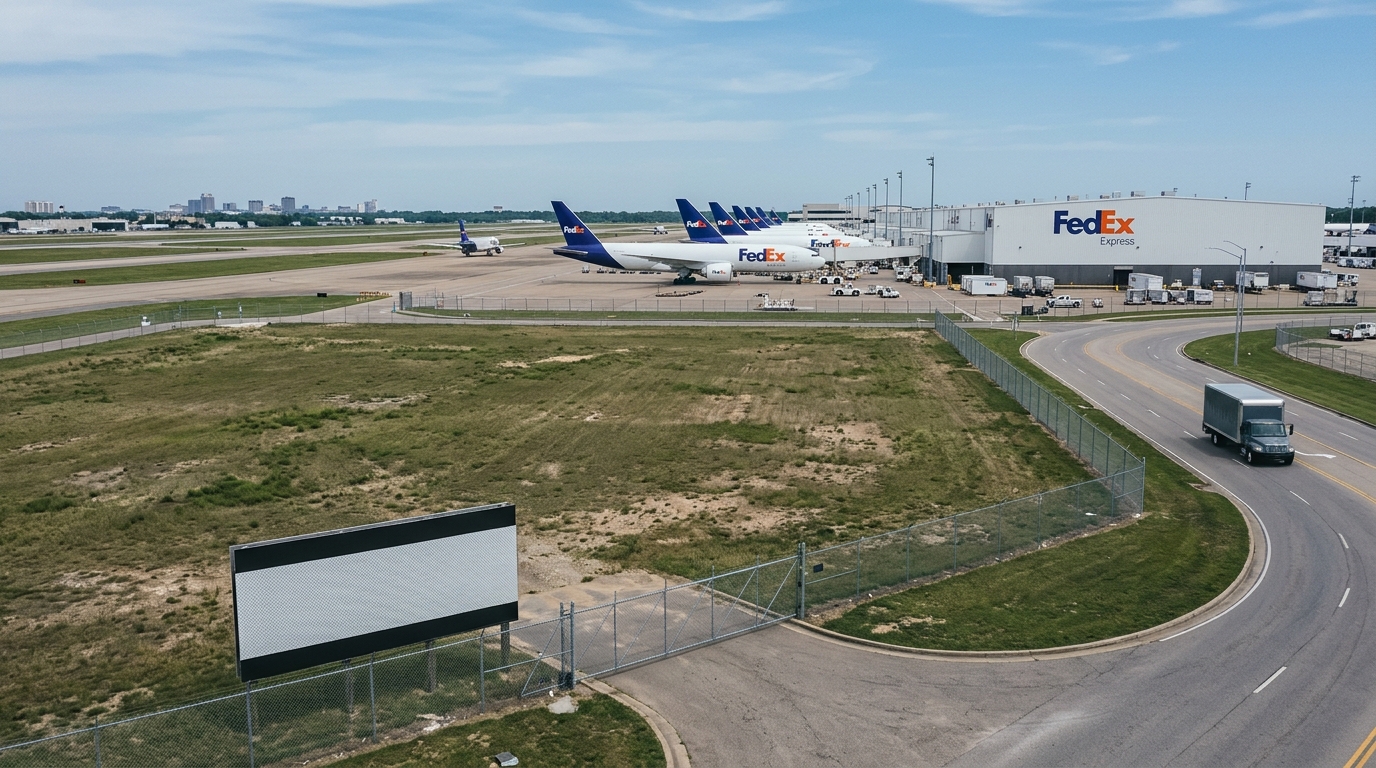
FedEx is not merely trimming costs at existing facilities. It is simultaneously planting its flag at the airports that will define global trade flows for the next two decades. In August 2026, FedEx announced plans to develop a new integrated air cargo hub at GMR Cargo City at Delhi’s Indira Gandhi International Airport, representing a long-term investment of approximately $150 million. Spread across approximately 230,000 square feet, the facility is designed to bring international gateway and pickup-and-delivery operations together within a single building. Six months earlier, FedEx broke ground on a fully automated air cargo hub at Navi Mumbai International Airport, committing ₹2,500 crore in long-term investment to support a proposed 300,000 square foot facility developed in partnership with Adani Airport Holdings.
These are not warehouse leases. They are long-term infrastructure commitments at airports being built to handle volumes that do not yet exist, securing positions that competitors cannot easily replicate later.
The real estate logic is compelling. In a CBRE analysis of large industrial leases, properties within five miles of certain major cargo airports commanded rent premiums of 24% or more versus their broader markets. Miami International Airport handled a record 3.4 million tons of freight in 2025, a 13.2% increase from the prior year. Proximity to the runway is not a convenience, it is a pricing moat. A carrier that controls airport-adjacent space controls the clock on last-mile delivery speed.
One widely cited Prologis forecast projects global industrial completions at 474 million square feet in 2026, the lowest level since 2018. That supply constraint makes early-mover positions at strategic airports increasingly difficult to displace.
FedEx’s Network 2.0 strategy is usually described as a domestic cost story, combining Express and Ground routes under one roof to cut redundancy. Management has said pickup and delivery cost is down by about 10% in integrated U.S. markets. But the international hub investments reveal a parallel ambition: controlling the physical real estate where air freight transitions into ground delivery in markets growing far faster than the U.S.
For investors, the question is whether the market is pricing both sides of this trade. FDX gets credit for cash generation and cost discipline. It gets far less credit for the compound value of exclusive positions at airports where air cargo capacity, in cities like Delhi and Mumbai, is scaling from hundreds of thousands of tonnes toward millions. Those positions depreciate slowly, and they compound quietly.
The competitive pressure on that valuation gap is real and accelerating. Retailers building automated fulfillment at scale are internalizing logistics capacity that once flowed through carriers like FedEx.