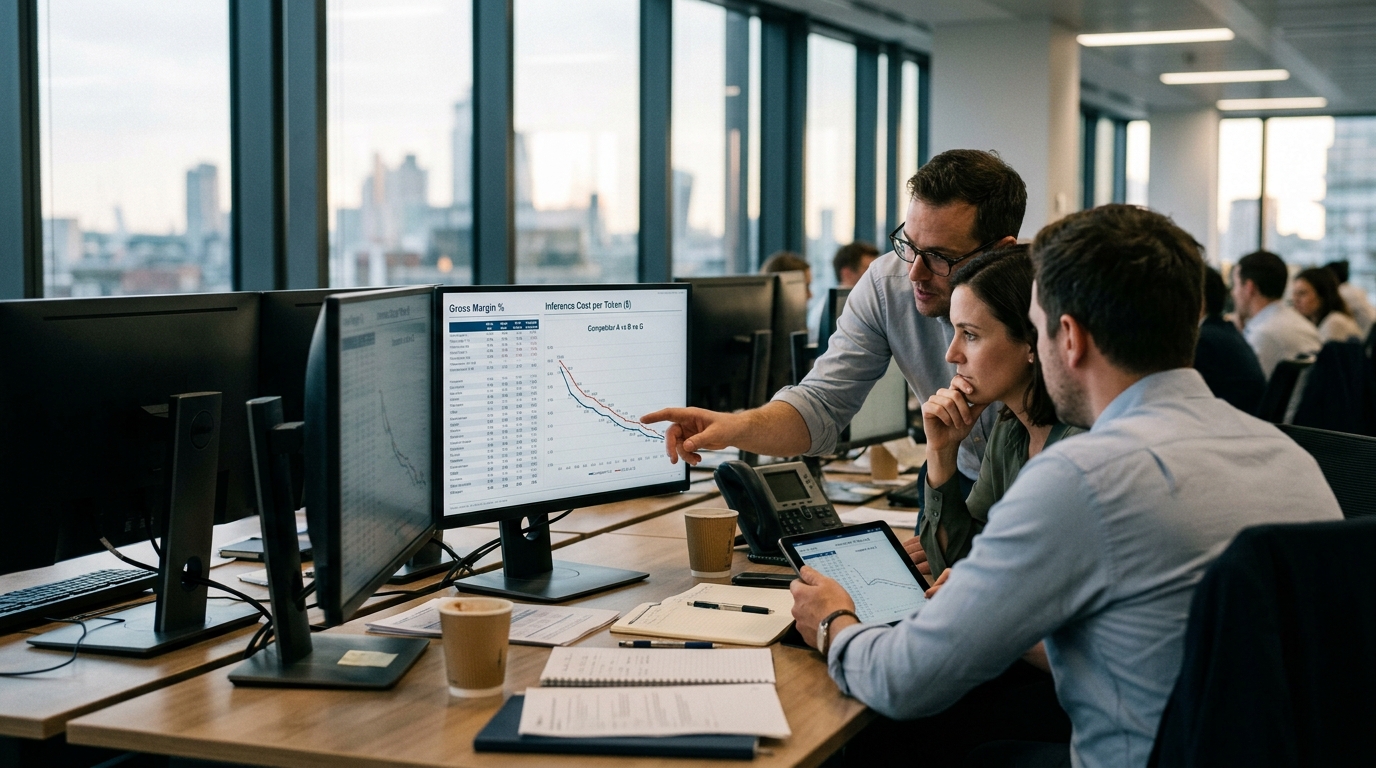
The central question in enterprise AI right now is not whether inference pricing is falling. It is whether it can fall far enough to matter without destroying the labs doing the falling.
Axios reported Tuesday that Google is explicitly calling out Anthropic’s and Microsoft’s enterprise AI costs, pricing Gemini to take share. The move deserves more scrutiny than a standard competitive price cut, because the companies involved do not share the same cost structure, and that asymmetry is what institutional investors are actually debating.
The Bull Case for Google
Google is the only hyperscaler that runs AI inference at scale on its own custom TPU stack rather than relying exclusively on NVIDIA GPUs. Every rival that is primarily renting NVIDIA GPUs is handing over a very large gross-margin toll on every token processed. Google runs its own silicon, its own models, and its own distribution. That gap is now quantified. On the Q1 2026 call, Sundar Pichai said the new TPU 8i delivers “80% better performance per dollar than the prior generation” on inference, and that after upgrading Search to Gemini 3, Google “reduced the cost of core AI responses by more than 30%.”
The pricing data reflects it. At the flagship tier, Gemini 3.1 Pro at $2 per million input tokens and $12 per million output tokens lists below GPT-5.6 Sol ($5/$30) and Claude Opus 4.8 ($5/$25), under half the price on both input and output. At the floor, Gemini 2.5 Flash-Lite ($0.10/$0.40) beats Haiku 4.5 ($1/$5) by more than 10x. For a company that manufactures its own inference silicon, cutting sticker price is a market share decision, not a survival question.
The Bear Case for the Labs
Anthropic cannot match that structural position. It procures compute from hyperscalers including Google and AWS, which means its inference economics carry a supplier margin by definition. Anthropic’s top model carries a price tag materially higher than many competing flagship offerings, while Chinese open-weight alternatives can be accessed at a fraction of that cost. Now add a competing hyperscaler actively advertising that gap to enterprise procurement teams.
The timing is particularly pointed. Some Anthropic investors have floated an October IPO with a valuation of $2 trillion or more, with backers projecting annualized revenue could reach $100 billion to $120 billion by year-end. The diligence question is the gap between a $47 billion May run rate and the $100 billion to $120 billion December figure investors are underwriting: roughly a 2x to 2.5x jump in seven months, and an investor projection, not Anthropic’s own guidance. Google’s price attack complicates the revenue growth story underpinning that valuation, even if it does not immediately break it.
The Evidence Is Contradictory
Three data points point in different directions on whether inference has a floor. First, Salesforce plans to spend approximately $300 million on Anthropic tokens in 2026 alone, supplementing an existing equity stake in the company now valued at about $5 billion. Enterprises at that spend level are not leaving for a cheaper model overnight; switching costs are real. Second, DeepSeek is raising prices for its flagship V4 models, with peak-hour pricing increasing rates by more than four times from current levels. The original low-margin aggressor from Hangzhou just blinked, which argues there is a floor somewhere. Third, token costs could pressure margins if usage scales rapidly, a risk that applies directly to Salesforce as Claudeforce adoption grows and inference volumes compound.
What Investors Are Missing
The debate over who sets the floor obscures the more important question: who collects rent after pricing stabilizes. Google’s TPU advantage is not just about today’s sticker price. Inference workloads are increasingly the majority of AI compute, and when a system like Claude handles enormous request volumes, the cost of answering each one looks like a utility bill. At that scale, an 80% improvement in cost per query is the difference between a sustainable margin and a burning one. Labs without proprietary silicon are permanently exposed to that math.
Stocks to Watch
Alphabet (GOOGL): The price attacker with the structural advantage. Owns the silicon, the model, and the distribution, which makes aggressive pricing a strategy rather than a sacrifice.
Anthropic (pre-IPO): The most exposed. A $2 trillion public debut prices in hypergrowth at the exact moment its largest direct competitor is advertising its cost premium to every enterprise buyer.
Salesforce (CRM): Posted $11.35 billion in Q2 revenue, up 11% year over year, with combined Agentforce and Data 360 ARR climbing to nearly $3.9 billion, growth of more than 210% versus the prior year. Its $300 million token commitment to Anthropic is a bet that quality and CRM integration matter more than per-token cost, and that bet gets tested harder every time Google cuts prices.
Microsoft (MSFT): Caught between its OpenAI dependency and Google’s explicit targeting of its enterprise AI costs. Azure’s inference margin faces pressure from both directions.
Amazon (AMZN): Runs Anthropic on its own Trainium silicon, positioning it similarly to Google but without the same vertical integration depth. Worth watching for whether AWS begins matching Google’s pricing aggression on Claude-via-Bedrock workloads.