Most $10 trillion conversations about Nvidia start with GPU shipment volumes and hyperscaler spending pledges. That framing misses the more important development: Nvidia is quietly raising the value of a single watt of electricity.
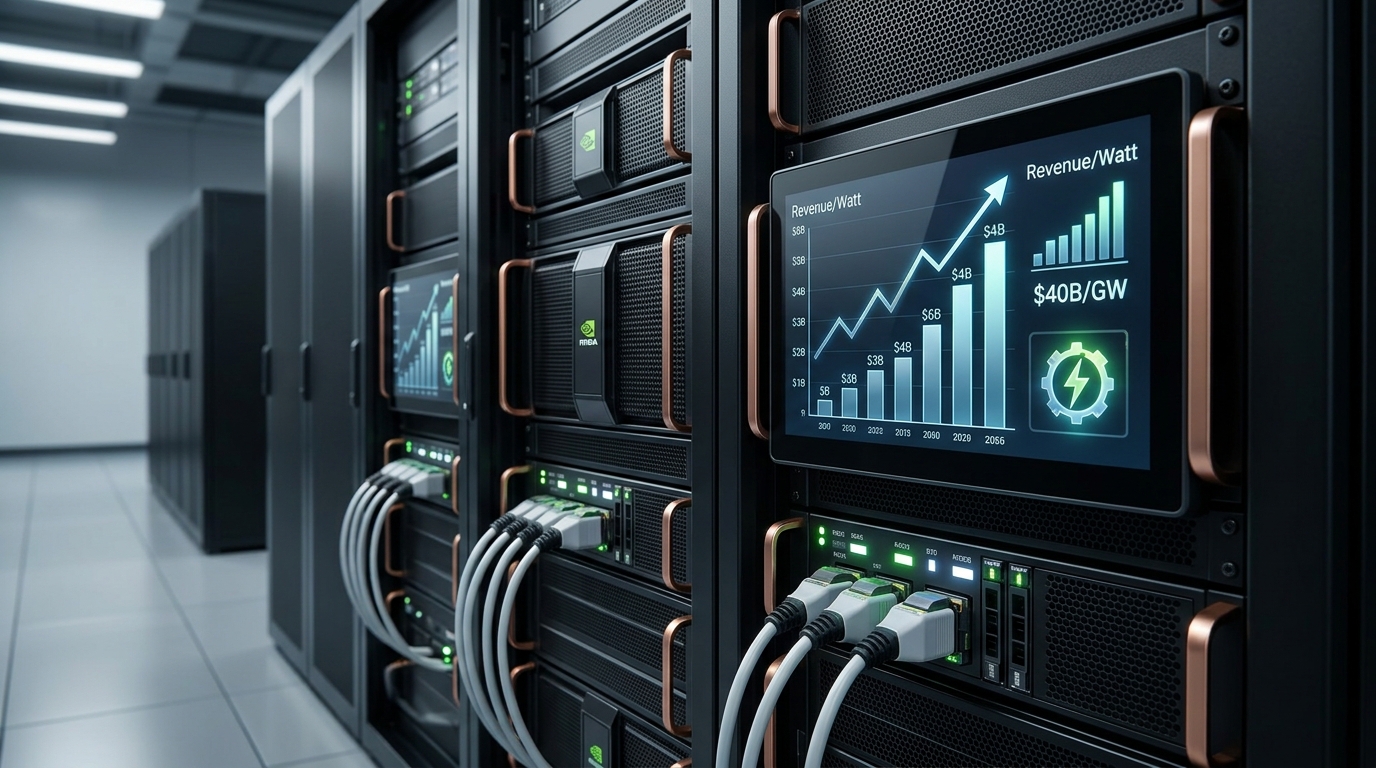
Nvidia’s CFO said the company’s revenue opportunity per gigawatt has grown from about $18 billion with Hopper to $25 billion with Grace Blackwell and $40 billion with Vera Rubin. That progression is not a marketing number. It describes a structural shift in how much Nvidia captures every time a data center powers on, regardless of whether customers build more capacity at all.
As AI data centers become constrained by electricity, performance per watt becomes an increasingly valuable competitive advantage, and Nvidia’s ability to raise its revenue opportunity from $18 billion per gigawatt with Hopper to $40 billion with Vera Rubin suggests its moat is not merely about making the fastest GPU. That is the part Wall Street is still underweighting.
The underlying financials have already caught up to the ambition. Nvidia posted $96.2 billion in revenue for the second quarter of fiscal 2027, up 106% from a year earlier, with data center revenue alone reaching $89.0 billion. Management’s preliminary expectation is for fiscal 2028 revenue to grow approximately 70% year over year, though supply constraints remain a key limiter, with the supply chain running at full capacity.
Revenue diversification is widening the runway. In its fiscal 2026 annual report, Nvidia said its sovereign AI business more than tripled to over $30 billion for the full fiscal year, with governments in the UK, France, the Netherlands, Canada, and Singapore among the primary contributors. Sovereign customers are purchasing the same full-stack Blackwell infrastructure as hyperscalers, including GB200 NVL72 systems, Spectrum-X Ethernet, and InfiniBand, rather than lower-specification alternatives. That matters for margins and average selling prices alike. Physical AI, still early-stage, contributed more than $6 billion in fiscal 2026 revenue and is scaling into robotics and autonomous vehicles.
Sovereign and hyperscaler demand for full-stack Blackwell infrastructure also intensifies the constraint that sits beneath every gigawatt conversation. Power grid capacity has become the binding limit on how fast AI data center buildout can actually proceed.
The math to $10 trillion is cleaner than most expect. Nvidia closed at $229.28 per share on October 9, 2026, giving the company a market cap around $5.53 trillion. Reaching $10 trillion with no material change in the share count would require roughly an 80.9% increase, implying a share price around $414.76. The stock’s forward P/E multiple varies with estimates and the date you measure it; recent market data has generally put it in the high teens rather than around 15x.
The risks are real. Supply chain capacity, export controls on China, and any deceleration in hyperscaler spending could all compress the timeline. Gross margin is expected to drift from 75% in fiscal Q2 to 71% to 72% in fiscal Q4 before stabilizing at 72% to 73% in fiscal 2028, a compression investors should monitor. If AI inference economics commoditize faster than expected, the per-gigawatt revenue curve could flatten before Vera Rubin’s successors arrive.
Hyperscaler spending commitments are the upstream variable that sets the ceiling on Nvidia’s revenue curve. The $2.4 trillion in combined AI infrastructure commitments from Alphabet, Amazon, Meta, and Microsoft is already splitting into uneven returns.
The wealth takeaway is this: the $10 trillion debate is framed as a question of demand. The better question is whether Nvidia’s architecture continues to claim a rising share of every watt spent on AI. So far, each new platform has answered yes, and by a wider margin each time.