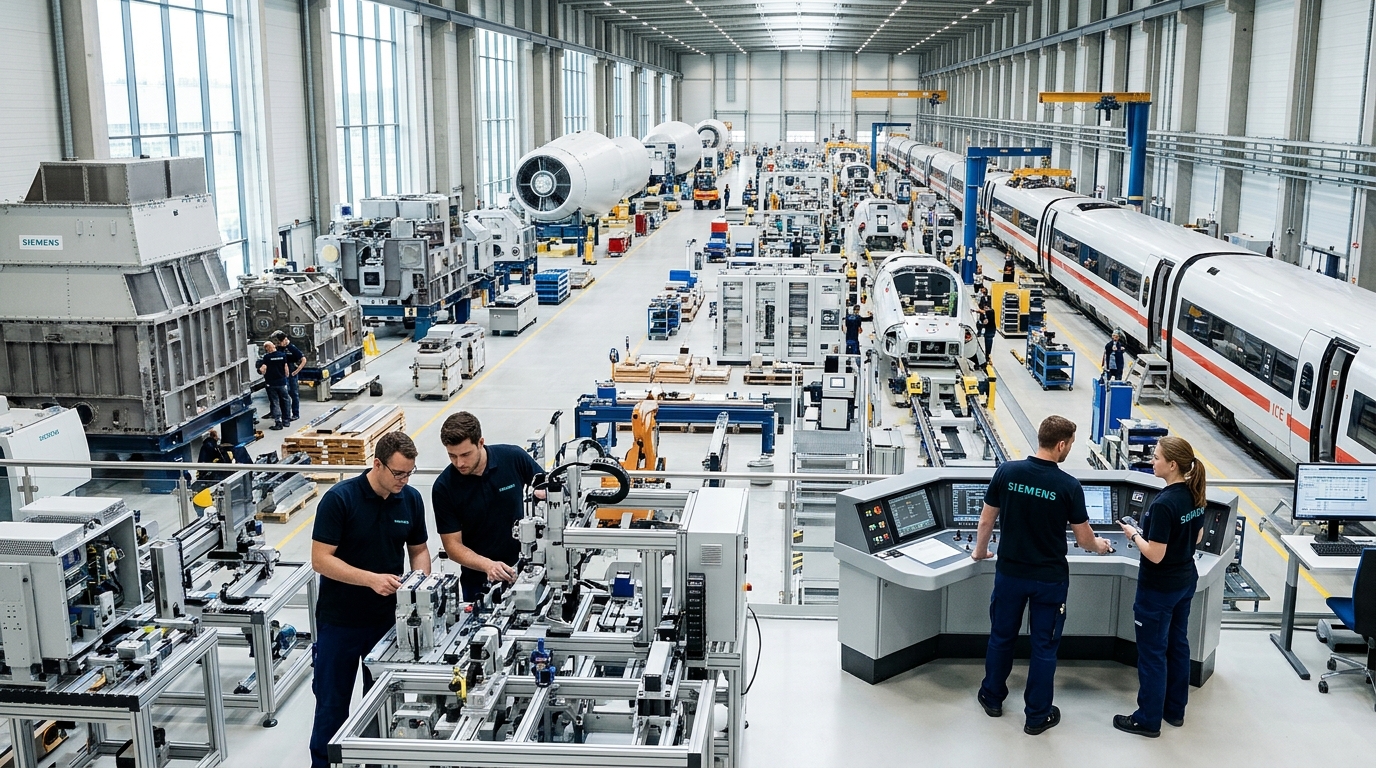
Here is a question worth sitting with: what would you pay for an industrial company that just booked more new orders in a single fiscal year than it will generate in revenue over the next sixteen months? Siemens answered that question for investors this morning, and the numbers are hard to dismiss.
In fiscal 2026, Siemens achieved €108.2 billion in orders, representing 25% comparable growth, while generating €12.1 billion in free cash flow, up 12% year-over-year. The backlog grew by €26 billion over the year to a record €143 billion, which is the base for the 9% to 11% revenue growth Siemens guides for fiscal 2027. That is not a demand question. It is an execution question, and Siemens has earned the benefit of the doubt on execution.
What Changed This Quarter
Industrial profit jumped 22% to €3.89 billion in the three months to the end of September, while revenue rose 11% to €23.68 billion, exceeding analyst forecasts, and orders surged 58% to a record €34.8 billion. The jump in orders was largely fuelled by large contract wins at Siemens’ Mobility division and its Smart Infrastructure business, which supplies power distribution equipment, cooling gear, and digital simulations of facilities to data centres.
That last point matters. AI infrastructure spending is not a Siemens side story. The results suggest Siemens is benefiting from several long-running trends at once: demand for electrification, data centers, factory automation, and industrial software. Each of those tailwinds reinforces the others.
The Thesis in One Line
Siemens raised its mid-term targets: comparable revenue growth is now expected between 7% and 11% (previously 6% and 9%), while double-digit growth is expected in earnings per share before purchase price allocation accounting. Digital business revenue reached €10.9 billion in fiscal 2026, growing 16% and remaining on track to double by fiscal 2030. CEO Roland Busch said industrial AI is the defining growth opportunity and that Siemens is built to win it. The backlog suggests he is not bluffing.
A bigger backlog makes a higher 7% to 11% mid-term growth target more credible, because more of next year’s revenue becomes an execution challenge instead of a demand question. And since industrial companies carry sizable fixed costs, delivering more of that backlog can lift profit faster than revenue over time, especially in Smart Infrastructure and Mobility.
The Valuation Gap
Siemens is Europe’s largest industrial by market cap. Its current price-to-earnings ratio is roughly 25x. Rockwell Automation carries a forward P/E closer to the high 20s. A company with a larger order book, faster revenue growth, record free cash flow, and a raised outlook priced at a discount to a smaller American peer is a valuation gap worth explaining.
Part of the answer is geography: European industrials trade at a structural discount to US names, partly on currency risk and partly on convention. Siemens offers significant upside but requires tolerance for European FX volatility. That is a real risk. But it is also a risk that has been in the price for years while Siemens compounded free cash flow through it.
What Could Go Wrong
AI monetization is still developing, so the revenue contribution from industrial AI remains early. A sharp slowdown in data center capital spending would hit Smart Infrastructure orders first. China is the other exposure: Siemens counts on Chinese customers embracing its Xcelerator platform, and any further deterioration in US-China industrial trade conditions could pressure the segment. And the Mobility backlog, while enormous, requires smooth government contract execution across multiple geographies.
What to Watch
Three metrics will determine whether this thesis plays out. First, whether the fiscal 2027 book-to-bill stays above 1, confirming that backlog growth continues rather than stalls. Second, whether digital business revenue accelerates past 16% growth toward its 2030 doubling target. Third, whether Siemens follows through on its stated intention to deconsolidate part of Siemens Healthineers to Siemens shareholders in a way that unlocks a cleaner valuation for the core industrial business.
Free cash flow at Group level reached a record €12.1 billion, and the Industrial Business set a new record for free cash flow of €13.3 billion. Those numbers, combined with a proposed dividend increase to €5.50 per share, suggest a company confident enough in its own outlook to return more cash even as it invests in AI. The market’s job now is to close the gap between what Siemens has built and what it is being paid for.