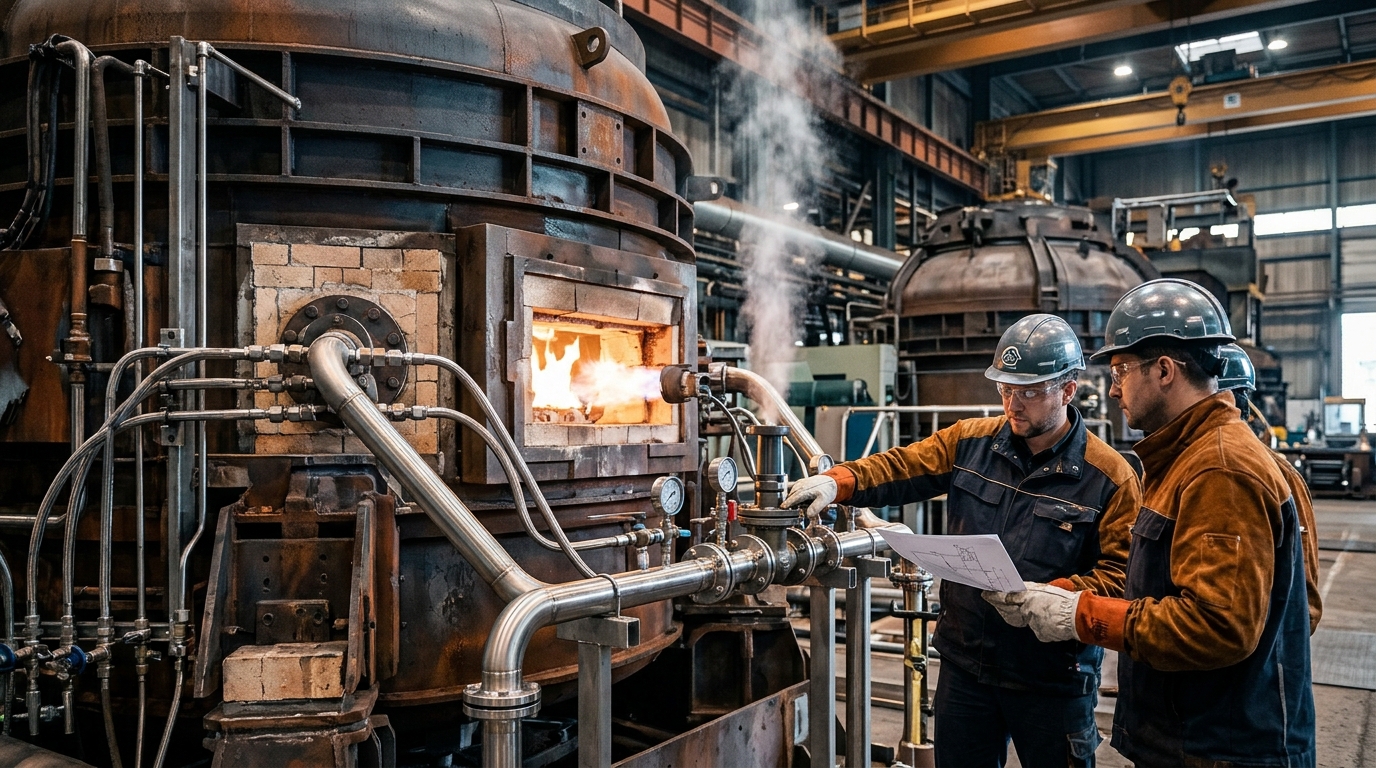
Steel has a carbon problem that solar panels cannot solve. Blast furnaces and basic oxygen furnaces account for roughly 70% of global crude steel output, and they run on coke. Replacing that chemistry is not a software update. It requires rethinking what flows into the furnace, and that is precisely where Linde plc (LIN) has positioned itself.
Linde is currently testing a hydrogen flameless burner in its U.S. lab to advance steel reheat furnace decarbonization with DOE-backed partners. That program follows a harder milestone: Linde partnered with customers to perform successful trials injecting hydrogen into blast furnaces, including one at Cleveland-Cliffs where hydrogen was injected into all 40 tuyeres at 0.6 kilograms of hydrogen per tonne of hot metal.
Neither trial eliminated carbon entirely. That was not the point. The point was proving that existing infrastructure can accept hydrogen at scale without retooling the entire plant. Using hydrogen in the blast furnace can reduce emissions by about 15% to 20% as an immediate bridge, while full direct-reduction routes are still reaching commercial scale. Hydrogen-based steel production via the H2-DRI-EAF route can cut CO2 dramatically versus traditional blast furnace methods, but the exact residual emissions depend on the power mix and the system boundary. The gap between an incremental cut and deep cuts is where Linde’s roadmap lives.
Linde’s REBOX Flameless Oxyfuel solutions have been installed in more than 180 reheat furnaces with production capacity up to 300 tonnes per hour, contributing to decarbonization of 20% to 50% in those furnaces. That installed base matters more than most investors price in. Every furnace already running Linde technology is a conversion candidate for higher hydrogen blends as green hydrogen costs fall.
The financial architecture rewards patience. In Linde’s Q2 2026 filings, its sale-of-gas backlog of large projects under construction was about $8.1 billion, and on the Q2 2026 earnings call management said it expected to start up more than 20 projects representing about $1.3 billion of investment in the second half of 2026. Once a gas plant is commissioned on-site, the customer is effectively locked in for decades under take-or-pay contracts. Industrial decarbonization is not a one-time sale. It is annuity revenue dressed in hard-hat clothing.
The toll-road revenue model Linde enjoys is not unique to gases. Energy-recovery devices embedded inside desalination infrastructure generate the same locked-in, annuity-style returns once a plant is commissioned and running.
Research published in Nature Communications has explored where and when green hydrogen-based steelmaking could be competitive, but it does not establish a blanket European cost-competitiveness threshold starting in 2026. What has changed on a fixed calendar is policy: the European Commission says the EU Carbon Border Adjustment Mechanism entered its definitive regime on January 1, 2026. That means imported covered goods, including iron and steel, now sit inside a compliance system that did not exist a year ago. That shift makes Linde’s customers’ decarbonization math look very different than it did in 2024.
The risk is well understood: green hydrogen procurement and pricing remain constraints for European steel decarbonization plans, including at major producers. Until that gap closes further, full conversion stays a multi-year project. But Linde’s oxyfuel and injection technologies generate revenue at every intermediate step along the way, not just at the finish line.
Linde started up a 35-megawatt proton exchange membrane electrolyzer system at its Niagara Falls facility, powered by renewable hydroelectric energy to generate green hydrogen for industrial decarbonization. That is not a pilot. It is supply infrastructure for the customer base that the blast furnace injection work is actively expanding. The furnace tests create demand. The electrolyzers fill it. For long-term investors, the cleaner read on Linde is not a green-energy story. It is a toll-road story, where every tonne of steel the world chooses to decarbonize has to pass through Linde’s gases to get there.